How battery storage really ages and how we model it
May 4, 2026
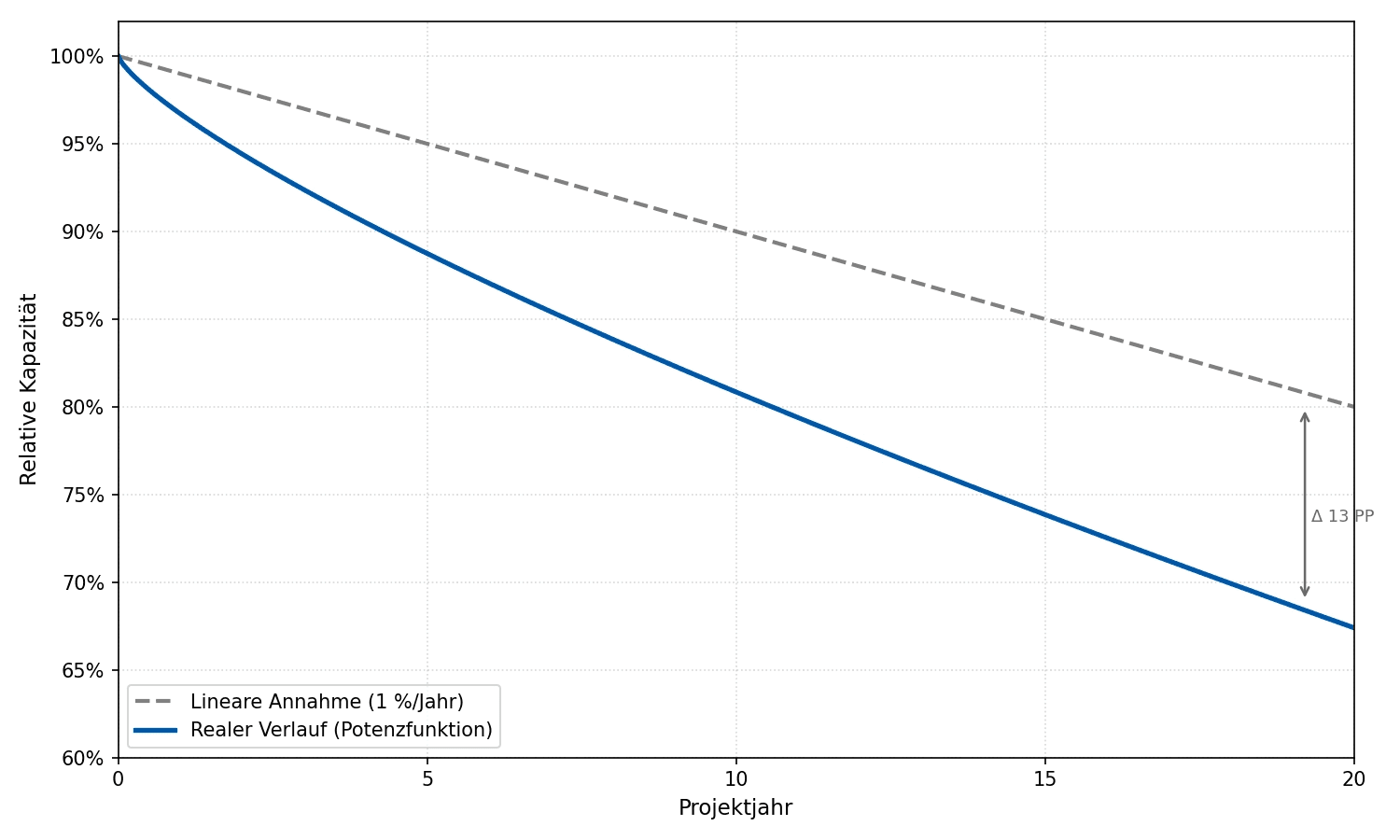
Batteries do not age linearly; they follow a curve that depends on cell chemistry and usage intensity. In addition to capacity loss, efficiency also decreases over the lifespan, which is missing in many profitability calculations. This article explains the physical background, compares cell chemistries, and shows, using a practical example, how realistic degradation modeling affects the business case.
How much capacity and efficiency does a battery storage system still have in year 10 or 15? The answer largely determines whether the investment pays off. At the same time, degradation is one of the aspects that are hardest to grasp in project planning, the data basis from manufacturer warranties is limited, and the underlying electrochemistry is complex.
However, reliable scientific models now exist that map real aging behavior much better than a constant annual discount. In this article, we show what physically happens in the battery, why degradation follows a curve, and how this affects the business case.
What happens in the battery: SEI growth as a driver
The aging of lithium-ion batteries is significantly determined by the growth of the so-called Solid Electrolyte Interphase (SEI). This thin layer forms at the graphite anode and binds lithium during each cycle, which is then no longer available for energy storage.
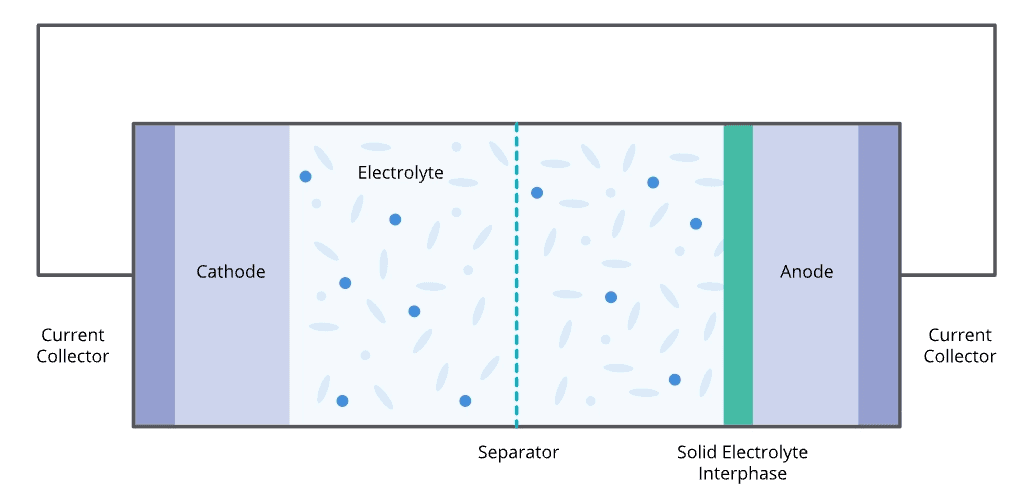
Crucially: the SEI does not grow evenly. The thicker the layer gets, the more it slows down its own growth, similar to a layer of ice on a lake, which first thickens quickly and then increasingly slowly.
A storage system therefore loses significantly more capacity in the first 1,000 cycles than between cycle 4,000 and 5,000. The degradation follows a flattening curve, not a straight line.
Capacity and efficiency: Two effects, one business case
When thinking of battery degradation, most people think of capacity loss. That is correct, but only half the story.
Capacity loss depends on the chemistry
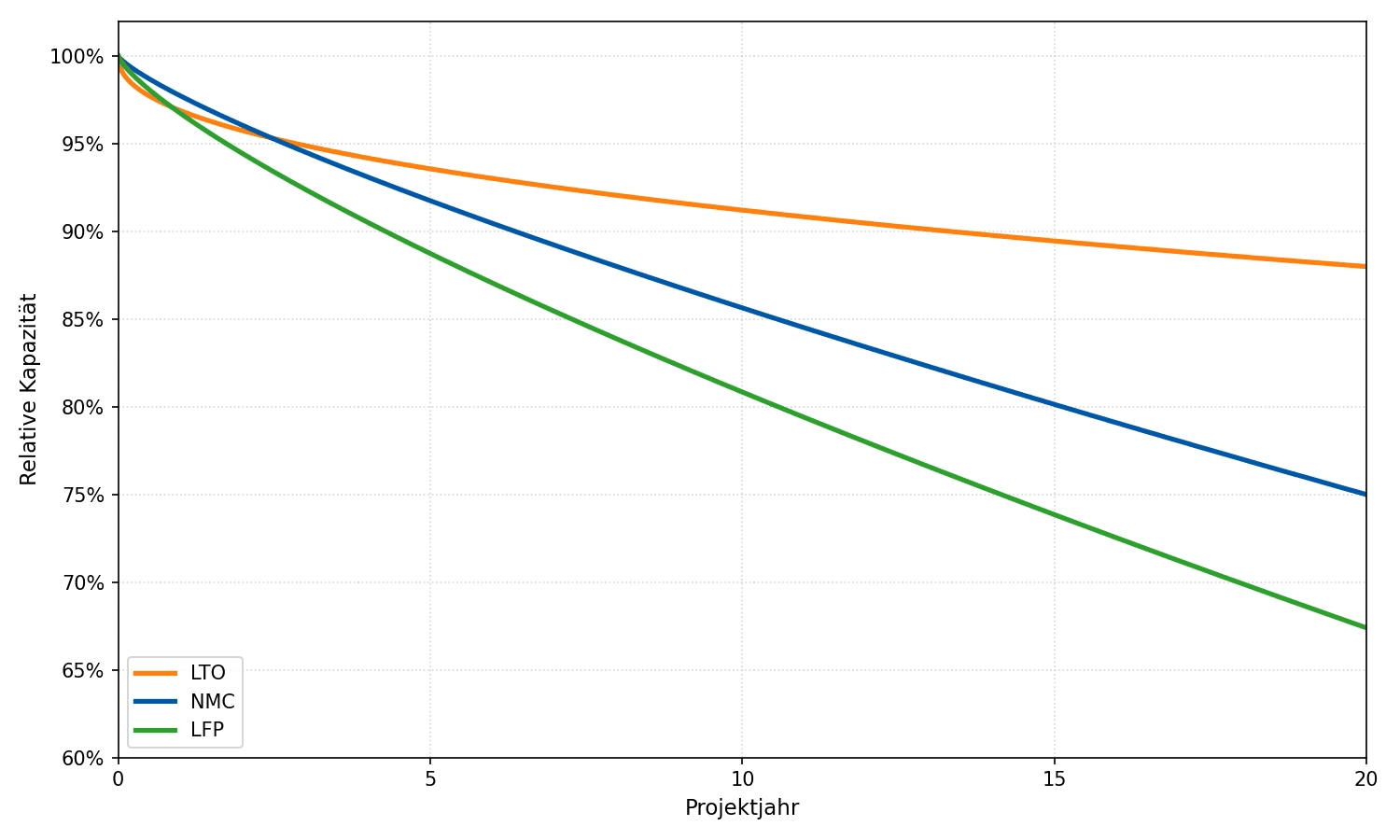
LFP cells (lithium iron phosphate) tolerate significantly more cycles than NMC or NCA cells before reaching their end-of-life threshold. LTO cells are even more robust, but play a minor role in the C&I sector due to higher costs.
An LFP system at 365 cycles per year typically still has significantly more usable capacity after 15 years than a comparable NMC system. The curves follow the same basic shape but have different slopes, which should be taken into account when selecting and designing a system.
Efficiency degradation: The often-overlooked factor
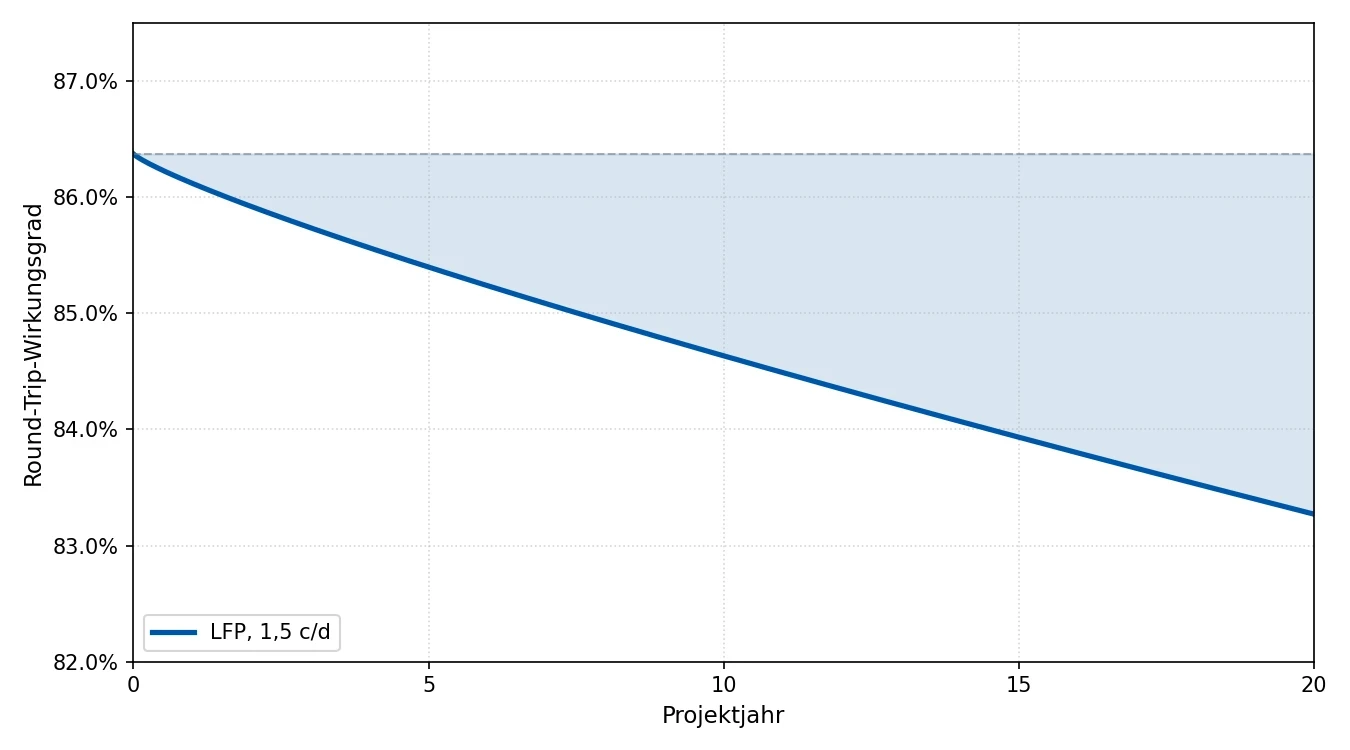
In addition to capacity, the round-trip efficiency (RTE) also decreases over the lifespan. The growing SEI layer increases the internal resistance of the cell, leading to more losses with every charge and discharge cycle.
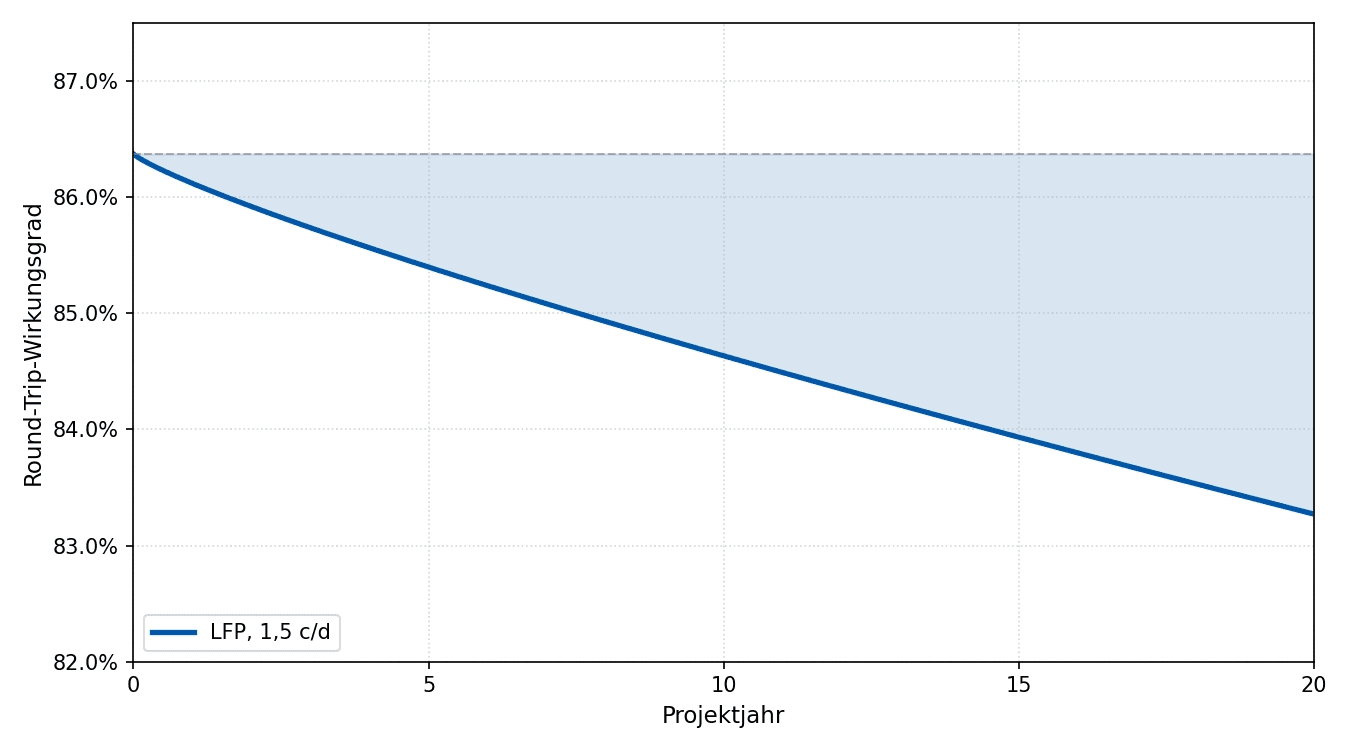
Both effects act simultaneously: less storable energy combined with poorer efficiency results in significantly fewer usable kWh overall than a model shows that only considers capacity.
Practical example: What degradation means for revenue
To make the effect tangible, here is a typical C&I scenario:
Initial situation: LFP storage, 100 kWh, 50 kW, 178 cycles per year, initial RTE 86%.
Without degradation, the profitability calculation yields constant savings over the entire term, the same usable capacity and same efficiency year after year.
With the degradation model, the picture looks different: capacity follows a chemistry-specific power function, initially falling faster, then increasingly flattening out. At the same time, the RTE decreases from 86% to around 83% depending on the accumulated equivalent full cycles (EFCs).
This directly impacts revenues: while savings of around €10,600 are still achieved in the first year, they are only about €10,100 in the sixth year. Over the entire project duration, this decline adds up, altering the payback period and ROI compared to a calculation without degradation.
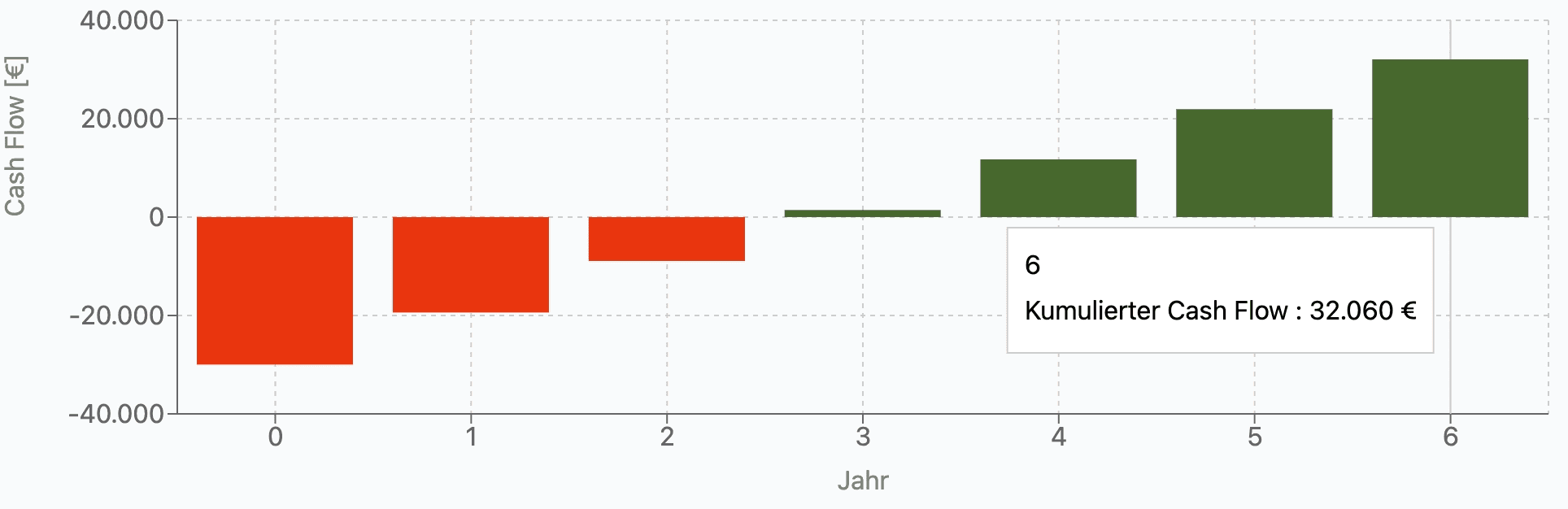
with degradation
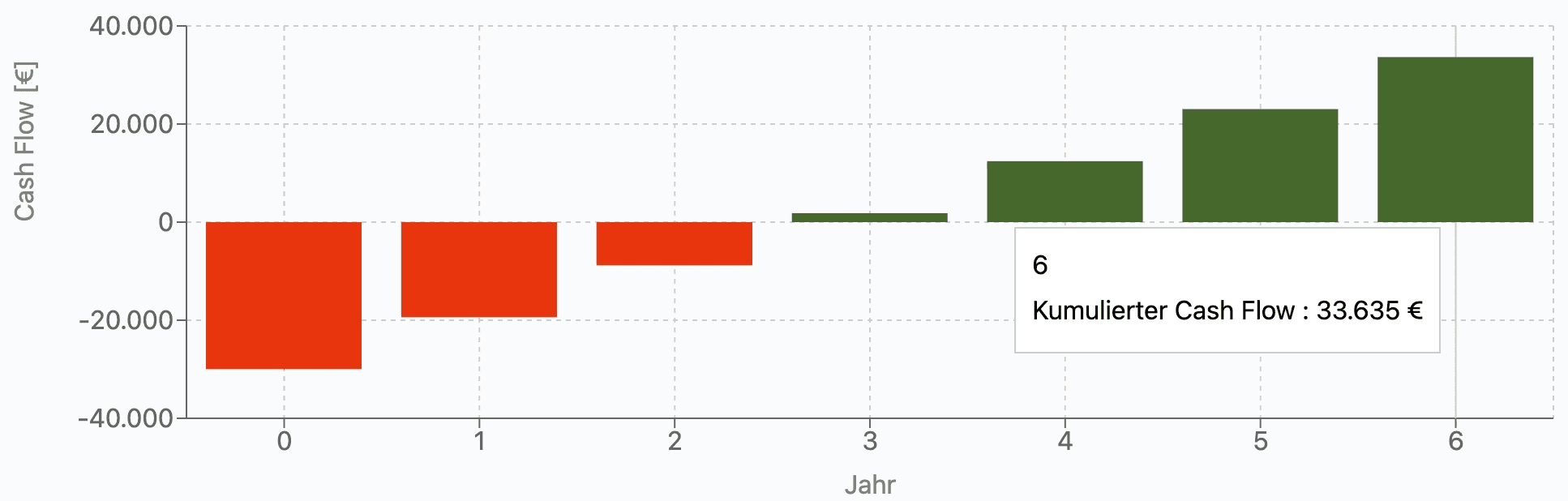
without degradation
Conclusion: Degradation belongs at the heart of planning
Battery degradation follows a curve that depends on cell chemistry and usage intensity. LFP systems age more slowly than NMC systems, and the efficiency loss significantly affects the usable amount of energy over the project lifecycle.
For reliable business cases, degradation models are needed that map both effects, are parameterized for specific chemistries, and adapt to the usage profile. In Lumera, exactly these models flow directly into the cash flow calculation, so that the profitability calculation reflects what actually happens in the battery.
Sources:
Solid–Electrolyte Interphase During Battery Cycling: Theory of Growth Regimes by Lars von Kolzenberg, Arnulf Latz, and Birger Horstmann (Chemistry Europe, 2020)
Lithium-Ion Battery Life Model with Electrode Cracking and Early-Life Break-in Processes Kandler Smith, Paul Gasper, Andrew M. Colclasure, Yuta Shimonishi, and Shuhei Yoshida (Journal of The Electrochemical Society, 2021)
Eduardo Redondo-Iglesias, Pascal Venet, Serge Pelissier. Efficiency Degradation Model of Lithium-ion Batteries for Electric Vehicles. IEEE Transactions on Industry Applications, 2018, 55 (2), pp. 1932-1940. ⟨10.1109/TIA.2018.2877166⟩. ⟨hal-01898906v2⟩
Theory of SEI Formation in Rechargeable Batteries: Capacity Fade, Accelerated Aging and Lifetime Prediction, Matthew B. Pinson and Martin Z. Bazant (Journal of The Electrochemical Society, 2012)