Atypical Grid Usage – Reducing Grid Fees with Industrial Battery Storage
Atypical grid usage – a topic at The smarter E that got everyone talking
Just under two weeks ago, we were at The smarter E Europe in Munich. After many exciting conversations with installers, project developers, and manufacturers, one thing quickly became clear: there is one topic the industry is especially focused on right now – atypical grid usage.
What's behind it? Who can take part? And is it even worth it? Here's a concise overview – no energy-nerd background required.
What does atypical grid usage mean?
Atypical grid usage is a tool for stabilizing the grid – and for lowering grid fees.
The idea: companies that manage to reduce their electricity consumption precisely when the grid is under the heaviest load are rewarded with reduced grid fees. To this end, the grid operator defines so-called high-load time windows for each voltage level and season. These windows are based on the expected annual peak loads – that is, the critical hours on the grid.
The principle: if a consumer reduces its load peaks during these high-load time windows, its individual share of grid fees decreases. This benefits companies that can actively manage their electricity consumption.
Who can take part in atypical grid usage?
The model is aimed exclusively at larger electricity consumers. The key eligibility requirements are:
Load-shifting potential of more than 100 kW:
Only companies with correspondingly large consumption loads qualify. Private individuals and smaller commercial businesses are excluded.At least €500 in grid fee savings per year:
The potential savings must exceed this threshold. The maximum reduction is capped at 80% of the grid fee.Meeting the so-called materiality threshold:
The load reduction during the high-load time window must be significant relative to the annual peak load – depending on the voltage level (e.g. 20% in the medium-voltage grid).
Case study: plastics company reduces load peaks with battery storage
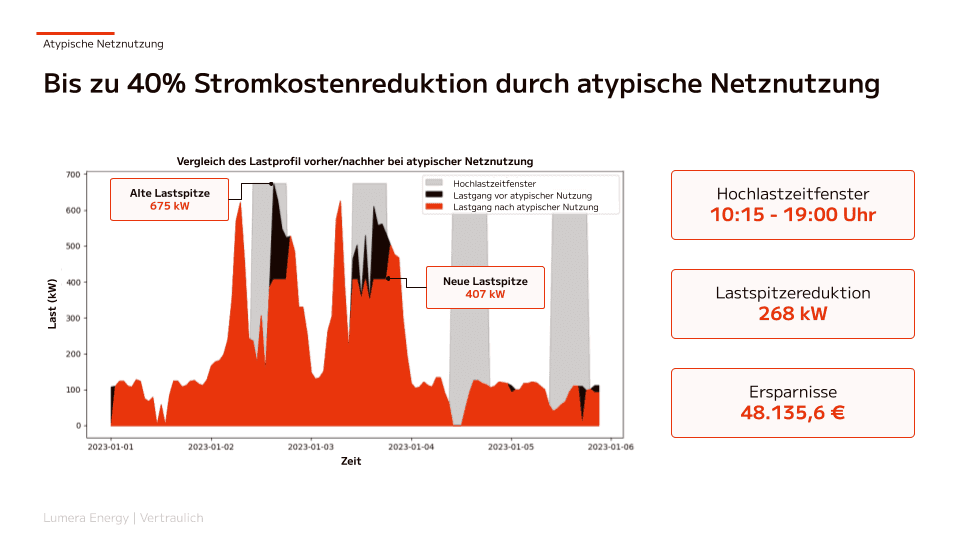
A real-world example: a plastics-processing company with an annual load peak of 675 kW is connected to the medium-voltage grid. The high-load time windows in winter run between 10:15 and 7:00 p.m.
Starting situation:
On January 2, the company's load peak (black line) falls within the high-load time window. Without any measures, the company would not benefit from atypical grid usage.
Possible solutions:
The company has two options for reducing its load peaks within this time window:
a) through smart production planning
b) through the use of a battery storage system
In our example, a battery storage system was used to reduce power drawn from the grid during the critical hours.
The result:
The load peak was reduced by 268 kW – to a new peak of 407 kW (red line). At a capacity price of approximately €180/kW, this results in savings of more than €48,000 – well above the required threshold.
The materiality threshold (20% for medium voltage) is also met. The company therefore qualifies for atypical grid usage.
Battery storage pays off – even beyond atypical grid usage
The payback periods for battery storage systems in the context of atypical grid usage are often under five years.
Since the high-load time windows usually occur only during the winter months, the storage system can additionally be used the rest of the time for self-consumption optimization or market-price-oriented use – generating further revenues.
Conclusion:
Atypical grid usage is not only an exciting tool for relieving the grid, but also a worthwhile business model for larger consumers – especially in combination with battery storage.
More Articles
Furo raises $4M from TQ Ventures, Neo and Sheryl Sandberg to build the operating system for industrial battery storage
Furo and LUOX Energy Launch Combined Solution for Optimizing Commercial and Industrial Battery Storage
MiSpeL Becomes Binding: Determination from October 2026, Transitional Phase until September 2027
Aging: Why Charging and Discharging an Industrial Battery Storage System for Arbitrage Doesn't Always Pay Off
Balancing Group and Balancing Energy: Why Storage Projects Lose Economic Viability During Operation
Why the dynamic rate plan is the first step toward flexible marketing, and what else you need