Industrial electricity price and battery storage: when storage counts as a decarbonisation measure

On 18 November 2026, the European Commission approved that energy-intensive companies in Germany may combine the industrial electricity price (Industriestrompreis) with electricity price compensation (Strompreiskompensation) for 2026. More relief also means more obligations: at least half of the basic aid must be invested in decarbonisation measures. A battery storage system is explicitly listed in the BAFA catalogue of measures. Whether it pays off, however, also depends on your grid fee discounts.
At a glance
- 18 Nov 2026: The European Commission approves combining the industrial electricity price and electricity price compensation for 2026. According to the Commission, Germany can spend up to €1.6 billion more per year from 2026 to 2030.
- Industrial electricity price: Target price €50/MWh, covering at most half of the consumption at the metering point. Applications for 2026 are open until 31 March 2027.
- Investment obligation: At least 50% of the basic aid must go into decarbonisation measures within 48 months of the grant.
- Battery storage: The BAFA guidance note lists electricity storage as an eligible example, provided it is implemented no earlier than 2026 and receives no other state aid, among other conditions.
- Flexibility bonus: 10% more aid if at least 80% of the required investment goes into flexibility such as storage.
- Open: the national implementation of the combination, the years after 2026 and the impact of storage on your grid fee discounts.
At least half of the basic aid goes into one of four categories. Electricity storage belongs to demand-side flexibility.
What did the EU approve on 18 November 2026?
The European Commission approved an amendment to Germany's state aid schemes for energy-intensive companies. In 2026, companies may now combine relief from two instruments: the industrial electricity price and the compensation for indirect CO₂ costs from the EU Emissions Trading System. The EU had previously rejected such a combination. According to the Commission, Germany can spend up to €1.6 billion more per year from 2026 to 2030 (Clean Energy Wire, 18 Nov 2026; Commission press release).
For sites eligible for both instruments, this changes the calculation. So far, BAFA's rule is: electricity volumes for which you apply for price compensation do not count towards the industrial electricity price. The German steel association WV Stahl criticises that the solution only applies to this year and therefore provides no planning certainty.
The industrial electricity price in brief
Who is eligible? Companies based in Germany with at least one metering point in a sector at significant risk of relocation, i.e. in sub-list 1 of Annex I of the CEEAG guidelines (KUEBLL). Eligibility is determined per metering point, not for the whole company. Undertakings in difficulty are excluded.
How does it work? The industrial electricity price is a retroactive grant for the billing years 2026 to 2028. You submit a separate application to BAFA for each year. The basic aid covers half of the eligible electricity consumption, multiplied by a differential price. If the reference price is below €100/MWh, the differential price is the gap to the €50/MWh target price; otherwise it is half the reference price. For 2026, BAFA states a reference price of €87.44/MWh and therefore a differential price of €37.44/MWh (BAFA).
When do you apply? Registration is expected to open in December 2026, with submission via the Förderzentrale Deutschland from January 2027. The deadline is 31 March 2027. If you also apply for electricity price compensation for the same year, you have until 15 July 2027.
The industrial electricity price provides retroactive relief for only half of your consumption. It does not replace a procurement strategy. How to combine planning certainty and spot price flexibility in purchasing is covered in our article on structured power procurement for industrial businesses.
Combination with electricity price compensation: what is new?
Electricity price compensation (SPK) offsets indirect CO₂ costs in the electricity price and is administered by the German Emissions Trading Authority (DEHSt). It also requires something in return: a certified energy or environmental management system and an environmental counter-performance under section 4.2 of the SPK guideline. These are economically viable efficiency measures identified in the management system or, alternatively, green electricity.
What is new is that Brussels allows both forms of relief to be combined for 2026. BAFA's ban on double counting investments remains unchanged:
- You can split an investment proportionally across the industrial electricity price, SPK, BesAR or BECV.
- The same share may only count towards one instrument.
- You decide which measure you assign to which instrument.
If you use both instruments, you have to plan both counter-performances and keep them clearly separate.
The decarbonisation obligation: which measures count?
Recipients of the industrial electricity price must invest at least 50% of the basic aid in measures under section 4.1 of the guideline. The BAFA guidance note on decarbonisation measures (as of 4 Aug 2026) names four categories:
- Renewable generation: new or modernised capacity, including new PPAs from 1 Jan 2026 for renewable electricity from Germany.
- Energy efficiency: measures that reduce electricity demand, for example from an ISO 50001 energy management system.
- Demand-side flexibility: energy storage, electrification, load management and hydrogen.
- Infrastructure: for example internal grids to integrate renewables and storage, including grid connection contributions.
The same rules apply to all categories:
- The measure must be implemented in Germany, but not necessarily at the metering point in the application. Third parties may implement it.
- It must be implemented within 48 months of the grant decision. For technical reasons that arose later, up to 72 months are possible.
- If you do not submit proof within three months of the deadline, the entire grant is revoked. If you do not meet the investment obligation, BAFA reclaims a proportional share, with interest at the base rate plus 5 percentage points.

Deadlines based on the example in the BAFA guidance note: grant decision dated 15 Sep 2027.
The flexibility bonus
The flexibility bonus increases the aid by 10%. In return, you commit to investing at least 80% of the required investment in demand-side flexibility. In addition, 75% of the bonus itself must be reinvested in decarbonisation measures. BAFA's example: with €100,000 of basic aid, the required investment is €50,000. The bonus adds €10,000 of aid. At least €40,000 must then go into flexibility, plus another €7,500 into decarbonisation.

BAFA's example: with the bonus, at least €40,000 goes into flexibility. (Graphic in German.)
This is where battery storage becomes interesting. It is the tool that lets a site respond flexibly to price signals, and the basis for marketing flexibility later on.
Battery storage as a decarbonisation measure
In chapter 2.3, the guidance note lists as an eligible example the
“installation of electricity storage to reduce load peaks, to optimise self-consumption from the company’s own photovoltaic system and/or to benefit from different prices on the spot market”
Peak shaving, self-consumption optimisation and arbitrage are therefore all covered. Only measures that actually increase flexibility on the load side are recognised, though: the measure must be suitable for adjusting electricity consumption to external price signals.

Four questions decide whether your storage system counts as a decarbonisation measure. (Graphic in German.)
The conditions at a glance
- Category: Demand-side flexibility, section 4.1 c). Electricity storage is explicitly named as an example (guidance note, ch. 2.3).
- Suitability: The storage system must make it possible to adjust consumption to market or grid signals (ch. 2.3).
- New, extension or replacement: New means first commissioning. Extensions and replacements count if they make a measurable contribution (ch. 2).
- Timing: No earlier than the start of the billing year, so for 2026 only measures from 2026. Costs incurred before 2026 do not count (ch. 3.2).
- Deadline: 48 months from the grant decision, up to 72 months in exceptional cases (ch. 3.2).
- Location and implementer: In Germany, not necessarily at the metering point. Third parties may implement it (ch. 1).
- No other state aid: No state aid for the storage system, including under the EEG. Funding that is not state aid is possible but must be declared (ch. 1 and 4).
- No double counting: Splitting across the industrial electricity price, SPK, BesAR and BECV is possible, but each share counts only once (ch. 3.3).
- Proof: Description, category, location, date and a cost table. Keep invoices and the commissioning report on file (ch. 4).
Double funding is the biggest risk. If the storage system receives an investment subsidy that counts as state aid, it no longer qualifies as a decarbonisation measure. Check this before ordering, including for PV and storage packages. Whether a programme counts as state aid is stated in its funding guideline.
Proof relates to the investment. The guidance note requires information on the measure and its costs, but no operating data. Still, document from the start what the storage system is designed for and how it is controlled. The description must make clear to BAFA why it falls under demand-side flexibility.
Storage and grid fees: don't lose your discounts
A storage system changes your load profile, which affects more than just the funding. It can affect:
- Demand charge and utilisation hours: If the storage system shaves peaks, the annual peak load falls and utilisation hours rise. If it charges at the wrong time, the opposite happens. When crossing 2,500 hours pays off is explained here.
- Atypical grid usage (section 19(2) sentence 1 StromNEV): The discount depends on low load during peak load time windows. A storage system that charges there based on spot prices can cost you the discount. Under AgNes, only sites meeting certain conditions keep the discount until 2031, see AgNes and atypical grid usage (German).
- Baseload discount (section 19(2) sentence 2 StromNEV): It requires at least 7,000 utilisation hours and more than 10 GWh per year at the metering point (section 19 StromNEV). An operating strategy that creates new peaks can push the hours below the threshold.
This is the real tension. The funding requires a storage system that can respond to price signals. Grid fee discounts, on the other hand, reward a particular load shape: low during peak load windows or as even as possible. A storage system can do both, but only with an operating strategy that treats the discount conditions as a hard limit.
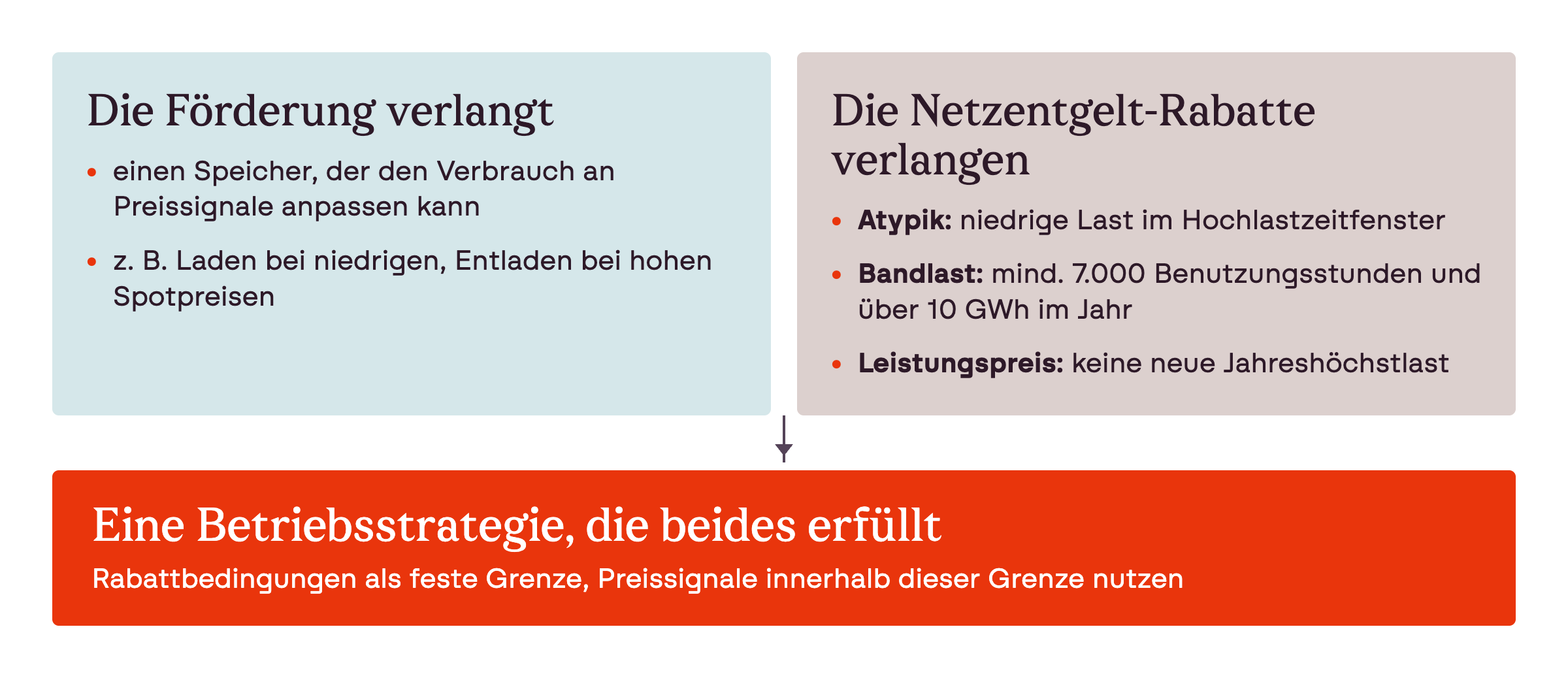
Funding and grid fee discounts place different demands on operation. (Graphic in German.)
Funding logic, grid fee discounts and operating strategy should therefore be assessed together, ideally across several electricity price scenarios. Why a single price year is not enough is shown in our article on multi-year optimisation of commercial battery storage.
What is still open
- National implementation: BAFA's FAQ still state that electricity volumes with an SPK application are not taken into account for the industrial electricity price. How the combination will be implemented has not yet been published.
- Exact limits: The wording of the Commission decision on the cumulation limits was not available to us at the time of writing.
- After 2026: The approval covers 2026. Whether the combination will be possible for 2027 and 2028 is open.
- Storage as SPK counter-performance: SPK recognises economically viable efficiency measures identified in the management system, or green electricity. DEHSt's information does not explicitly say whether storage counts there.
- Operation: The guidance note requires the storage system to be suitable for responding to price signals. It does not require proof of operation. Whether BAFA will check the operating strategy later is not regulated.
How we analyse this at Furo
At Furo, we model storage based on your actual load profile. We map demand charges, utilisation hours and atypical grid usage together with the operating strategy, across several electricity price scenarios. This shows you whether a storage system that meets your investment obligation also keeps your grid fee discounts. We walk through it in our webinar Industriestrompreis: an opportunity for battery storage (in German); the recording is available in the Furo Academy.
As of 19 November 2026. This article is not legal or tax advice. The guideline and BAFA are authoritative for eligibility in individual cases.
Sources: European Commission, press release IP/26/2456; Clean Energy Wire, 18 Nov 2026; BAFA, industrial electricity price incl. FAQ; BAFA, guidance note on decarbonisation measures (4 Aug 2026); Industrial electricity price guideline, BAnz AT 06.05.2026 B1; DEHSt, electricity price compensation; section 19 StromNEV. All sources in German unless stated otherwise.
FAQ: industrial electricity price and battery storage
Yes, if the conditions are met. The BAFA guidance note explicitly names the installation of electricity storage as an example of demand-side flexibility. It must be implemented no earlier than the billing year, be completed within 48 months of the grant and receive no other state aid.
For 2026, the European Commission approved the combination on 18 Nov 2026. National implementation is still pending; BAFA's FAQ currently exclude SPK volumes from the industrial electricity price. For investments, each share counts towards only one instrument.
10% more aid. In return, at least 80% of the required investment must go into demand-side flexibility, for example a battery storage system, and 75% of the bonus additionally into decarbonisation.
Not state aid, otherwise it no longer qualifies as a decarbonisation measure. Funding that is not state aid under EU law is allowed but must be declared in the proof.
No. It must be implemented in Germany, which can also be at another site or by a third party. Third parties are subject to their own proof and declaration requirements.
Yes, if it charges during peak load windows or creates new load peaks. Assess funding, grid fee discounts and operating strategy together before you invest.
More articles
Lohnt sich ein Gewerbespeicher jedes Jahr gleich? Zwei Betriebe, drei Strompreisjahre
PV, CHP and battery storage at one site: what MiSpeL means for the market premium and CHP bonus
Will commercial battery storage still pay off in 2035? Two real sites, 15 years, four electricity price assumptions
AgNes und atypische Netznutzung: Wer seinen Rabatt bis 2031 behält
AgNes: What the new grid fee from 2029 means for your battery storage, and how to model it today
Furo raises $4M from TQ Ventures, Neo and Sheryl Sandberg to build the operating system for industrial battery storage