Structured power procurement: planning certainty and spot-price flexibility for industrial businesses
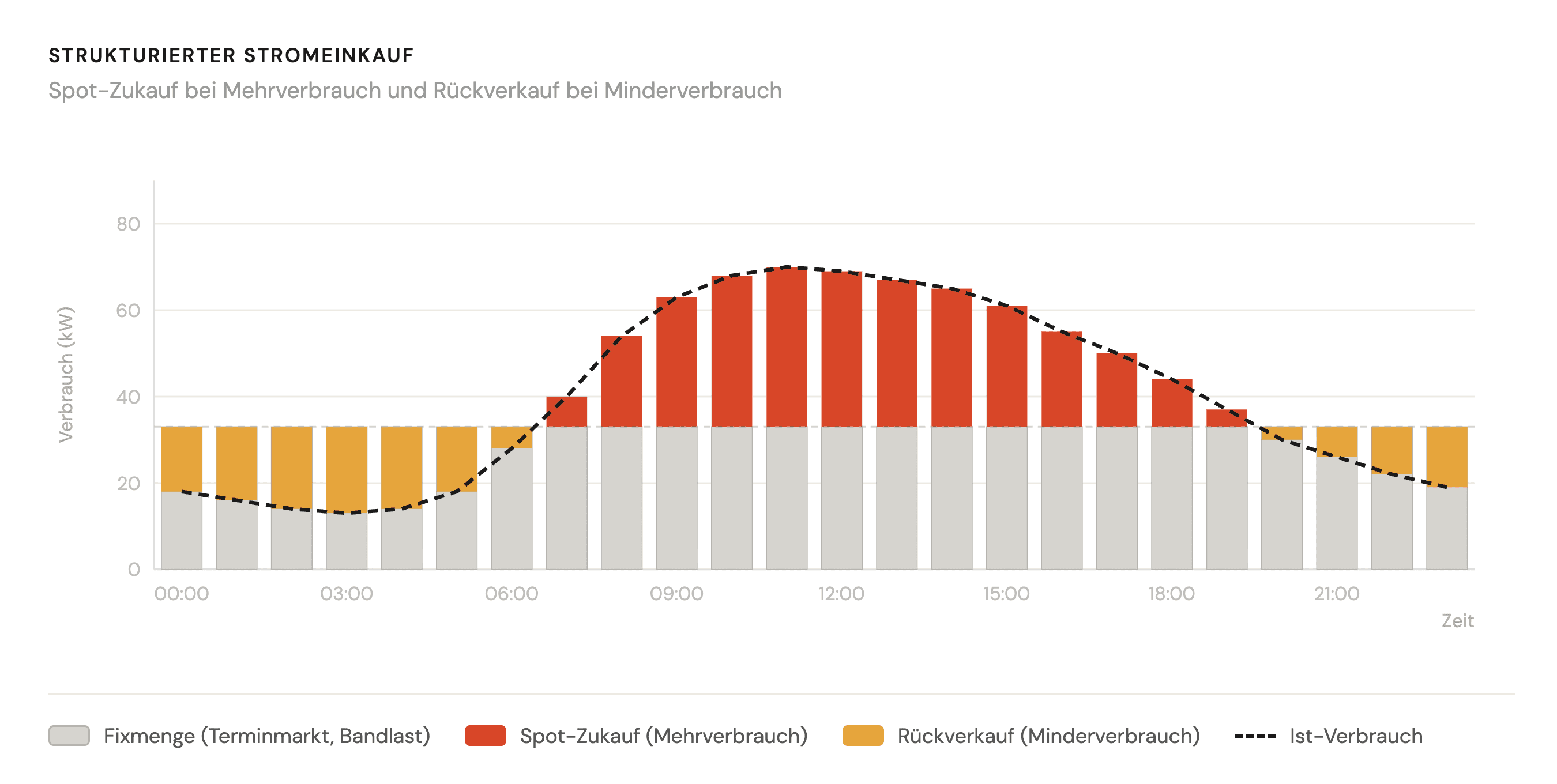
Many industrial companies no longer buy their electricity from a supplier at a single fixed price. Instead, experienced energy buyers use a mix: a defined share of consumption is secured long-term on the forward market at fixed prices. The remainder is procured short-term on the spot market and adapts to current exchange prices on the day.
This model — often referred to in practice as structured power procurement — combines the planning certainty of a fixed price with the flexibility and savings potential of the spot market. For companies with battery storage, it also significantly changes the basis of every economic simulation: electricity no longer has a single price, but two different ones.
We explain exactly how the model works, what variants exist, and why a realistic battery simulation has to map this tariff correctly.
What is structured power procurement?
In structured power procurement, a company's total energy demand is split into two parts: a fixed share, which is procured long-term on the forward market, and a variable share, which is purchased short-term on the spot market.
The term band procurement derives from so-called baseload: a constant, steady electricity load drawn evenly over a defined period. On the forward market of the European Energy Exchange (EEX) in Leipzig, such baseload deliveries can be bought as standardized futures — typically as monthly, quarterly or annual products with constant capacity in megawatts.
The difference from a classic spot-market tariff: in structured procurement, the fixed share is secured in terms of price, regardless of what the market does on the delivery day. Only the variable remaining share is subject to daily price fluctuations.
The two common models
In practice, two basic variants have emerged:
Model A — Capacity threshold (classic baseload)
Everything below a fixed capacity threshold — for example 700 kW — is procured on the forward market. Only the consumption that exceeds this threshold goes to the spot market. The base load is thus a genuine constant "band" load: steady, every hour, regardless of the actual load profile.
Model B — Percentage split
Here, for example, 80% of the forecast annual consumption is procured at a fixed price on the forward market, while the remaining 20% goes to the spot market. The fixed share is distributed as a constant, even capacity across all hours of the year. With an annual consumption of 100,000 kWh, this means: 80,000 kWh ÷ 8,760 hours ≈ 9.13 kW constant baseload — the same every hour, regardless of how much the site actually consumes in that hour. The remaining 20,000 kWh (and any deviations from forecast consumption) are covered via the spot market.
This model corresponds more closely to what large industrial customers actually use today — especially with a predictable base consumption subject to seasonal and time-of-day fluctuations.
How billing works
An important technical point: the fixing on the forward market does not take place on a quarter-hourly basis. On the forward market, only standardized base and peak products can be traded — the smallest unit is a full megawatt for a defined delivery period. The fixing therefore takes place on an aggregated basis over months, quarters or a year and is then distributed across all hours by calculation.
What happens with deviations from the plan?
Excess consumption relative to the fixed volume: the supplier buys the missing volumes short-term on the spot market. The customer pays the current day-ahead price plus a surcharge for portfolio management.
Under-consumption (over-hedging): if more volume was fixed than actually consumed, the supplier sells the surplus energy back on the spot market. The customer receives the spot price, usually with a small discount.
A tolerance band rule — a buffer within which smaller deviations remain unbilled — generally does not exist here. Billing is always based on actual consumption.
Why the forward market price includes a risk premium
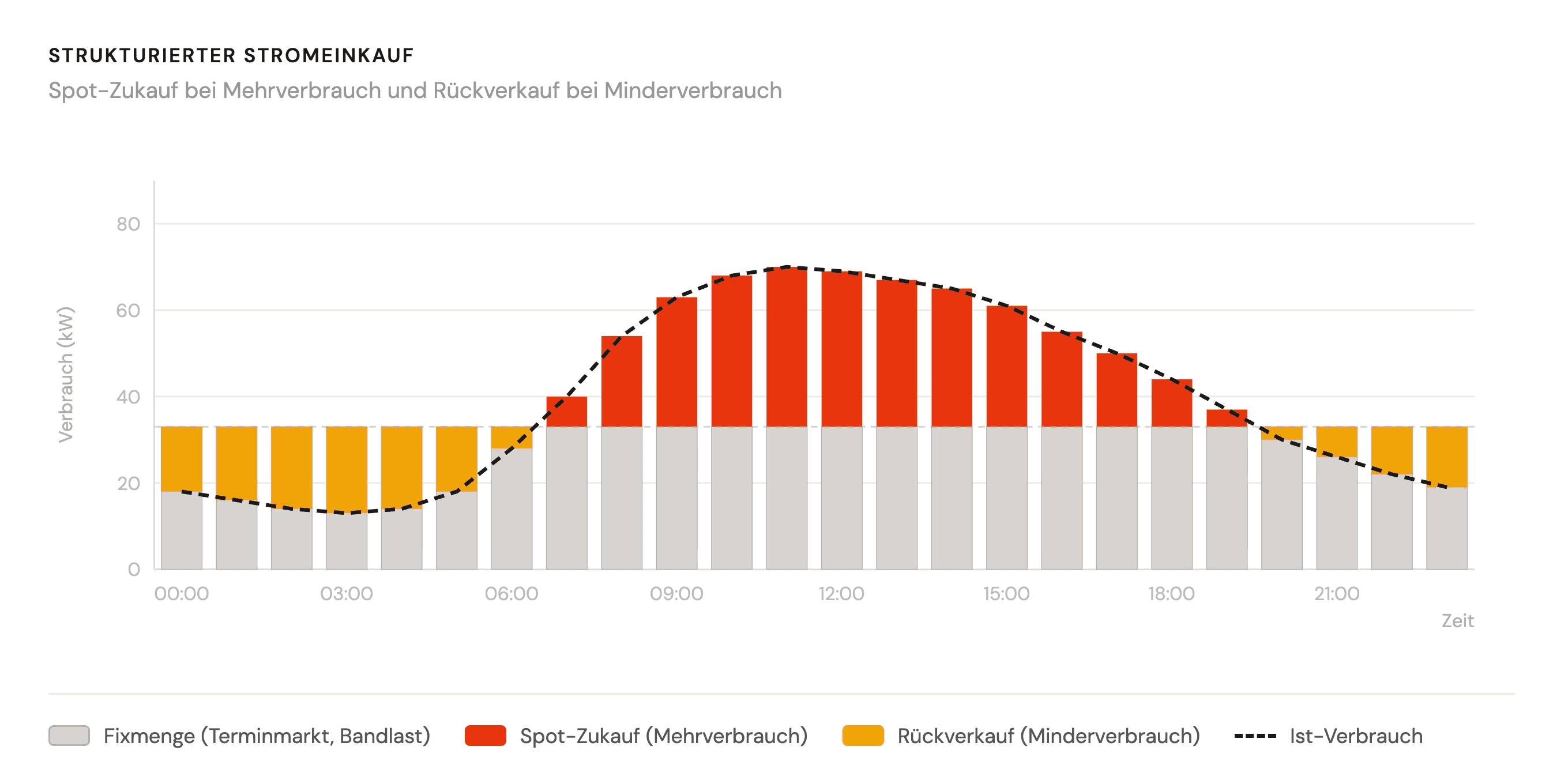
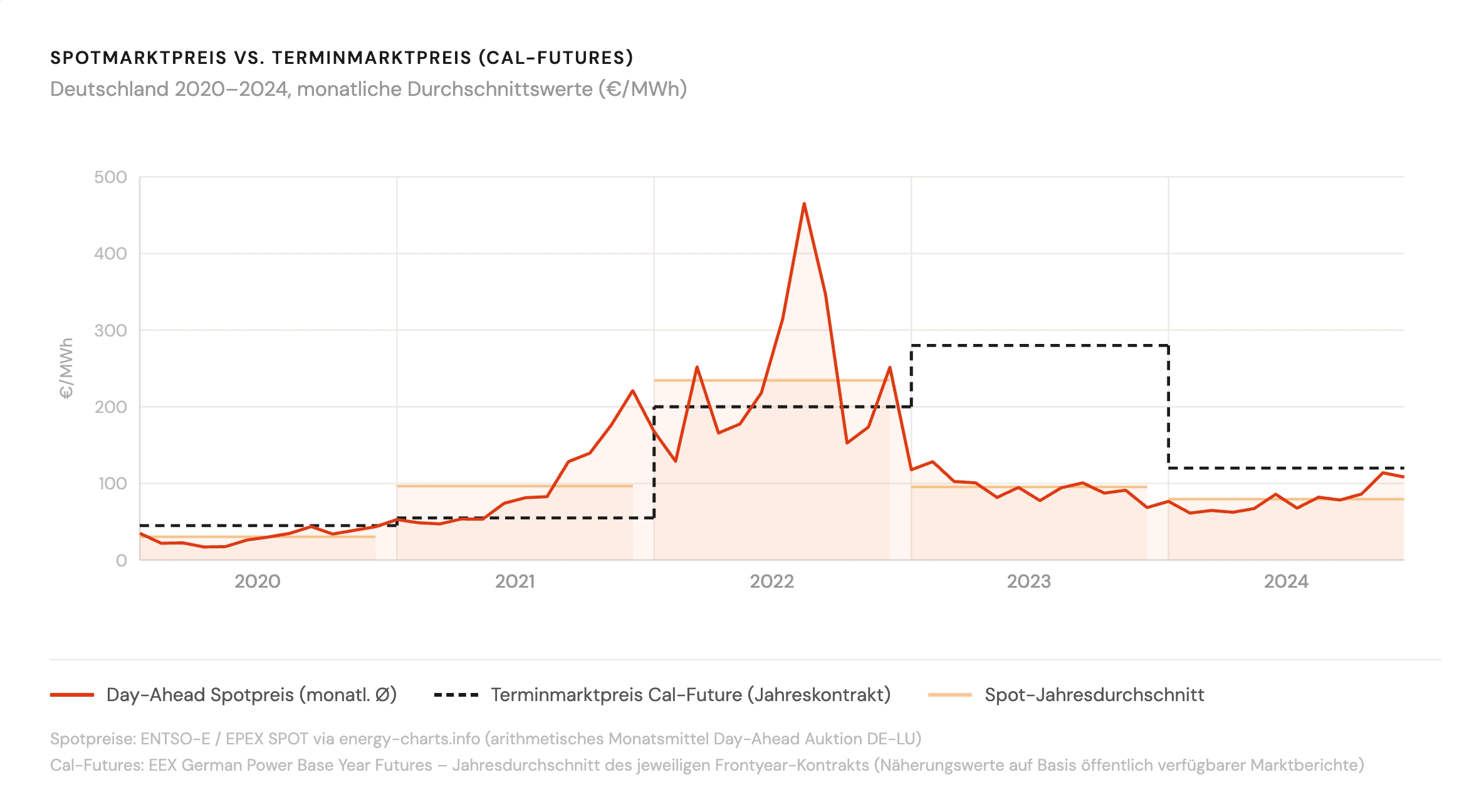
Anyone buying long-term on the forward market usually pays an implicit risk premium: at the time of the offer, the supplier cannot know how spot prices will develop and prices in this uncertainty. That is why the average spot price has frequently been below the forward market price in the past — a structural advantage for companies with direct spot market access.
At the same time, the spot market brings considerable price fluctuations. As renewable energy expands, low-price periods are emerging more and more often — for example on very windy or sunny days. For companies with battery storage, this opens up interesting opportunities for cost optimization.
Structured procurement addresses exactly this field of tension: the base load is hedged in a calculable way, while the variable share can benefit from the market.
What this means for battery storage
Anyone assessing a battery storage system economically typically calculates how much the storage system saves through peak shaving, self-consumption optimization or dynamic charging. These calculations depend directly on the price at which the electricity drawn is valued.
With a uniform fixed price, this is simple. In structured procurement, the following applies:
The fixed-price share has already been paid, regardless of how much is actually consumed. Reducing consumption in a given hour — because the battery is discharging — initially does not change the fixed costs. The economic lever of the battery lies here in the variable spot-price share: it can charge during low-price periods and discharge during expensive hours, thereby actively optimizing the cost of the spot share.
This fundamentally changes the logic of the profitability calculation. It is not the average price but the marginal cost of the spot share in the respective hours that is decisive for the added value of the storage system. A simulation that does not take this difference into account systematically overestimates or underestimates the savings.
Lumera maps structured power procurement directly in the simulation. Users can enter their fixed-price share, the spot surcharge and the procurement structure — and thus receive a profitability analysis that matches their actual contract, instead of calculating with a simplified average price.
Who is structured power procurement suitable for?
The model is primarily of interest to companies that have a predictable base consumption of a few hundred kW or more and that either employ their own energy buyers or work with a supplier offering structured tariffs. Since the minimum size on the forward market is one megawatt, direct exchange access only makes sense for large consumers — for small and medium-sized enterprises, this is typically handled by a supplier or an energy service provider.
Those who have a structured tariff value the mix of budget certainty and market flexibility. The question is not whether, but how well the associated battery simulation reflects this reality.
Conclusion
Structured power procurement is not a special case for energy professionals — it is the procurement reality of many large industrial customers. Anyone planning a battery and working with such a tariff needs a simulation that correctly models the difference between the secured fixed share and the variable spot share. Only then does a profitability calculation emerge that you can genuinely trust.
More Articles
Furo raises $4M from TQ Ventures, Neo and Sheryl Sandberg to build the operating system for industrial battery storage
Furo and LUOX Energy Launch Combined Solution for Optimizing Commercial and Industrial Battery Storage
MiSpeL Becomes Binding: Determination from October 2026, Transitional Phase until September 2027
Aging: Why Charging and Discharging an Industrial Battery Storage System for Arbitrage Doesn't Always Pay Off
Balancing Group and Balancing Energy: Why Storage Projects Lose Economic Viability During Operation
Why the dynamic rate plan is the first step toward flexible marketing, and what else you need