MiSpeL Becomes Binding: Determination from October 2026, Transitional Phase until September 2027
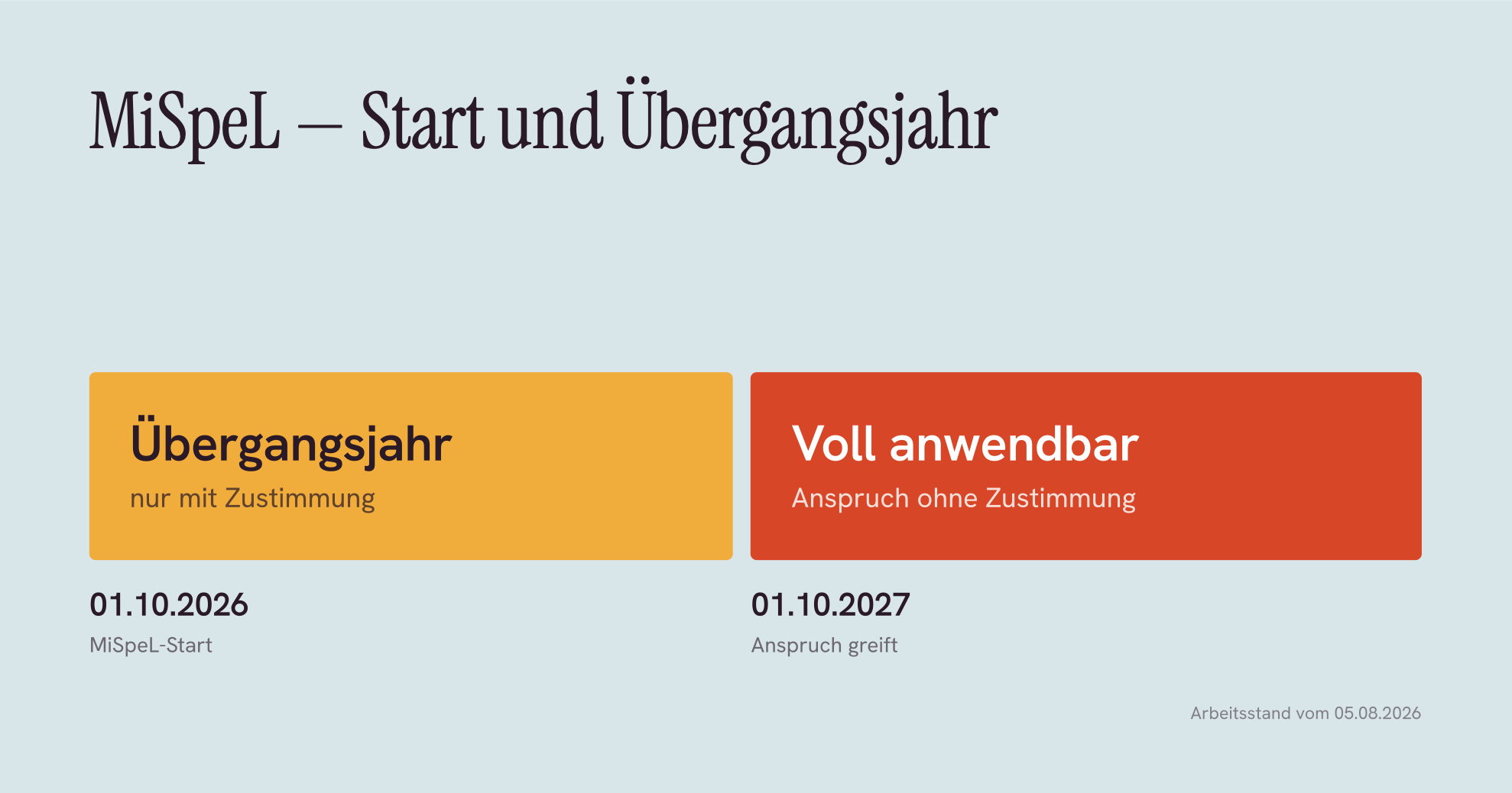
Germany's Federal Network Agency (Bundesnetzagentur) has published a revised working draft of its determination on the market integration of storage systems and charging points (Marktintegration von Speichern und Ladepunkten, MiSpeL), which it intends to adopt on the basis of Section 85d EEG and Section 62(2)(1) EnFG. The draft replaces the framework paper of 17 September 2025 and broadens the scope of the MiSpeL determination.
A quick reminder: what MiSpeL is about
Under the existing exclusivity option in Section 19(3a) EEG, operators face an either/or decision: either a storage system is charged exclusively with self-generated PV electricity and retains its full EEG support, or it is operated flexibly and loses that support. In practice, this means storage systems are technically blocked from drawing grid electricity or from feeding into the grid — and their flexibility potential goes unused.
The issue affects more than just subsidy entitlements; it extends to levies as well. Where grid electricity is charged into a storage system and later discharged back into the grid, no levies are payable on it. But this so-called netting of levies under Section 21 EnFG presupposes precisely that grid electricity is charged into the system — which the exclusivity option rules out.
MiSpeL resolves this deadlock by introducing two new options. The apportionment option (Abgrenzungsoption) allocates electricity flows on a calculated basis and permits fully mixed operation, in which both EEG support and levy benefits are retained on a pro-rata basis. The flat-rate option (Pauschaloption) simplifies the allocation using standardised assumptions, but is limited to solar installations up to 30 kWp. We have summarised the details of the original MiSpeL framework paper in a separate article.
MiSpeL is coming — but the first year is a transitional year
Current plans have the MiSpeL determination taking effect on 1 October 2026. What is new, however, is a transitional arrangement that matters more for project planning than the date itself. While the determination will in principle oblige grid operators and metering point operators to enable the use of levy privileges, market premium payments and the necessary allocations, this obligation will not yet apply until 30 September 2027. During that period, the rules can only be used where the grid operator and metering point operator agree. The flat-rate option is subject to an additional state aid caveat: it will apply at the earliest from the month following approval of Section 19(3c) EEG by the European Commission.
The apportionment option opens up to storage without a subsidised PV installation
Under the previous framework paper, at least one renewable installation behind the feed-in point had to be allocated to subsidised direct marketing via the market premium under Section 19(1)(1) EEG. Anyone operating a storage system without any generation asset, or with exclusively non-subsidised generation, was unable to access the apportionment option. That barrier now falls: the working draft expressly covers these cases and permits the levy privileges under Section 21(1) to (4) EnFG there as well. Consistently, the requirements that relate solely to EEG support fall away — such as allocation to a direct marketing balancing group or the calculation of the market premium on the basis of the annual market value.
In practice, this means that standalone grid-scale batteries as well as PPA and post-EEG configurations gain a regulated route to levy netting for the first time.
Less metering effort for simple configurations — but the choice is binding
Until now, the apportionment option effectively required at least two calibration-compliant bidirectional meters with quarter-hourly resolution: one at the grid connection point and one at the storage system. That does not change in principle — the base case with both meters remains the standard route. For three simple configurations, however, the working draft now permits an alternative simplified calculation method that makes do with the meter at the grid connection point: for storage co-located with a renewable installation and no other consumption, for purely grid-connected storage, and for storage without generation but with other consumption. No charging point may be integrated in any of these configurations.
This reduces the metering effort for these specific cases. In two of the three, accuracy may decline as a result. In the co-location case, the simplified calculation method may yield a slightly lower volume of eligible electricity than the base case, and in the case of storage with other consumption, storage losses can no longer be reported and privileged separately. For purely grid-connected storage, by contrast, there is no downside — the Federal Network Agency expressly notes that the simplified route leaves operators neither better nor worse off there. In that configuration, the second meter would simply serve no purpose.
Two new rules apply for planning purposes. First, the simplified calculation methods may not be applied where the existing metering equipment already allows the more precise determination. Second, the choice between the simplified and the full calculation method is binding and can be changed at the earliest with effect from the following calendar year.
Conclusion
The working draft makes MiSpeL concrete and broadens its scope. Three points can now influence project planning: the transitional year until the end of September 2027, during which use depends on the agreement of the grid operator and metering point operator; the new accessibility for storage systems without a subsidised PV installation; and the choice of metering concept, which is binding for at least one calendar year.
More Articles
Furo raises $4M from TQ Ventures, Neo and Sheryl Sandberg to build the operating system for industrial battery storage
Furo and LUOX Energy Launch Combined Solution for Optimizing Commercial and Industrial Battery Storage
Aging: Why Charging and Discharging an Industrial Battery Storage System for Arbitrage Doesn't Always Pay Off
Balancing Group and Balancing Energy: Why Storage Projects Lose Economic Viability During Operation
Why the dynamic rate plan is the first step toward flexible marketing, and what else you need
Trading spare capacity: how your battery earns money on the spot market on the side