Why the dynamic rate plan is the first step toward flexible marketing, and what else you need
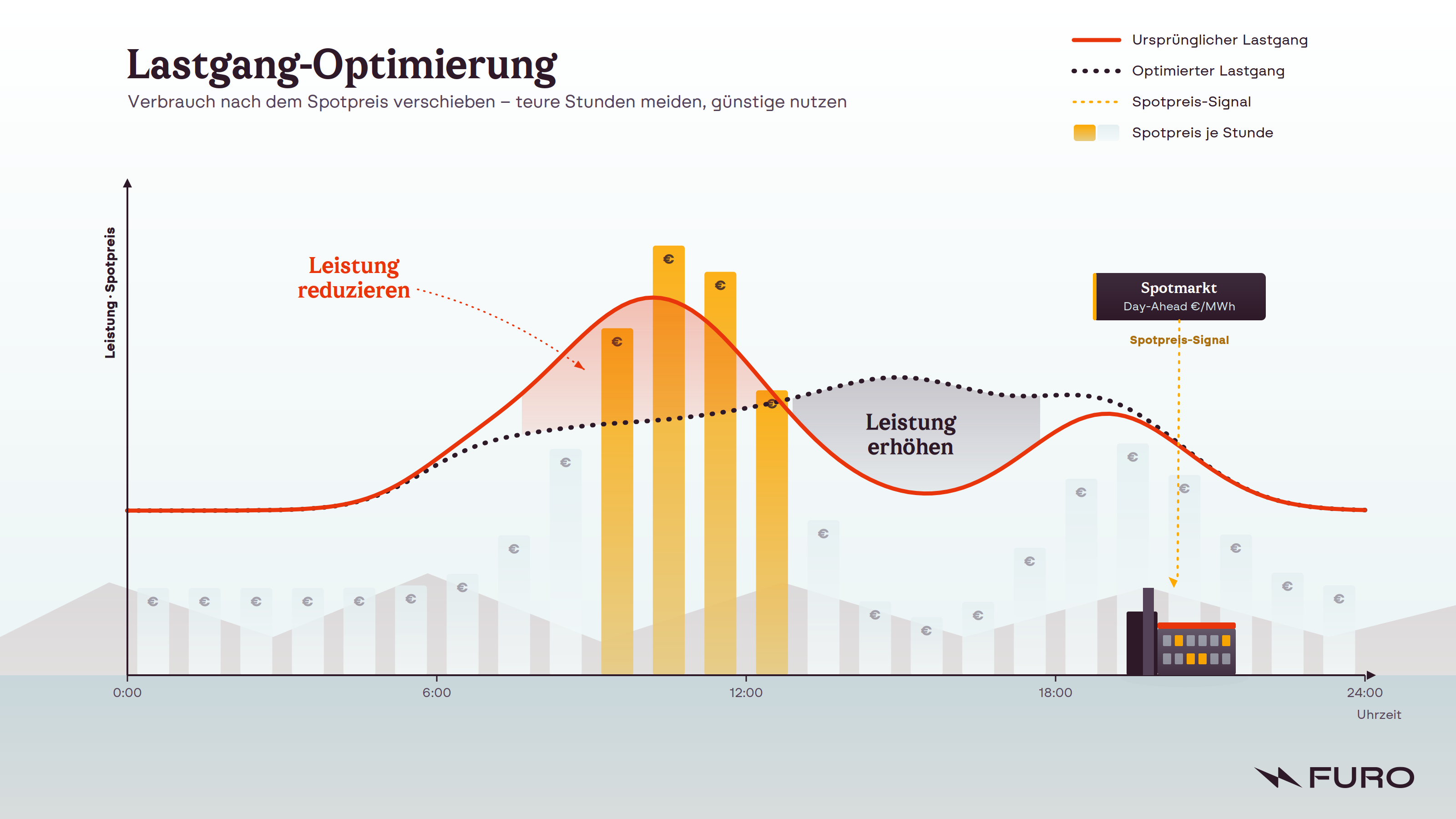
The dynamic tariff captures the largest part of the storage value. For anything beyond that, industrial companies don't need a particular tariff, but a partner who takes responsibility for the balancing group.
The previous blog article was about the risk. A storage system changes the load profile, and a supplier that cannot reflect this produces imbalance energy costs that worsen the economic basis during operation. The conclusion was to choose a supplier that understands the storage.
This part flips the perspective. Assuming this partner is in place: how does value actually arise from the storage with such a partner, and how far can it be expanded? The short answer: the biggest lever lies in electricity procurement. Everything beyond that presupposes a cleanly managed balancing group.
The biggest lever the dynamic tariff opens up lies in procurement
The biggest optimisation lever arises not from selling electricity, but from buying it. At its core is the day-ahead market, on which the dynamic tariff is based. There, electricity is traded the day before for each hour of the following day. The storage charges in the cheap hours and covers consumption in the expensive ones. That lowers your own electricity bill.
For this lever to take hold, you need a dynamic tariff. Only when the procurement price fluctuates over the day does the price spread arise that the storage exploits. With a fixed price, there is nothing to shift that makes procurement cheaper.
The real key is the balancing group
One point is often overlooked here. For flexibility marketing, the dynamic tariff is not the prerequisite. The prerequisite is someone who takes responsibility for the balancing group.
In theory, this even works with a fixed tariff. A supplier that handles balancing group management, direct marketing of the PV system and flexibility marketing can deploy the storage on the market without the procurement tariff being dynamic. On the market, market prices apply anyway, regardless of how the supply contract is structured.
It's just that in this case the biggest lever is left untapped, because it hangs on procurement and thus on the dynamic tariff. That is why the dynamic tariff comes first. It captures the largest part of the value first.
Who does what

For marketing, three roles must interact. The energy supply company supplies the site and reports the schedule. The marketer offers free capacity on the market. The balance responsible party reports the balancing group to the grid operator. [1]
These three roles serve the same schedule. Any deviation between the reported schedule and actual operation generates imbalance energy. If the roles are distributed across several independent actors, the coordination effort rises, and with it the risk that forecast and reality diverge. If the roles come together, the storage can be run in such a way that it supports the balance.
The two stages of storage value
The value of a storage system can be raised in two stages.
Stage 1 is procurement optimisation for own consumption. The storage lowers your own bill via cheap procurement on the day-ahead market. This is the biggest lever, and even here it is linked to imbalance energy, because the changed offtake hits the supplier's forecast. A balancing-group partner that knows the storage keeps this risk small.
Stage 2 is the marketing of unused residual capacity. Whatever the storage does not need for own consumption, the marketer can offer on the market. Here a second market comes into play: continuous intraday trading, on which trading continues until shortly before delivery. There, short-term price changes and current forecasts count. Whoever includes intraday trading alongside the day-ahead market when marketing increases revenues by up to 40 percent.
In trading, two forms must be distinguished: physical and balance-based (see the article "Physical and virtual trading"). In physical trading, energy actually flows — the storage feeds in or draws in order to serve a market position. This requires a grid connection with a clearly delimited feed-in and offtake point, and the corresponding feed-in permit. In balance-based trading, also called virtual trading, the same energy quantity is bought and sold again via day-ahead and continuous intraday, without physically delivering it. What is traded is the price difference, not the electricity flow. [2]
For the balancing group, this means: in physical trading, energy flows for real, it must match the schedule, and deviations generate imbalance energy. In balance-based trading, the purchase and sale of the same quantity cancel out in the schedule. As long as the position is closed, no electricity flows and no imbalance energy arises. The balancing group only becomes relevant once a position remains open and energy actually flows or is missing.
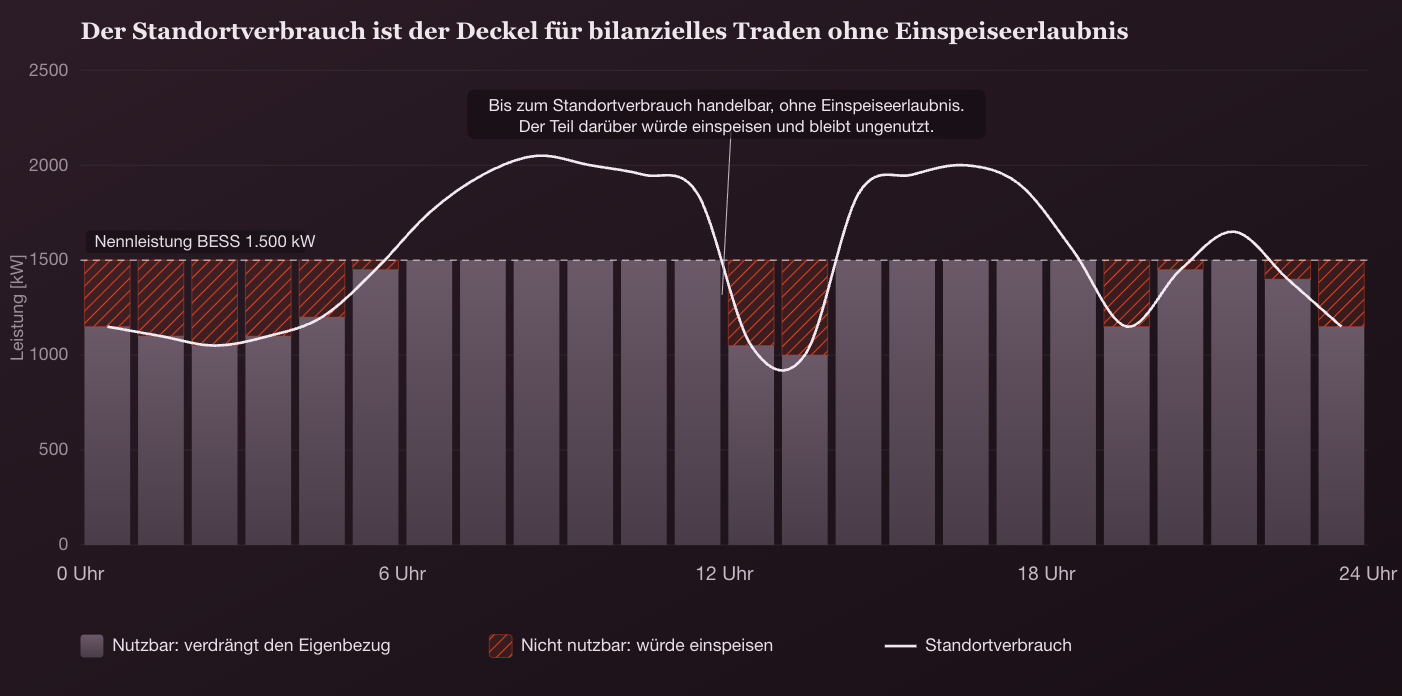
For a storage system behind the meter, this is an advantage. When discharging, it only displaces the electricity the site draws anyway. To the grid operator this looks like less consumption, not like feed-in. As long as the discharge stays capped at the current site consumption, nothing flows into the public grid, no feed-in permit is needed, and the marketing runs on a balance basis through the partner's balancing group.
Conclusion
Two things determine how much a storage system brings in. The dynamic tariff captures the largest part via procurement optimisation. And a partner who takes responsibility for supply, balancing group and marketing from a single source makes the marketing beyond that viable and keeps the imbalance energy under control.
Whoever plans a storage project should therefore clarify two questions early: Do I have a dynamic tariff that allows procurement optimisation? And do I have a partner who takes responsibility for the balancing group and handles the marketing? If both are in place, the order is simple: first optimise procurement, then market on that basis.
In planning with Furo, both can be reflected before installation — from the right tariff to the question of which residual capacity can be marketed. The decisive part comes afterwards. On request, we bring along the right market participants for operation, so that the optimisation is actually implemented and does not just stay on paper.
--
How a storage system technically participates in the market, from physical to virtual trading, is covered in the article "Physical and virtual trading." The last blog post, "Balancing group and imbalance energy: Why storage projects lose economic viability in operation," shows why the choice of supplier decides the economics in operation.
[1] Interconnector (EnBW), Wissen: Bilanzkreis. https://www.interconnector.de/wissen/bilanzkreis/
[2] Interconnector (EnBW), Energieblog: Gewinnmaximierung durch virtuelle Ladezyklen mit Batteriespeichern. https://www.interconnector.de/energieblog/gewinnmaximierung-durch-virtuelle-ladezyklen-mit-batteriespeichern/
More Articles
Aging: Why Charging and Discharging an Industrial Battery Storage System for Arbitrage Doesn't Always Pay Off
Balancing Group and Balancing Energy: Why Storage Projects Lose Economic Viability During Operation
Plant Certificates for Battery Storage: When You Need One, What It Costs, and How the Process Works
Lumera Energy becomes Furo
How battery storage really ages and how we model it
Charging a PV storage system with grid power: comparing the rules in Germany (MiSpeL) and Austria