Plant Certificates for Battery Storage: When You Need One, What It Costs, and How the Process Works
Plant Certificates for Battery Storage: When You Need One, What It Costs, and How the Process Works
A battery storage system can move a lot of power at the grid connection point. If it behaves in a fault situation in a way that the grid connection rules don't allow, it can jeopardise the stability of the power grid. That's why, before commissioning, you have to prove that the system meets the technical requirements. The central proof for this is the plant certificate (Anlagenzertifikat).
For installers, planners and EPCs, this is not a side issue: the certification has a direct impact on cost, timeline and the final price for the end customer. This article explains what plant certificates are, when you need which one, and how the process works.
What is a plant certificate – and why is it mandatory?
A plant certificate is the proof, issued by an accredited certification body, that a generating or storage plant complies with the applicable technical connection rules (NC RfG, NELEV, VDE-AR-N 4105/4110/4120).
The reason is grid stability: a storage system feeds in, draws power, provides reactive power, and has to behave correctly during grid faults. If that doesn't work reliably, the plant endangers grid operation – precisely at the grid connection point (GCP), where it becomes critical for the system.
Which proof is required depends on two factors:
- the maximum AC active power at the grid connection point (in kW, including existing plants – not the kWp of the PV generator), and
- the voltage level (low, medium or high voltage).
➡️ Key point: What counts is the AC active power of the inverters at the grid connection point – not the theoretical maximum (kWp) of the PV modules. In practice, this mix-up regularly leads to wrong classifications.
Why the topic is worth real money for installers and EPCs
Certification is expensive and time-consuming: costs start at around €5,000 (Type B) or €10,000 (Type A) – and with the conformity declaration, expert assessments and typical follow-up requests, €10,000 to €20,000 is quickly reached. On top of that, certification adds around six months to the project timeline.
Both feed into the economics of the storage system – and therefore into the price the end customer sees. And there is usually no way around it:
➡️ Without valid proof, there is no connection to the grid – and therefore no remuneration and no self-supply.
Two things therefore pay off. First: price in the certification costs from the start and be transparent with the end customer early on. A five-figure amount that only appears late in the quote is hard to add later – whoever communicates clearly from the beginning what to expect creates planning certainty on both sides.
Second: timing. If the process is started early and in the right order, the documents can be submitted once correctly – instead of going through several rounds of corrections with the distribution system operator (DSO). It's exactly these correction loops that cost the most time.
So the topic belongs at the beginning of the planning. The first step: distinguishing the three types of certificate, which are often confused.
Unit, component and plant certificate: the difference
- Unit certificate: certifies a single device type (e.g. a battery or PV inverter). Obtained by the manufacturer through an accredited body.
- Component certificate: certifies individual component types – in practice mainly the plant controller (EZA-Regler) and protection devices.
- Plant certificate: certifies the entire plant as it is built at this specific GCP – including the interaction of units, controller, protection concept and grid connection. This is the complex, project-specific proof (Type A, B or C).
In short: unit and component certificates are the building blocks, and the plant certificate is the proof for the finished whole. It can only be issued if valid certificates exist for all units and components.
➡️ Practical tip – check ZEREZ before you order: Whether a unit or component is certified can be checked in ZEREZ (the Central Register for Unit and Component Certificates). Check this before purchasing. Especially with non-European manufacturers: a device can be technically flawless and still lack a valid certificate – in which case it blocks the entire plant certificate.
Do I need a plant certificate – and if so, which one?
The decisive factors are the maximum AC active power at the GCP and the voltage level.
Basic rule by maximum active power at the GCP
Plant certificate C is a special case for individual proofs and rarely relevant in storage practice.
The key exception: feed-in limit ≤ 270 kW
It's not the installed inverter power alone that's decisive, but the agreed feed-in power at the GCP. This is where the biggest economic lever lies:
➡️ If the feed-in power is permanently limited to ≤ 270 kW (e.g. via a certified plant controller), the plant certificate requirement can be waived – even with higher installed power. A unit and component certificate (plant controller, verified via ZEREZ) plus the E-forms are then sufficient.
More important than limiting the connection power after the fact, however, is to factor the right certification level into the sizing of the storage system from the start: whoever considers power, use case and certification effort together from the beginning chooses the storage size deliberately – instead of having to correct via the connection power later.
Plant certificate decision tree
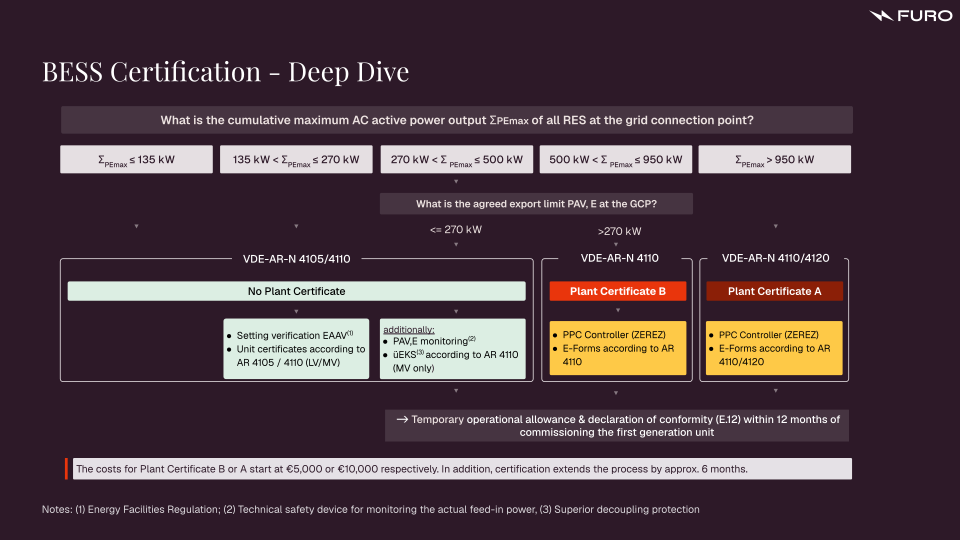
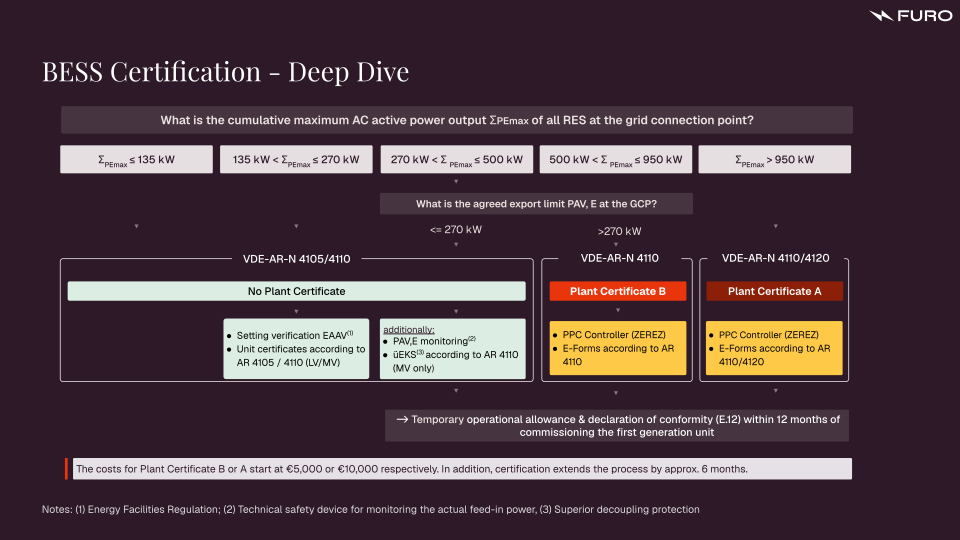
A structured overview of the requirements and implications of various facility certifications.
- Determine the maximum AC inverter active power at the GCP (including voltage level):
- ≤ 135 kW (LV) → no plant certificate; unit certificate + setting verification. Done.
135 kW → a plant certificate is required in principle – continue to step 2.
- Does the exception apply? Is the feed-in power at the GCP limited to ≤ 270 kW (e.g. via a certified plant controller)?
- Yes → no plant certificate needed; proof via unit/component certificate, plant controller (ZEREZ) and the E-forms.
- No → plant certificate required:
135 kW to ≤ 950 kW (MV) → Plant certificate B.
950 kW (MV/HV) → Plant certificate A.
Grid operators may set differing rules in their technical connection conditions (TAB) – when in doubt, always confirm the classification with the responsible grid operator.
How certification works: phases and forms
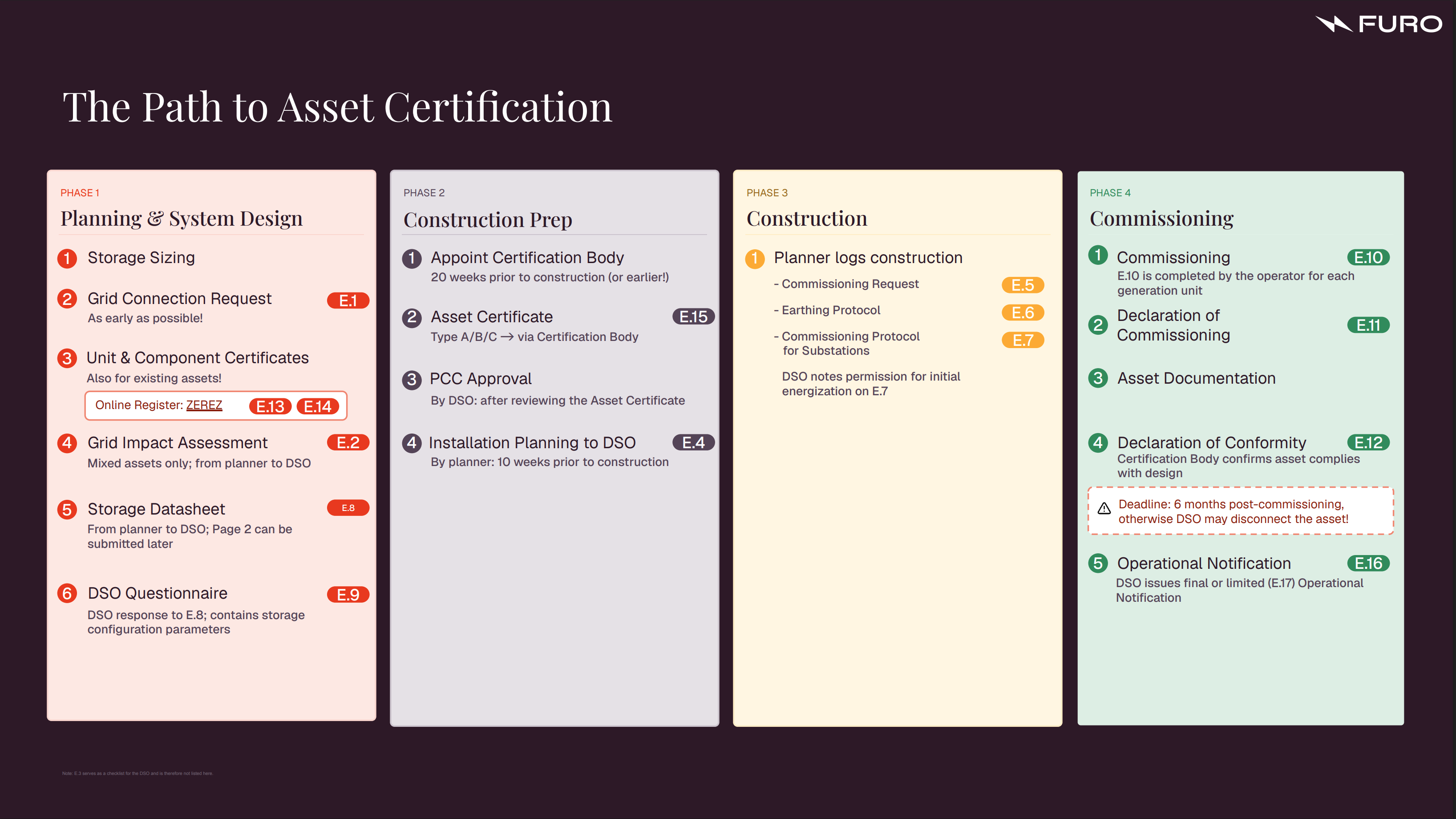
Steps towards BESS certification, using the example of a Plant Certificate Type B.
The proof is provided in two stages: first the plant certificate (planning certificate) for the provisional operating permit, then, after commissioning, the conformity declaration for the final one. The process is divided into four phases.
Phase 1 – Planning & sizing
The planner sizes the storage system and submits the grid connection request (E.1) to the grid operator – as early as possible, since it clarifies the available connection capacity. For mixed plants, the assessment of grid perturbations (E.2) is added. For all units and components, the planner obtains the unit and component certificates (E.13 / E.14) and checks their validity in the ZEREZ register. To the storage data sheet (E.8), the grid operator responds with the questionnaire (E.9) – it contains the setting specifications and is the basis for the plant certificate.
Phase 2 – Construction preparation
The planner commissions the certification body early – ideally 20 weeks before construction starts (or earlier). It produces the plant certificate (E.15, Type A/B/C). After reviewing it, the grid operator approves the grid connection point. The planner then submits the installation planning (E.4) to the grid operator – at the latest 10 weeks before construction starts.
Phase 3 – Construction
The planner documents the construction: commissioning order (E.5), earthing protocol (E.6) and commissioning protocol for transfer stations (E.7). On the E.7, the grid operator notes the permission for initial connection to the grid.
Phase 4 – Commissioning
The plant operator commissions the system and completes the commissioning form (E.10) for each generating plant; the certification body confirms that the plant matches the plan. This is followed by the commissioning declaration (E.11), the conformity declaration (E.12) and finally the operating permit (E.16) issued by the grid operator.
➡️ Important deadline: The conformity declaration must be submitted within six months of commissioning – otherwise the grid operator can disconnect the plant again.
Practical tip: submit E.1 and E.8 early
You can submit E.1 and E.8 right at the start – even before signing the contract with the customer. This kicks off the process early and, via the E.9 questionnaire, also provides a check of whether you'll get the planned grid connection capacity. This is usually unproblematic, but it takes risk out of the project before you commit contractually.
Take-away
The plant certificate is a cost and time factor that noticeably affects economics. Three levers pay off:
- Start early: submit E.1 and E.8 right at the start of the project.
- Check ZEREZ: before purchasing, make sure all units and components are validly certified.
- Factor in storage size: include the right certification level in the design from the start and size the storage system so that power, use case and certification effort fit together.
That turns an obligation into a plannable step – and keeps the storage system economical for your end customer.
Plan your storage system right – from the first quote to the operating permit
With Furo's planning software, you calculate the sizing, certification and economics of a battery storage system in a single tool – and know what's coming for your customer even before you send the quote.
➡️ Try Furo Plan for free for 14 days!
➡️ Register for the next Furo webinar for free
Sources & further information:
- FGW guide "Plant Certificate B, Commissioning Declaration and Conformity Declaration"
- VDE FNN guidance "Simplified connection and verification of generating plants in medium and high voltage" (NELEV amendment, July 2024)
- VDE FNN guidance "Connection and operation of storage systems on the low-voltage grid" (2024)
- BDEW application guide on the "certification package" for generating plants
- Technical connection rules VDE-AR-N 4105 (LV) / 4110 (MV) / 4120 (HV); NELEV
- ZEREZ – Central Register for Unit and Component Certificates
More Articles
Furo raises $4M from TQ Ventures, Neo and Sheryl Sandberg to build the operating system for industrial battery storage
Furo and LUOX Energy Launch Combined Solution for Optimizing Commercial and Industrial Battery Storage
MiSpeL Becomes Binding: Determination from October 2026, Transitional Phase until September 2027
Aging: Why Charging and Discharging an Industrial Battery Storage System for Arbitrage Doesn't Always Pay Off
Balancing Group and Balancing Energy: Why Storage Projects Lose Economic Viability During Operation
Why the dynamic rate plan is the first step toward flexible marketing, and what else you need