Balancing Group and Balancing Energy: Why Storage Projects Lose Economic Viability During Operation
A battery storage system pays off on paper (more on that here). Whether it holds up in operation is often decided not by the hardware, but by the electricity supplier behind it.
When planning a battery storage system, everything revolves around the economics on paper: load profile, storage size, savings, payback. What rarely shows up in this calculation is the operational level — the question of what happens once the storage is actually running and the electricity supplier has to reflect the changed consumption.
This is exactly where projects stall. Not on the day of installation, but months later, when the first bills arrive. The reason is usually not a technical defect, but the way a storage system changes the load profile the supplier had planned around beforehand.
For planners and channel partners advising their customers, this is the level to raise early. This article explains how the conflict arises, why it turns into costs, and what matters when choosing a supplier.
What the supplier assumes about every customer
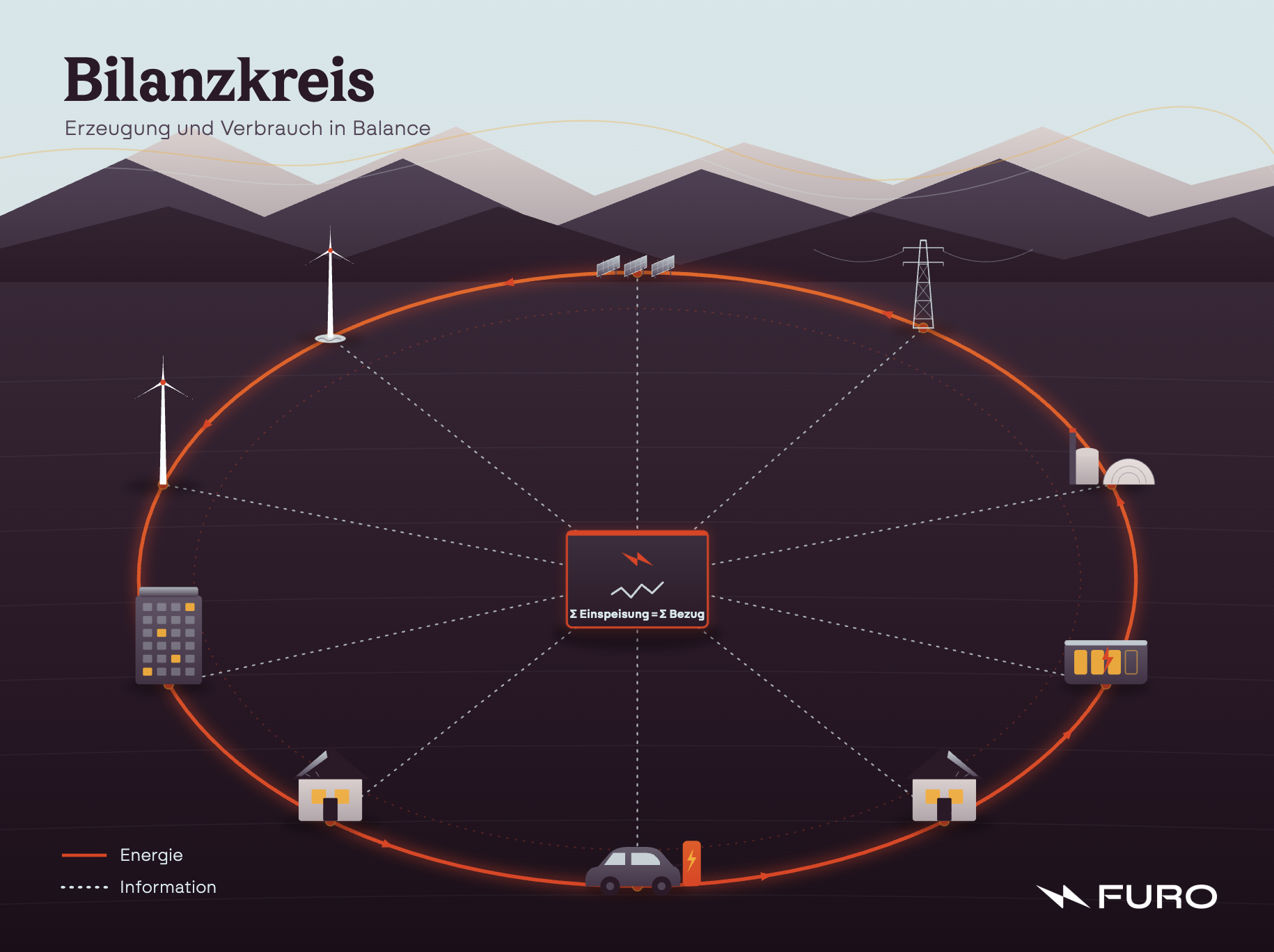
Every electricity supplier works with a forecast — specifically within its balancing group. A balancing group is the energy-quantity account in which the supplier bundles the procurement and consumption of all its customers, and which must be balanced in every quarter-hour. For each consumption point, the supplier estimates how much electricity the customer draws in which quarter-hour and reports these quantities as a schedule to the transmission system operator. This report is submitted daily for the following day, on a quarter-hourly basis. [1]
This forecast is the basis of all procurement. The supplier buys the electricity in advance in the volume it expects. As long as the customer behaves roughly as forecast, the numbers add up, because it can smooth out across all customers in the balancing group.
Why a storage system breaks this assumption
A battery storage system fundamentally changes the load profile. It charges when electricity is cheap and discharges when it is expensive or when a load peak looms. From the perspective of the grid connection, consumption then looks different than before.
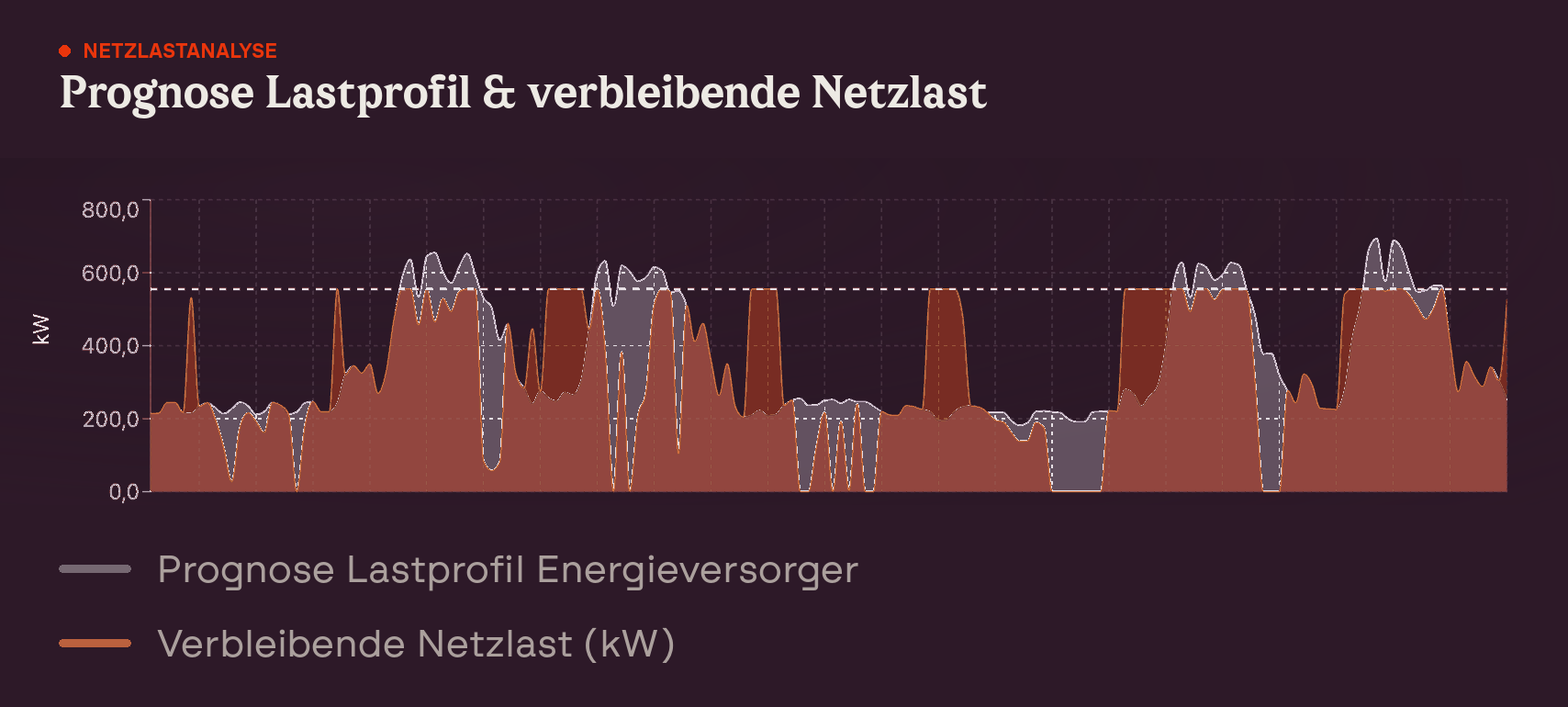
The grey area shows the supplier's forecast based on the old load profile, i.e. consumption without storage. The orange area shows the remaining grid load that is actually drawn from the grid after the storage is deployed. The dashed line marks the targeted load ceiling.
The two curves visibly diverge. The supplier purchased based on the grey curve, but the orange curve arrives at the grid. The more consistently the storage optimises, the larger this deviation becomes.
How the deviation turns into costs
Such deviations are first netted against each other across all balancing groups in a control area, since where one draws too much, another draws too little. Only the remaining balance is then offset via balancing reserves. The transmission system operator allocates the cost of this to the balancing groups that deviated. This allocation is called imbalance energy, and it is borne by the balance responsible party — usually the supplier. [1]
One point for proper context: imbalance energy is not a penalty for a wrong forecast. It is the allocation of the costs that arise because the transmission system operator has to offset the deviation via balancing reserves. The price for this is not fixed in advance. It results quarter-hourly from the balance of the entire control area and from the balancing reserves actually called upon at that moment. The same deviation can cost almost nothing in one quarter-hour and a lot in the next. The cost risk therefore cannot be calculated away — only kept small through a good forecast and portfolio netting. Over the last 12 months, the €/MWh figure has risen to as high as €4,718.69/MWh. [2] And this is exactly what a supplier delivers who knows what the storage is doing at the meter, whereas a supplier without this understanding passes on the risk unfiltered.
Where these costs land on the customer
The supplier initially bears the imbalance energy costs itself, but passes them on. In market practice, there are roughly three routes for this:
- A fixed surcharge that is applied flat across all customers.
- A cause-based 1:1 pass-through to the customer who generates the deviation.
- An individualised billing for individual large customers whose deviations noticeably burden the portfolio.
For a storage project, more important than the billing model is whether the supplier factors the storage into its forecast from the start. If it does, its procurement for the site remains predictable. The deviation is then no larger than for any other customer, and hardly any additional imbalance energy arises. If, on the other hand, it keeps planning with the old profile without storage, the deviation only arises through this gap, and it passes on the costs regardless of the model.
The dynamic tariff amplifies the effect
A dynamic or structured tariff is the prerequisite for procurement optimisation to be possible, because only the price difference over the day provides the usable spread. But it is precisely this incentive that leads the storage to run harder against the prices, moving the load profile further away from the original forecast.
The dynamic tariff is therefore not the cause of the balancing-group problem. It is an amplifier. The greater the optimisation lever, the greater the deviation the supplier must be able to reflect.
Why the conflict becomes visible late
The tricky part is the time lag. Between commissioning and the first noticeable imbalance energy bill, there are often months. During this time, the project appears to run without problems.
⚠️ If a storage project runs smoothly for the first few months, that does not mean it is being balanced cleanly. Often the first bill is simply still outstanding.
This is not a cause for worry, but a reason to address the topic early. With a supplier that factors the storage in from the start, the problem does not arise in the first place. Whoever conceals the storage, by contrast, risks in the extreme case a back-payment or the termination of supply.
What matters when choosing a supplier

The customer is free to choose its supplier. For a storage project, however, this choice is not trivial.
Conclusion
A storage system is only as economical as the contract it runs under. Whoever plans a project should check the supplier as early as the hardware — not only when the first imbalance energy bill arrives. Three questions are enough for the first check: Does my supplier understand the storage? How does it pass on imbalance energy costs? And am I able to switch, in case it does not go along?
In planning with Furo, the changed load profile can already be reflected before installation. This way the question of the right supplier becomes part of the sizing, rather than a subsequent surprise.
--
How a dynamic tariff is built from a fixed base share and a spot share, and what that means for the storage, is covered in the article "Structured electricity procurement."
[1] Interconnector (EnBW), Wissen: Bilanzkreis. https://www.interconnector.de/wissen/bilanzkreis/
[2] Netztransparenz.de, AEP-Schätzer. https://www.netztransparenz.de/de-de/Regelenergie/Ausgleichsenergiepreis/AEP-Schätzer
More Articles
Aging: Why Charging and Discharging an Industrial Battery Storage System for Arbitrage Doesn't Always Pay Off
Why the dynamic rate plan is the first step toward flexible marketing, and what else you need
Plant Certificates for Battery Storage: When You Need One, What It Costs, and How the Process Works
Lumera Energy becomes Furo
How battery storage really ages and how we model it
Charging a PV storage system with grid power: comparing the rules in Germany (MiSpeL) and Austria