Charging a PV storage system with grid power: comparing the rules in Germany (MiSpeL) and Austria
Anyone wanting to charge a PV storage system with grid power faces, in Germany, a regulatory framework of exclusivity option, delineation option and flat-rate option. Austria has no comparable rule. This article puts the differences into context and shows which regulations actually apply to battery storage in Austria.
The question of whether a battery storage system may charge grid power in addition to PV power without losing the feed-in tariff has been a central regulatory topic in Germany for years. With the MiSpeL determination (market integration of storage systems and charging points), there have been clear rules for the mixed operation of green-power and grey-power storage for the first time since 2025.
Austria has no comparable rule. The reasons for this lie in a fundamentally different funding architecture.
Germany: MiSpeL governs mixed operation
The exclusivity option (§19 para. 3a EEG) requires that a battery storage system charge exclusively electricity from renewable energy sources within a calendar year. As soon as grid power flows into the storage system, the entire EEG eligibility for all feed-ins of the year in question is forfeited. In practice, this means: no arbitrage trading, no response to market price signals, no flexible mixed operation.
The Solar Peak Act (BGBl. 2025 I No. 51, in force since 25 February 2025) introduced two new options into §19 EEG:
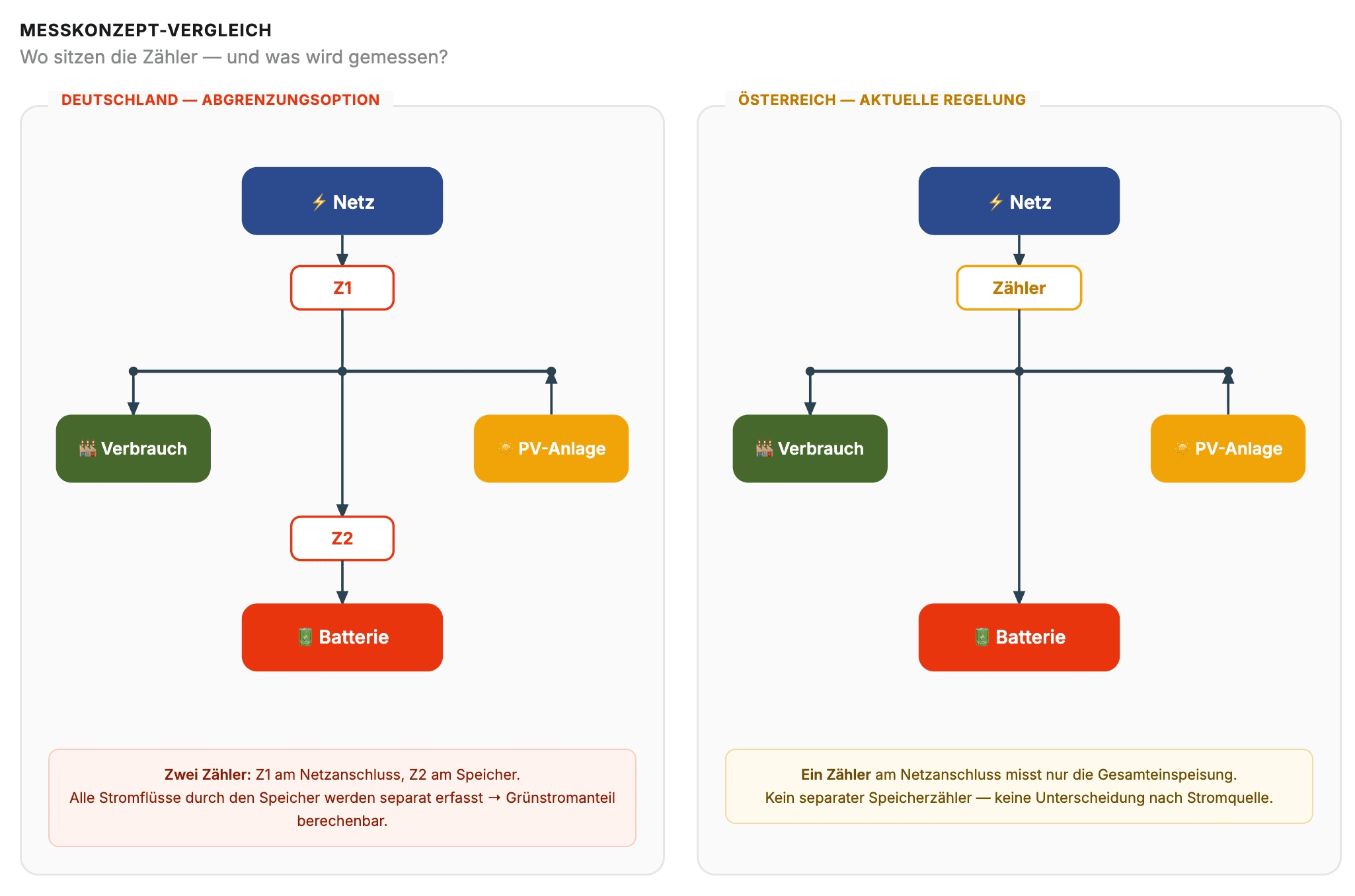
Delineation option (§19 para. 3b): Mixed operation with PV and grid power is permitted. The eligible share is verified quarter-hourly via a metering concept. Two calibration-law-compliant meters are required. The allocation follows two rules: grid power has priority for charging the storage system, storage generation has priority for grid feed-in.
Flat-rate option (§19 para. 3c): Simplified variant for systems up to 30 kWp. As a flat rate, up to 500 kWh per kWp of installed PV capacity counts as eligible. Only a bidirectional meter is required.
In a practical article we calculated the actual costs of the delineation option: for a 2 MWp project, the MiSpeL costs amount to €416/year — less than 1% of the feed-in tariff. We summarized the details on the metering procedures and allocation rules in a separate article on the MiSpeL key points. The BNetzA determination will be finalized by June 2026.
Austria: no exclusivity — but no regulation either
Anyone searching the Austrian EAG (Renewable Energy Expansion Act) for an equivalent of the German exclusivity option will not find one. The market premium under §9 para. 2 EAG applies to „electricity from renewable sources that is marketed and actually fed into the public electricity grid". However, the law contains no provision affecting battery storage systems that also charge grid power. The only storage-related exception in the EAG (§10 para. 1 no. 1) explicitly concerns pumped-storage power plants only.
OeMAG feed-in tariff and metering technology
The difference from Germany also lies in the metering technology. In Austria, a single bidirectional smart meter at the grid connection point is used by default. A separate generation meter behind the PV system - as is customary in Germany - generally does not exist.
OeMAG compensates on the basis of the feed-in meter. This measures how much electricity flows into the grid, but does not distinguish whether it comes directly from the PV system or from the storage system. A proportional reduction of compensation for grid power in the storage system is not provided for by law.
In practice, this means: the entire feed-in measured at the metering point is currently eligible for compensation — regardless of whether the storage system was also charged with grid power. Anyone checking the current 2026 OeMAG feed-in tariff will find no storage-specific restriction there.
Limitations and open questions
Two points should be noted:
For energy communities, an exclusivity rule applies: the storage system may only be charged via the PV system and not via the grid.
The market premium is formally tied to the issuance of guarantees of origin, which are issued on the basis of PV generation. With strongly arbitrage-oriented schedules — when the measured feed-in is significantly higher than the PV generation — this could become regulatorily relevant in the long term.
Battery storage funding in Austria: ElWG as an economic lever
While the question of the feed-in tariff for grey-power storage in Austria remains a regulatory gap, the new Electricity Industry Act (ElWG), adopted on 11 December 2025, has created an economically more relevant lever.
Under §127 para. 3 ElWG, energy storage facilities operated in a system-supportive manner are exempt from the supply-side grid usage and grid loss fees for 20 years. When charging the storage system from the grid — the most expensive part of operating costs — these fees are eliminated entirely. For the economic viability of a battery storage project, this is a bigger factor than the proportional market premium.
The exact criteria for system-supportiveness are set by E-Control through a regulation. The market consultation on this has been concluded; the new fee tariffs are to apply from 1 January 2027. For economic viability calculations, it is therefore advisable to model two scenarios: with and without grid fee exemption.
The ElWG also introduces, for the first time, a legal definition of energy storage facilities (§6 para. 1 no. 36/37), rules on virtual metering points (§110f) for hybrid systems and a flexibility market (§139).
In addition to the grid fee exemption, operators can also apply for an investment subsidy of up to €150/kWh (max. 50 kWh) for PV-storage combinations via the EAG processing office. These investment grants are one-off and independent of subsequent operation — whether or not the storage system is charged with grid power does not affect the funding. PV-storage funding and the market premium cannot, however, be combined.
SNAP: cheaper grid fees when charging in summer
Since 1 January 2026, there has been another lever for economic viability: the SNAP (summer low-period energy price). For customers on grid level 7 (households and small businesses), the energy-price component of the grid fee is reduced by 20% from 1 April to 30 September, between 10 a.m. and 4 p.m. each day.
In this time window, solar power is available in abundance and spot prices are typically low. Anyone charging the storage system from the grid then benefits twice: lower spot prices and reduced grid fees. For the economic viability of arbitrage models, this can be a relevant factor.
Limitations:
Quarter-hourly metering at the smart meter must be activated — the grid operator then takes the SNAP into account automatically.
The SNAP currently applies only to grid level 7. For commercial systems at higher grid levels, there is an optional flexibility tariff (NE 3/4), which requires an individual agreement with the grid operator.
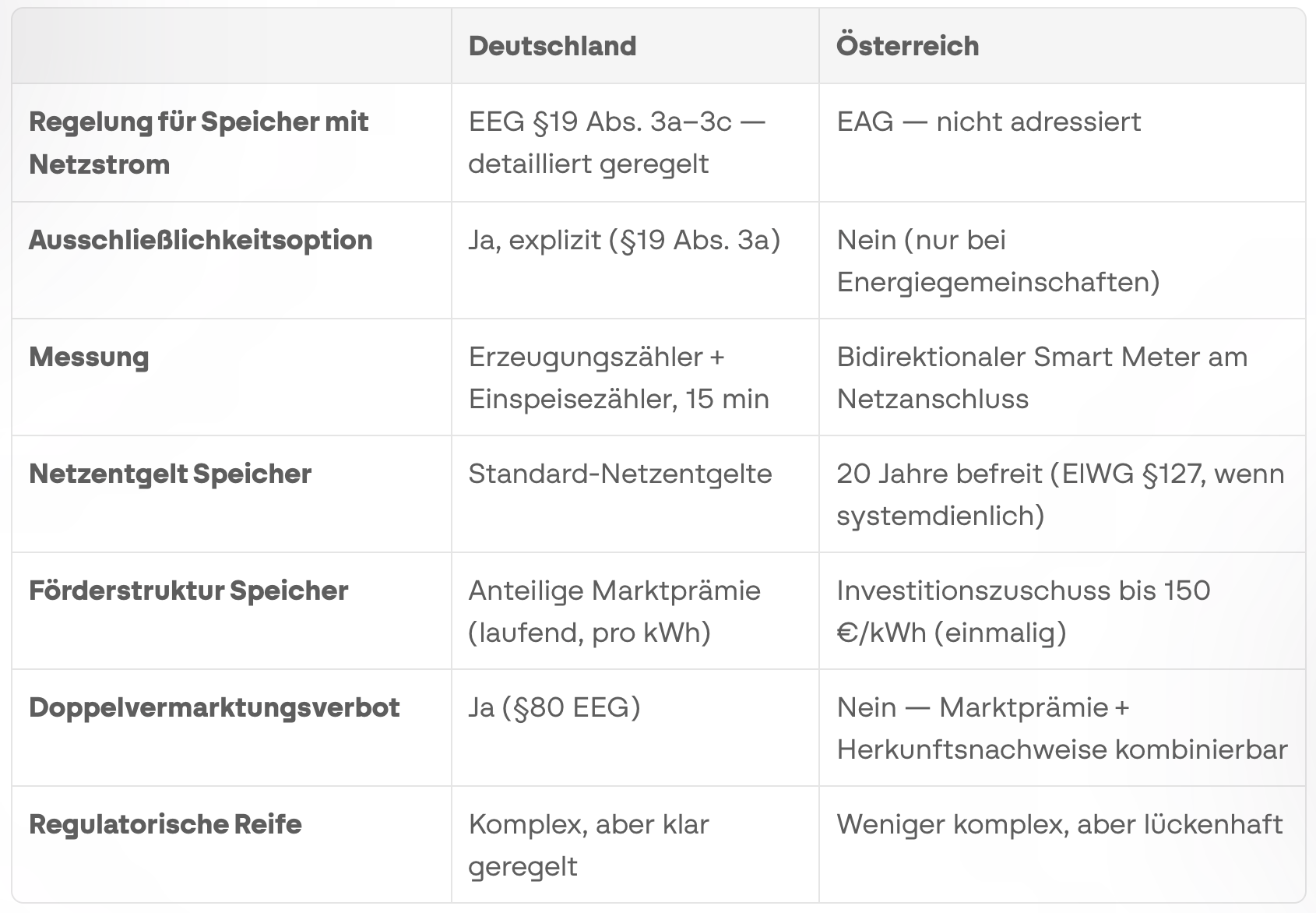
Comparison: Germany vs. Austria
Assessment for operators
Germany: The situation has been clear since MiSpeL. Mixed operation is almost always economically advantageous. The delineation option incurs low costs and enables full flexibility when charging with grid power.
Austria: Operators currently benefit from the fact that there is no exclusivity rule — mixed operation is de facto not restricted. This is, however, not an explicit permission but a regulatory gap. Operators should keep an eye on the following points:
The E-Control regulations on the ElWG — in particular the criteria for system-supportiveness and the grid fee exemption from 2027
The guarantee-of-origin issue with strongly arbitrage-oriented schedules
The regional grid fee differences — in Austria these vary considerably by federal state (e.g. Burgenland +16% vs. Salzburg −9% in 2026)
The SNAP discount for systems at grid level 7
Conclusion
Germany has regulated the mixed operation of PV storage systems with grid power over the years and, with MiSpeL, created a clear framework. Austria has not addressed the topic in the EAG — for operators, this currently means more flexibility with less bureaucracy.
In any case, the economically more relevant lever in Austria lies not in the feed-in tariff, but in the 20-year grid fee exemption of the ElWG and the SNAP tariff. Whether Austria will introduce subsequent regulation as battery arbitrage increases remains to be seen. Until then, it is advisable to keep an eye on E-Control's ElWG regulations.
Sources:
More Articles
Furo raises $4M from TQ Ventures, Neo and Sheryl Sandberg to build the operating system for industrial battery storage
Furo and LUOX Energy Launch Combined Solution for Optimizing Commercial and Industrial Battery Storage
MiSpeL Becomes Binding: Determination from October 2026, Transitional Phase until September 2027
Aging: Why Charging and Discharging an Industrial Battery Storage System for Arbitrage Doesn't Always Pay Off
Balancing Group and Balancing Energy: Why Storage Projects Lose Economic Viability During Operation
Why the dynamic rate plan is the first step toward flexible marketing, and what else you need