Aging: Why Charging and Discharging an Industrial Battery Storage System for Arbitrage Doesn't Always Pay Off

A battery storage system ages with every charge and discharge cycle, and that wear has a tangible economic value. How often and how intensively a system is cycled is part of what determines how long it lasts and when it has to be replaced. That is exactly why aging belongs in every credible business case — ideally already in the control logic of the storage system itself. This article explains why that is, how the cost of a cycle can be quantified, and what matters when you factor aging in from the start.
In our article "How battery storage systems really age and how we model it," we showed that battery aging follows a curve and belongs in every serious business case. That article was about representing aging correctly. Here we go one step further: we show how aging actively helps decide when charging and discharging is worthwhile, and how a storage system is controlled and sized.
Why aging has to be accounted for in storage control
A battery storage system doesn't last forever: every charge and discharge cycle consumes a piece of its limited lifetime. And that consumed piece has a real value in euros, because anyone who puts more strain on their storage system has to replace it sooner.
If this isn't accounted for in the control logic, the system may end up charging and discharging for even the tiniest price differences — even though the lifetime consumed in doing so costs more than the cycle earns. For a storage system to be operated in an economically sensible way, aging therefore has to be part of the calculation from the outset. Only then can you weigh up, for every single cycle, whether it is really worth it.
What exactly is cyclic aging?
Cyclic aging is exactly the effect you know from your phone: with every charge and discharge, the battery wears down a little and loses a tiny fraction of its capacity. After many charge cycles, the phone lasts noticeably less long than it did at the beginning — and the same thing happens with a battery storage system. The more often and the more intensively it is charged and discharged, the more this wear adds up.
What a lost piece of capacity is worth
Implementation in the control logic: aging gets a price.
Every cycle is assigned a price. With every charge and discharge decision, the system factors in how much lifetime that decision costs and weighs it against the revenue. A cycle is therefore only run if it genuinely pays off on balance.
But how can the "price" of a cycle be quantified in concrete terms? The reasoning behind it is as follows: every cycle costs a piece of capacity, and that piece of capacity has a value.
The value of a unit of capacity corresponds to what replacing it costs. So you divide the investment cost by the total capacity the storage system loses over its lifetime:
Value per unit of capacity = investment cost ÷ capacity loss until end of life
Put differently: if a storage system costs X euros and has lost a certain share of its capacity by the end of its lifetime, what does a single unit of that loss cost me?
Multiplying this value by the capacity loss accumulated over the year gives you the annual aging cost in euros. This is deducted from the annual cash flow before the net present value is calculated.
A practical side effect: this logic works regardless of whether the battery size is fixed in advance or chosen by the system itself. In both cases the calculation stays simple — and therefore just as fast as before.
The benefit doesn't lie in a higher net present value
One important point, to avoid misunderstandings: because aging is deducted from the cash flow as a cost item, the reported net present value tends to come out somewhat lower than in a calculation without this item — not higher. That is not a contradiction; it is the whole point. The net present value is more realistic because lifetime costs are priced in.
The real added value shows up in the operating pattern. The optimizer cuts precisely those cycles whose margin doesn't justify the lifetime consumed. The result is significantly fewer cycles at nearly the same revenue. Over the project lifetime, this means less strain on the storage system, slower aging, and therefore a later replacement investment — effects that a pure single-year view without aging costs simply cannot capture.
What changes in practice
How strongly accounting for aging affects results depends heavily on the operating strategy:
With an arbitrage-driven operating pattern using dynamic tariffs, over-cycling is noticeably dampened: charge and discharge events whose margin doesn't justify the lifetime consumed are simply not run.
With peak shaving, what stands out above all is that the operating pattern is already close to optimal anyway. So little cycling happens here that aging costs barely register.
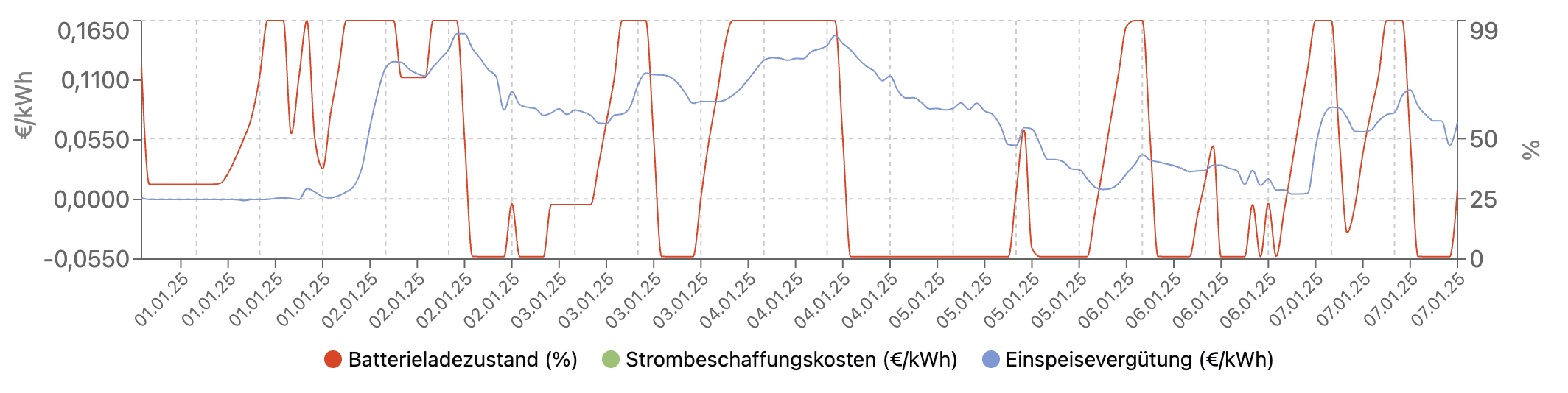
Without aging priced in
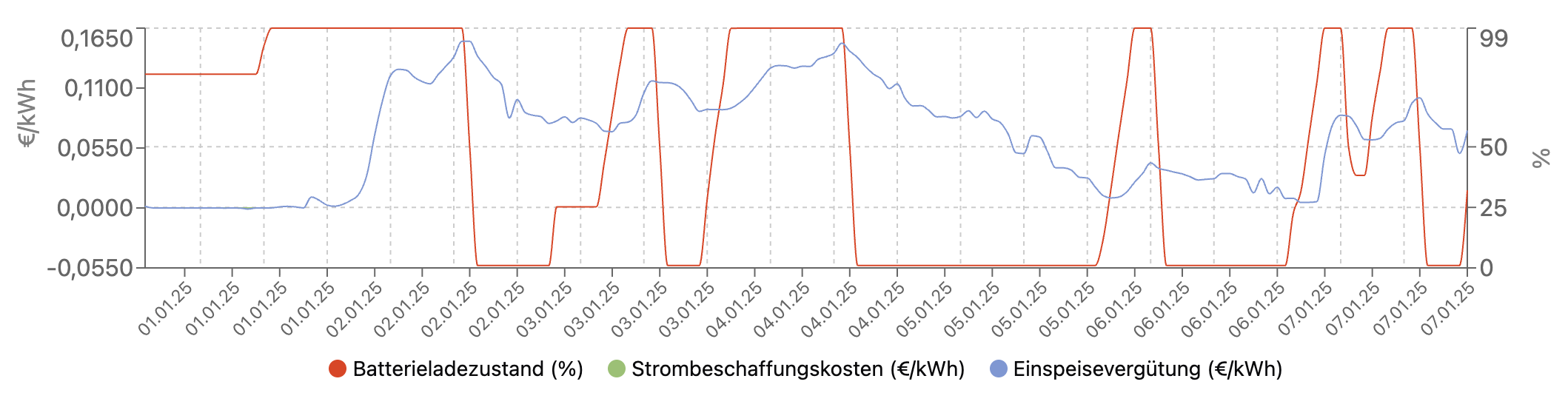
With aging priced in
Finally, with aging priced in, the optimizer can also conclude that no storage system pays off at all and set the size to zero. That, too, is a realistic result — and one that wouldn't have emerged without accounting for aging costs.
Conclusion
The optimizer now represents the cost of cycling in a way that is closer to reality and scientifically grounded: it accounts not only for the revenue of a cycle, but also for the lifetime that cycle consumes. For dynamic arbitrage, this prevents unnecessary cycling for minimal margins; for peak shaving, it confirms that the operating pattern is already right. Since the calculation stays simple and fast, aging is active by default in every analysis.
Sources:
- Kumtepeli et al., "Energy arbitrage with battery storage degradation modeling" (2024), arXiv:2403.10617
- Naumann et al., "Analysis and modeling of cycle aging of a commercial LiFePO4/graphite cell" (2020), Journal of Power Sources 451, 227666
- Collath et al., "Aging aware operation of lithium-ion battery energy storage systems: A review" (2022), Journal of Energy Storage 55, 105634
More Articles
Furo raises $4M from TQ Ventures, Neo and Sheryl Sandberg to build the operating system for industrial battery storage
Furo and LUOX Energy Launch Combined Solution for Optimizing Commercial and Industrial Battery Storage
MiSpeL Becomes Binding: Determination from October 2026, Transitional Phase until September 2027
Balancing Group and Balancing Energy: Why Storage Projects Lose Economic Viability During Operation
Why the dynamic rate plan is the first step toward flexible marketing, and what else you need
Trading spare capacity: how your battery earns money on the spot market on the side