From below to above 2,500 utilization hours with a battery storage system: When is the jump worth it – and when does it become a cost trap?
Utilization hours determine whether a company is classified as a low-volume user (under 2,500 h/a) or a high-volume user (over 2,500 h/a). It sounds like a formality – but it can make a difference of several thousand euros per year, because depending on the classification the grid fees change.
Under 2,500 h/a, the following typically applies: low capacity price, high energy price.
Over 2,500 h/a, the following typically applies: high capacity price, low energy price.
How utilization hours are calculated and why this “kink” exists is explained in this article.
This article addresses the practical question: Is it better to be below or above 2,500 h/a – and when is it worth crossing the threshold with a battery storage system?
What are utilization hours (briefly and clearly)?
Utilization hours are derived from annual consumption (kWh) divided by the annual load peak (kW).
Example: With an annual consumption of 1,000,000 kWh and a load peak of 450 kW, this gives 1,000,000 / 450 = 2,222 utilization hours per year. That is under 2,500 h/a, so the company is a low-volume user.
The big question: Stay below or go above?
Many people think: “Under 2,500 h/a is definitely cheaper.” That is not always true. The reason is simple: electricity costs essentially come down to two levers.
Energy price (euros per kWh): applies to every kilowatt-hour over the year
Capacity price (euros per kW and year): applies to the load peak
If the energy price in the high-volume-user tariff is significantly cheaper, this can offset or even overcompensate the higher capacity price. To get a quick sense of this without complicated calculations, a simple traffic-light rule helps.
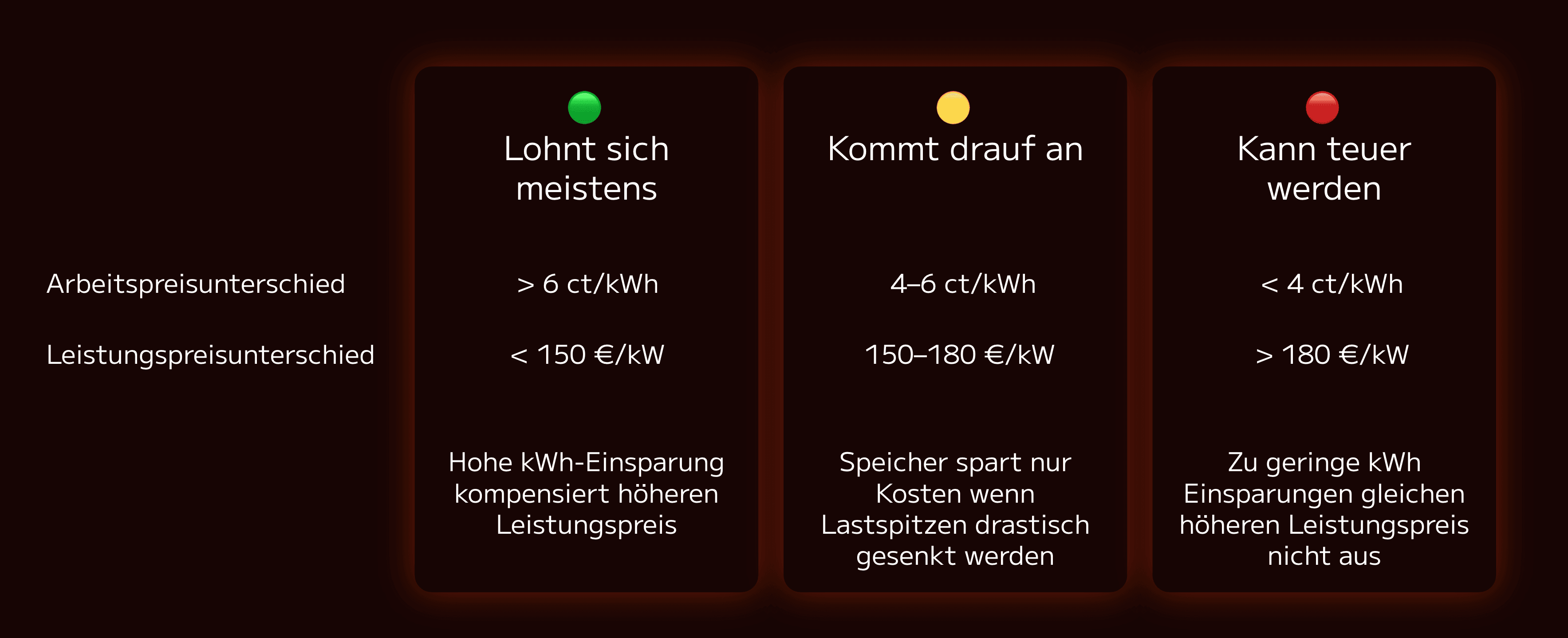
Traffic-light rule: When is “above” good – and when is it dangerous?
🟢 Green: Going above is usually worth it
This is often the case when the energy-price advantage in the high-volume-user tariff is large, for example at least 6 ct/kWh. Then every kilowatt-hour drawn saves so much that the higher capacity price is offset in many cases.
🟡 Yellow: It depends
This range typically applies when the energy-price advantage is only moderate, around 4 to 6 ct/kWh, and the capacity price rises significantly at the same time. In that case, economic viability depends heavily on how much the storage system actually reduces the load peak. In this range, a quick calculation is almost always worthwhile.
🔴 Red: Going above can become a cost trap
This often happens when the energy-price advantage is small (under 4 ct/kWh) but the capacity price rises sharply. Then you suddenly pay significantly more per kW, but do not save enough on the kWh to offset it.
Below before – above with storage: Calculation example (1,000,000 kWh/year)
To understand when the jump above 2,500 utilization hours is worthwhile, a concrete example helps. Here, only the load peak is reduced through peak shaving with a battery storage system. The annual consumption stays the same.
1) Starting point: Without storage (low-volume user)
Assumptions:
Annual consumption: 1,000,000 kWh
Load peak: 450 kW
Utilization hours: 1,000,000 / 450 = 2,222 h/a
Classification: Low-volume user (under 2,500 h/a)
Typical tariff logic in this range:
low capacity price
high energy price
2) With battery storage: Peak drops significantly (high-volume user)
Now a battery storage system is deployed that reduces the load peak.
New assumptions:
Load peak (with storage): 300 kW
Annual consumption: unchanged at 1,000,000 kWh
Utilization hours: 1,000,000 / 300 = 3,333 h/a
Classification: High-volume user (over 2,500 h/a)
Typical tariff logic in this range:
low energy price
high capacity price
The decisive factor here is: whether the switch actually brings advantages depends on how much the energy price drops and how much the capacity price rises. That is precisely why the same storage deployment can be very worthwhile in one case – and become a cost trap in others, depending on the tariff structure.
Two typical tariff structures: When is the jump uncritical – and when is it dangerous?
To make clear why crossing 2,500 h/a is not automatically “good” or “bad,” two scenarios with different prices help.
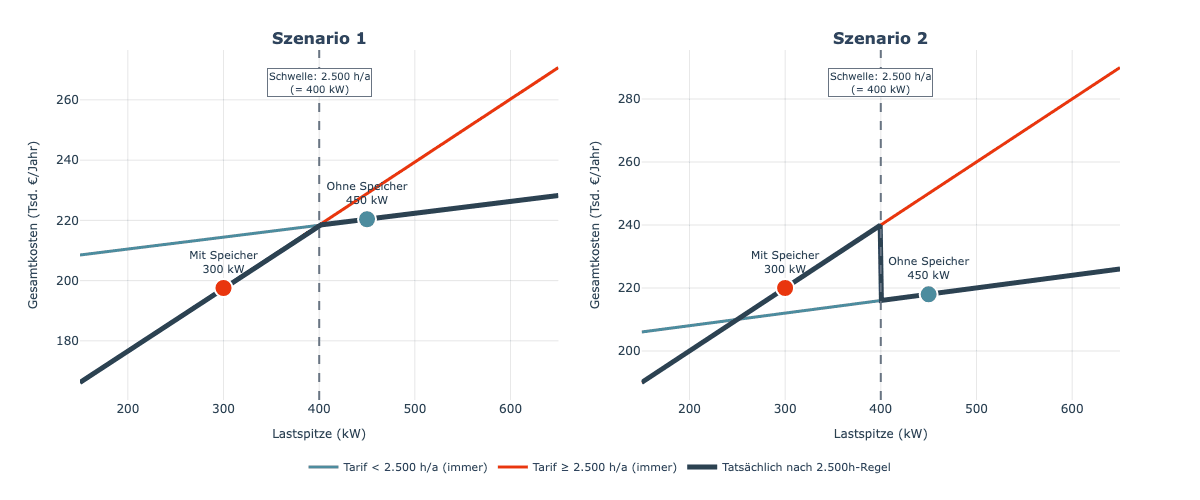
✅ Scenario 1: “Above” is usually uncritical (large energy-price advantage)
In this tariff structure, the energy price in the high-volume-user tariff becomes significantly cheaper. The advantage on the kWh is so large that it can often offset the higher capacity price.
Example tariff:
Under 2,500 h/a: energy price €0.2026/kWh, capacity price €39.46/kW·a
Over 2,500 h/a: energy price €0.1348/kWh, capacity price €209.12/kW·a
Costs:
Without battery storage:
Energy price: 1,000,000 kWh * €0.2026/kWh = €202,600
Capacity price: 450 kW * €39.46/kW·a = €17,757
Total: €220,357
With battery storage:
Energy price: 1,000,000 kWh * €0.1348/kWh = €134,800
Capacity price: 300 kW * €209.12/kW·a = €62,736
Total: €197,536
➡️ In this example, the total costs drop from €220,357 to €197,536 thanks to the storage system. That corresponds to a saving of €22,821 per year. The reason is the significantly lower energy price in the high-volume-user tariff. At the same time, the storage system reduces the load peak, so the high capacity price is applied to fewer kW.
❌ Scenario 2: “Above” can become a cost trap (small energy-price advantage)
Here the energy price in the high-volume-user tariff drops only slightly, while the capacity price rises sharply. In that case it can happen that the tariff switch ends up costing more despite peak shaving, because the capacity price outweighs the small kWh advantage.
Example tariff:
Under 2,500 h/a: energy price €0.20/kWh, capacity price €40/kW·a
Over 2,500 h/a: energy price €0.16/kWh, capacity price €200/kW·a
Costs:
Without battery storage:
Energy price: 1,000,000 kWh * €0.20/kWh = €200,000
Capacity price: 450 kW * €40/kW·a = €18,000
Total: €218,000
With battery storage:
Energy price: 1,000,000 kWh * €0.16/kWh = €160,000
Capacity price: 300 kW * €200/kW·a = €60,000
Total: €220,000
➡️ Despite peak shaving, the total costs in this example rise from €218,000 to €220,000. That is €2,000 in additional costs per year. The energy price does save €40,000, but the capacity price rises by €42,000 at the same time. In this scenario, the kWh advantage is too small to offset the kW jump.
Conclusion: It comes down to the prices
The same battery storage system can, for a company just under 2,500 h/a, either deliver significant savings or increase electricity costs. The decisive difference is not the 2,500-hour threshold itself, but the specific tariff structure of energy price and capacity price in the respective grid area.
It is important to note: even if, viewed in isolation, the jump above 2,500 h/a leads to additional costs as in Scenario 2, a battery storage system can still be worthwhile within the overall concept. In practice, the storage system is usually not used for peak shaving alone, but can also unlock further revenue and savings potential, for example through self-consumption optimization, arbitrage with dynamic tariffs, or participation in flexibility and balancing-energy markets. Anyone who factors in these additional use cases can come out positive overall even with an unfavorable 2,500-hour tariff switch. More on multi-use here.
In practice, a quick check is therefore always worthwhile: Is the energy-price advantage in the high-volume-user tariff large enough to offset the higher capacity price, and what additional revenue sources or savings can the storage system realistically unlock beyond that?
More Articles
Furo raises $4M from TQ Ventures, Neo and Sheryl Sandberg to build the operating system for industrial battery storage
Furo and LUOX Energy Launch Combined Solution for Optimizing Commercial and Industrial Battery Storage
MiSpeL Becomes Binding: Determination from October 2026, Transitional Phase until September 2027
Aging: Why Charging and Discharging an Industrial Battery Storage System for Arbitrage Doesn't Always Pay Off
Balancing Group and Balancing Energy: Why Storage Projects Lose Economic Viability During Operation
Why the dynamic rate plan is the first step toward flexible marketing, and what else you need