AgNes: What the new grid fee from 2029 means for your battery storage, and how to model it today

With the German grid fee reform AgNes (Allgemeine Netzentgeltsystematik Strom), the demand charge (Leistungspreis) disappears from 2029. Commercial and industrial customers will no longer pay grid fees on the highest load peak of the year, but a capacity price on an ordered capacity they set themselves. For multi-use battery storage this is good news: the expensive buffer for the annual peak is gone, and the full capacity is available for self-consumption and market trading. Our free AgNes calculator shows which prices and which ordered capacity to expect.
What is the AgNes grid fee reform?
With AgNes, the Federal Network Agency (Bundesnetzagentur) is redesigning grid fees. AgNes is set to apply from 2029 to every connection at medium voltage and above, and at low voltage from 100,000 kWh per year. Instead of a demand charge on the annual peak load, you pay a capacity price on the capacity you order, plus two energy prices:
Grid fee = KP × BK + AP1 × energy below BK + AP2 × energy above BK
KP is the capacity price, BK the ordered capacity (Bestellkapazität). Grid offtake below the ordered capacity is charged at the low energy price AP1, offtake above it at the higher AP2. Drawing more than you ordered is allowed, it just costs more. If you don't order anything, your grid operator derives the ordered capacity from your past load profiles. It doesn't know about changes on your side, such as a new battery.
How do I calculate the cheapest ordered capacity?
One extra kW of ordered capacity costs the capacity price once and saves the surcharge AP2 − AP1 in every hour in which your load is above it. The cheapest choice is therefore the load your site exceeds for h* hours per year:
h* = KP / (AP2 − AP1)
You can read it off the annual load duration curve. It plots every quarter hour of the year sorted by grid offtake, highest on the left, lowest on the right. At h* you read off the cheapest ordered capacity.
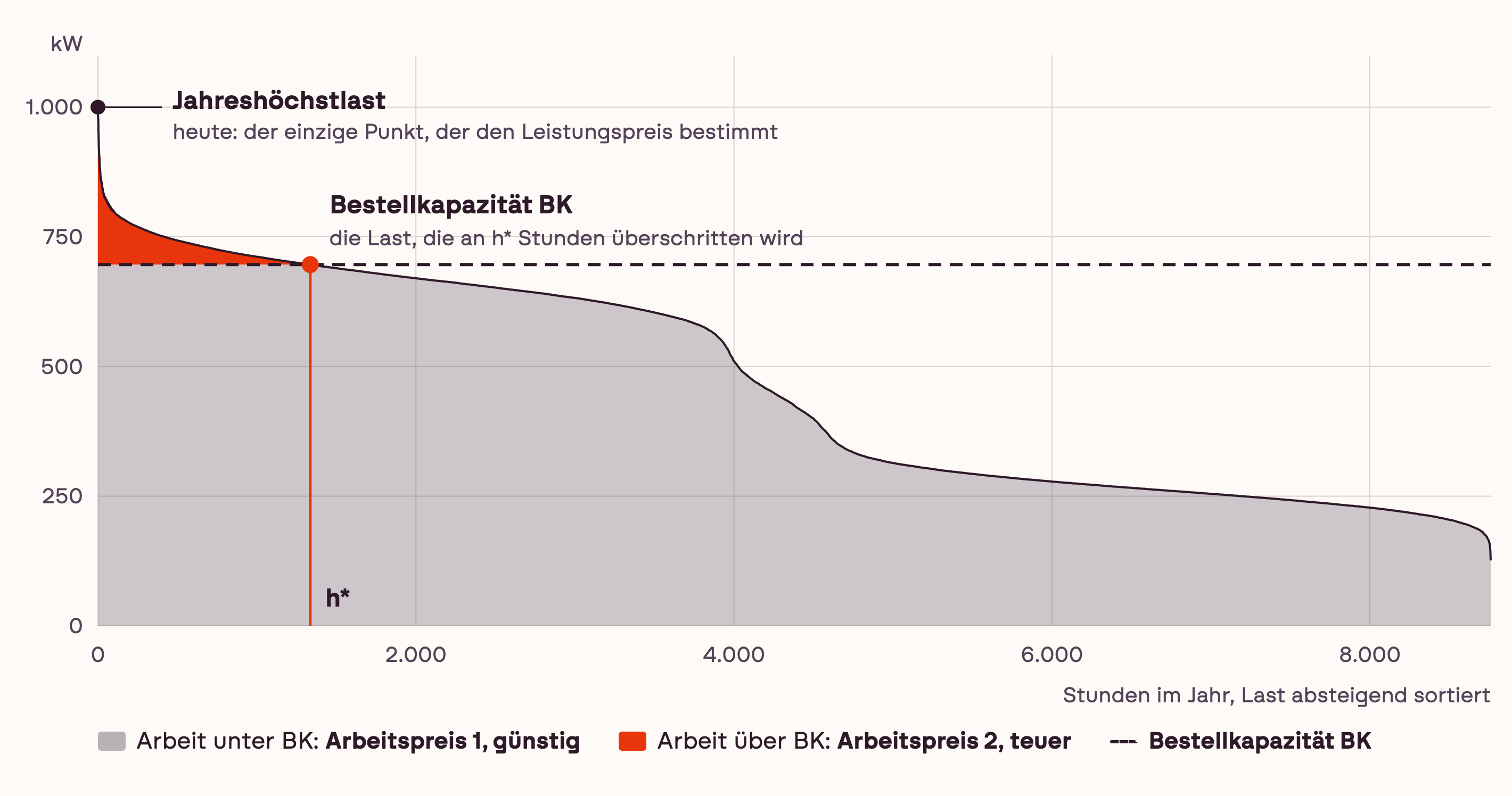
Annual load duration curve of an example site with the cheapest ordered capacity at h*.
Depending on prices, that is a few hundred to a few thousand hours per year. The ordered capacity is therefore usually well below the annual peak, and ordering the full peak to be safe wastes money. With our calculator you can calculate your ordered capacity for free, including the prices to expect in your grid area.
Example site in numbers
1,000 kW annual peak load, prices estimated with the AgNes calculator from a current medium-voltage price sheet.
- At h* = 1,335 hours, the cheapest ordered capacity is 697 kW.
- With 697 kW ordered capacity, the site pays €126,487 in grid fees per year. Ordering the full 1,000 kW to be safe costs €142,571, a good €16,000 more.
- If a battery on a dynamic tariff charges above the ordered capacity, the surcharge is 4.64 ct/kWh. Since January 2026, the spread between the three cheapest and the three most expensive hours of a day was larger on 93% of days, and about three times as large on a typical day.
What does AgNes mean for my battery storage?
Today, a single quarter hour sets the demand charge for the whole year. A battery that shaves peaks in addition to self-consumption and trading must therefore constantly hold a buffer for the next peak. If it still misses one, the savings for the whole year are lost. And the buffer is expensive, because the capacity it ties up earns nothing.
Under AgNes this risk disappears. If the site exceeds its ordered capacity, it only pays the surcharge AP2 − AP1 on the energy above it. A missed peak therefore costs the surcharge on a few kilowatt hours instead of a full year's demand charge. The battery no longer needs a buffer and can use its full capacity for self-consumption and flexibility trading.
On a dynamic tariff, a higher ordered capacity can pay off. The battery charges when electricity is cheap and discharges when it is expensive. While charging, the site draws more from the grid and is more often above its ordered capacity. For this energy it pays the surcharge AP2 − AP1. On the electricity market, however, the price difference between cheap and expensive hours is usually much larger than this surcharge, so charging still pays off. Because the site then draws a lot of power in more hours, the cheapest ordered capacity with a battery can be higher than without. We explain why the dynamic tariff is the first step towards flexibility trading in a separate article.
In addition:
- PV self-consumption becomes more valuable: every self-consumed kWh saves AP1, which is likely to be higher than today's grid fee energy price.
- According to the draft, flexibility trading pays no energy prices if the stored energy is metered separately. More on this in “Trading spare capacity”.
How do I model AgNes in Furo?
In the “Tariff & grid fees” card, switch on the “AgNes” toggle in the top right. Furo suggests the three prices from your grid operator's price sheet, determines the cheapest ordered capacity with and without a battery, and sizes the battery accordingly. Flexibility trading can be added. In the results you see the load duration curve with and without the battery, each with its ordered capacity.
Conclusion
AgNes removes the annual-peak risk from a multi-use battery and frees its full capacity for self-consumption and trading. Anyone planning a battery today should therefore model it with AgNes. The AgNes calculator gives you a first impression for your grid area and your load profile. Whether a battery pays off for your site is shown by the commercial battery storage calculator. You can model the full design with AgNes in Furo: try it free for 14 days.
--
Status: draft determination of 6 August 2026; the final determination is still pending. For the January status, see “New developments on grid fee reform: BNetzA orientation points”.
Source: Bundesnetzagentur, determination procedure AgNes (GBK-25-01-1#3), draft determination of 6 August 2026, sections 8.4, 8.5, 10.2 and 17. Procedure page
Frequently asked questions about AgNes
According to the draft determination, from 1 January 2029. The final determination by the Bundesnetzagentur is still pending.
Every connection at medium voltage and above, and at low voltage every offtake point with more than 100,000 kWh per year.
That is allowed. For the energy above the ordered capacity you pay the higher energy price AP2 instead of AP1.
The 2,500-hour rule disappears together with the demand charge: under AgNes there is one capacity price and two energy prices per grid level, regardless of utilisation hours. Atypical grid usage ends at the end of 2028 according to the draft. Only sites that draw more than 10 GWh per year on average over 2024 to 2027, already have an agreement and received a discount at least once in 2026 to 2028 keep it until the end of 2031. Anyone planning a battery for atypical grid usage today should therefore already model it as a multi-use battery under AgNes.
More Articles
Furo raises $4M from TQ Ventures, Neo and Sheryl Sandberg to build the operating system for industrial battery storage
Furo and LUOX Energy Launch Combined Solution for Optimizing Commercial and Industrial Battery Storage
MiSpeL Becomes Binding: Determination from October 2026, Transitional Phase until September 2027
Aging: Why Charging and Discharging an Industrial Battery Storage System for Arbitrage Doesn't Always Pay Off
Balancing Group and Balancing Energy: Why Storage Projects Lose Economic Viability During Operation
Why the dynamic rate plan is the first step toward flexible marketing, and what else you need