Battery storage and the 2,500-hour rule – What you need to know
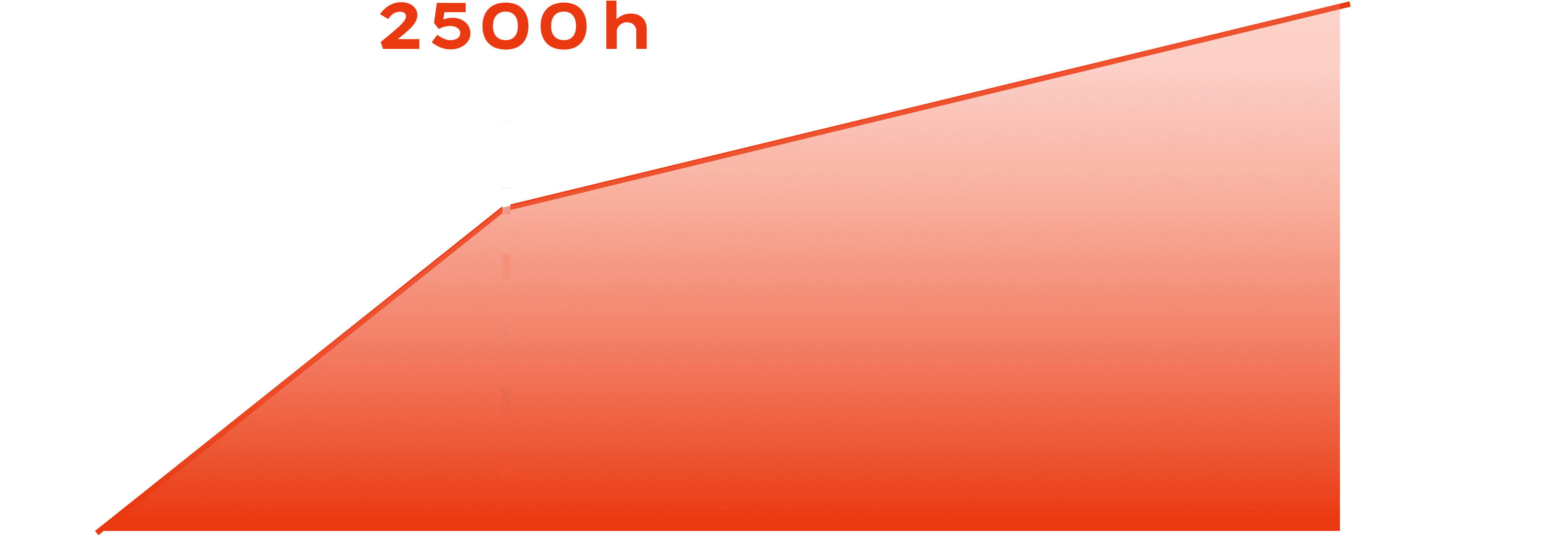
The 2,500-hour rule in the electricity sector is a special tariff arrangement for grid fees that primarily affects larger electricity consumers. It defines a threshold at 2,500 annual utilization hours, above which the calculation of grid costs changes significantly. The following explains what this rule is about and why it exists. We then look at the effects that installing a battery storage system (e.g. for peak shaving or self-consumption optimization) can have on this rule – including an example scenario with 500,000 kWh of annual consumption and approx. 200 kW peak load. Finally, we examine points of criticism of the rule and how the grid fee system could change in the future.
What does the 2,500-hour rule state and why does it exist?
Utilization hours indicate how many hours per year a consumer would theoretically draw on their maximum capacity at full load. Mathematically, this is the annual energy (kWh) divided by the highest power drawn (kW). This ratio serves as an indicator of how evenly the grid is utilized: an operation with a constant load has high utilization hours, whereas an operation with pronounced load peaks and otherwise low consumption shows low utilization hours.
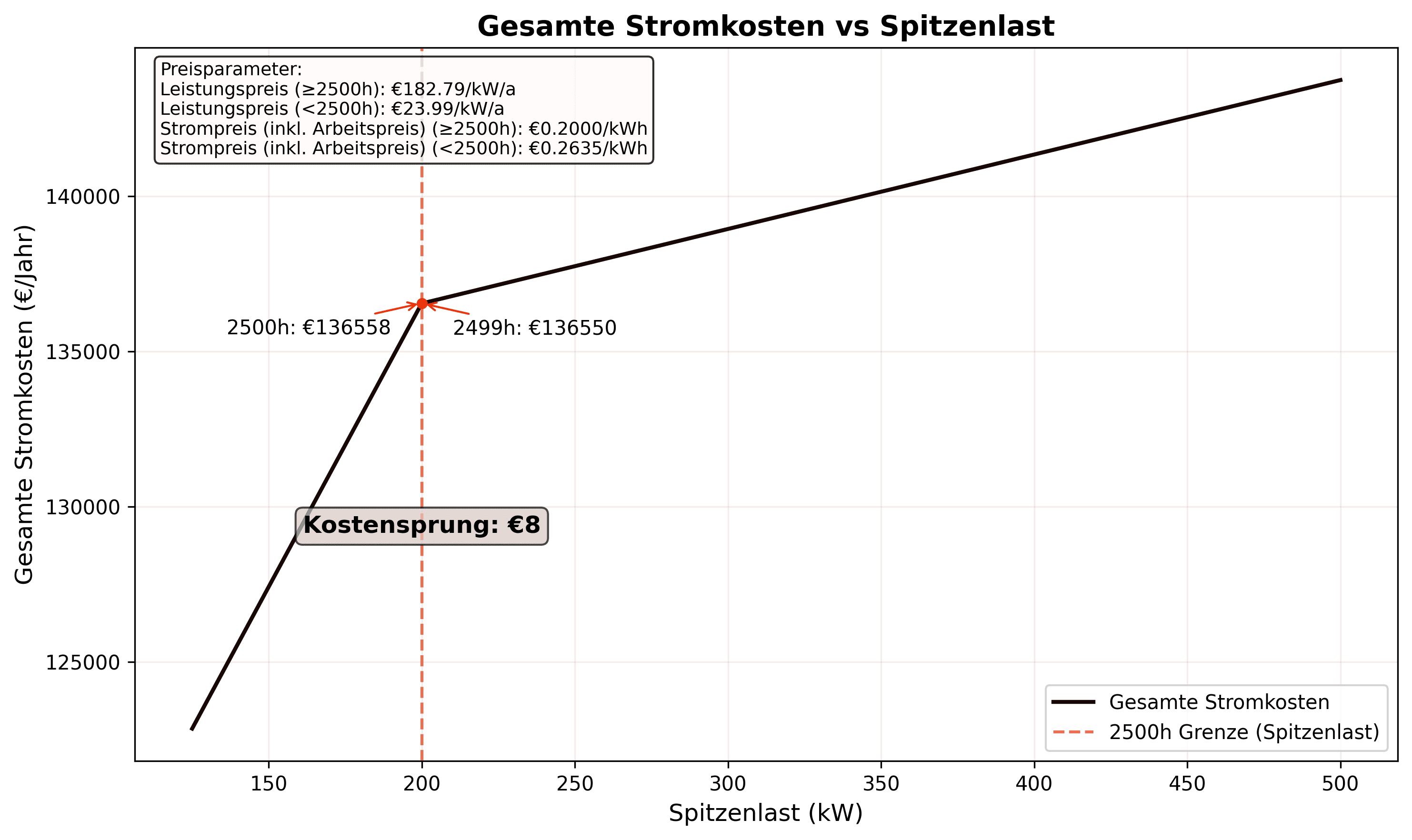
The chart shows annual electricity costs as a function of peak load at a constant annual consumption of 500,000 kWh. The prices correspond to medium voltage in the Bayernwerk grid. At the 2,500h threshold, the tariff structure changes: below it, a high energy price and a low demand charge apply; above it, the reverse. This leads to a pronounced kink in the slope of the cost curve – even when the absolute cost jump remains minimal (here: €8). Optimizing around this point is therefore economically sensitive.
The 2,500-hour rule creates a kink in the grid fee calculation. Up to 2,500 utilization hours, a comparatively low demand charge (€/kW) and a high energy price (ct/kWh) apply; beyond 2,500 h the ratio reverses – a high demand charge and a low energy price apply. In other words:
Less than 2,500 h/yr: The grid operator classifies the customer as a low-volume user. The annual demand component (for the maximum kW peak) is cheaper, but the energy component (for each kWh consumed) is more expensive. This model therefore benefits customers with irregular consumption and infrequent peaks – they pay relatively little for the provision of connection capacity, but a lot per kilowatt-hour consumed.
More than 2,500 h/yr: The customer is considered a high-volume user with an even load. Here, a high demand charge applies, while the energy price per kWh falls. A steady high power draw is therefore rewarded with favorable energy prices, but more must be paid for the continuously used grid capacity (high kW charge).
This two-part structure ensures that at exactly 2,500 h both tariff variants result in roughly equal grid fees. The threshold of 2,500 h was deliberately set in the German Electricity Grid Fee Ordinance (StromNEV), based on empirical values, in order to achieve a cost allocation that reflects who causes the costs [1]. Grid operators therefore structure their fees with four price positions: energy price and demand charge, each for <2,500 h and for >2,500 h. Small consumers with a standard load profile (without interval load metering) are unaffected by this and often pay flat-rate energy prices. For larger off-takers with load curve metering (RLM customers), however, this 2,500 h system applies automatically in most grid areas.
Why does this rule exist? The aim behind it is the fair allocation of grid costs to those who cause them and the creation of incentives for more efficient grid use. Electricity grids have high fixed costs, particularly for covering peak loads. Consumers with strongly fluctuating or irregular consumption burden the grid through high peaks and long phases of low usage. They are therefore expected to contribute more to the costs by paying higher energy prices. By contrast, steady consumers are relieved – those who use the grid more continuously receive cheaper kWh prices, but pay a higher base price for the capacity provided. Overall, this arrangement is intended to prevent peak-load causers from getting off more cheaply at the expense of everyone else, and instead to reward grid stability and even utilization.
Battery storage, peak shaving and the effects on the 2,500h rule
Battery storage systems can significantly influence a company's load profile – above all through peak shaving and self-consumption optimization. This produces a twofold effect on utilization hours:
Peak shaving increases utilization hours: When storage cuts load peaks, the maximum grid supply power (kW) decreases. The annual consumption drawn from the grid stays roughly the same (apart from storage losses), so that the consumption/peak ratio increases. High load peaks shorten the utilization hours; capping them increases them accordingly. A company that previously had, for example, 2,400 h of utilization can potentially reach >2,500 h through sufficiently large peak shaving. It would thereby move into the category with a higher demand charge and a lower energy price.
Self-consumption optimization lowers utilization hours: If less load is drawn from the grid by charging the battery instead of feeding PV power into it, the annual energy (kWh) falls and with it the utilization hours.
Caution: However, the 2,500h rule can have undesirable effects on the economic viability of a battery storage system. You have to analyze precisely which category the storage shifts you into and how the tariff structure changes:
If a company was just below 2,500 h, i.e. previously had a low demand charge and a high energy price, peak shaving can push it over the threshold. Then the demand costs rise abruptly and the energy prices fall. Without a cap on utilization hours, installing a battery that strongly reduces the load peak would, for example, cause the utilization hours to rise from ~2,400 to perhaps 3,300 – grid fees would be recalculated and could even increase. In our example (500,000 kWh, ~205 kW peak originally), the operation paid ~€28,000 in grid fees (as calculated above). Let us assume the storage reduces the peak to 150 kW (utilization hours ~3,333 h). Then the expensive demand-charge tariff applies: even if the energy price falls significantly, the high demand charge could wipe out the saving. The saving on grid fees through the storage would be small in this case – or, in the worst case, negative, if the high base fee means you pay more than you save on kWh costs.
In practice, therefore, care is often taken not to cross the 2,500h threshold unfavorably. The storage could, for example, be controlled so that the load peak is reduced but not too strongly – so that the utilization hours remain just below 2,500. It is preferable to keep a small residual peak load and stay in the "cheaper" tariff (with a low demand charge), rather than fully flattening the profile and slipping into the expensive demand charge. Put differently: a certain degree of peak shaving can make sense, but too much smoothing tips the cost ratio over. This optimization requires a careful simulation of the cost structure in advance, as is possible with Lumera, for example.
In summary: a battery storage system can optimize grid fees by reducing load peaks – but you have to keep the 2,500h effect in mind. For battery project developers in commercial & industrial settings, this means: before installation, both tariff states should be calculated. The key is to find out whether the storage moves the company into a different fee bracket and whether this ultimately saves costs or causes additional costs.
Criticism of the 2,500h rule and an outlook on future changes
While the 2,500-hour rule is well-founded from a historical perspective, it also faces criticism today. Critics object in particular to:
Hindering flexibility: The rigid separation between energy price and demand charge rewards as steady a power draw as possible, but penalizes flexible consumers. In times of the energy transition, however, it would be desirable for industry and commercial businesses to adapt their consumption flexibly to the electricity supply from renewable energy sources.
Rigid thresholds: Fixed limits (such as 2,500 h, or also 7,000 h for other special arrangements) lead to abrupt cost changes as soon as you fall just below or above them. These jumps are seen as unfair and economically suboptimal, because small changes in consumption behavior can lead to disproportionate tariff switches.
Regional differences and a lack of real-world relevance: Grid fees vary widely depending on the grid area, partly for historical reasons, which means that the same consumption can cause different costs at different locations – not always in proportion to the actual grid benefit. The 2,500h rule itself applies everywhere, but the exact value of the energy and demand prices is set locally.
In light of these points of criticism, it is foreseeable that the grid fee system – and with it the 2,500-hour rule – will be reformed. In fact, in July 2024 the Federal Network Agency presented a key issues paper for new industrial grid fees. It outlines a transition from rigid to flexible incentives [2]. In the future, industry and commercial businesses are to receive reduced grid fees if they consume more when electricity is abundant and less when electricity is scarce.
Excursus: Atypical grid usage and the right to choose at <2,500 h
A special case arises with so-called atypical grid usage (Section 19 (2) sentence 1 StromNEV). In this case, a final consumer whose annual peak load lies outside the high-load time windows defined by the grid operator can apply for an individual grid fee. In this case, the demand charge is no longer calculated on the basis of the annual peak load, but only on the basis of the concurrent load within the high-load time window – and for controllable assets such as battery storage systems, this can theoretically even be 0 kW.
Important: The utilization hours continue to be calculated in the classic way – that is, as
Utilization hours = annual energy (kWh)/annual peak load (kW)
even when the actual load peak lies outside the high-load time window. This can make grid fee models inconsistent: a consumer with few utilization hours would normally pay the high energy price, even though they barely burden the grid – for example through targeted charging outside the critical time windows.
For such cases, the Federal Network Agency therefore allows a right to choose: customers with <2,500 h may voluntarily opt for the tariff structure above the threshold – that is, a low energy price and a higher demand charge. However, since the demand charge is calculated on the basis of the (very low) concurrent high-load power, this can lead to a significantly lower total fee.
In practice, the optimal decision – whether to "stay below 2,500 h" or "exercise the option to choose" – depends on several parameters: the level of the annual peak load, the load distribution, the storage control, the grid area, and the high-load time windows. A suitable simulation tool such as Lumera can compare these options automatically and select the most economically advantageous variant. Only in this way can it be ensured that battery storage operators do not accidentally slip into an unfavorable grid fee model, but instead realize the full savings potential.
Conclusion and recommendations:
For developers of battery storage projects in commercial & industrial settings, this means that the planning of today's projects must take the 2,500h rule into account – but you should also keep an eye on the future. The current rule of thumb is: optimizing grid fees = smoothing the load profile, but without falling into the cost trap. Companies should be informed about why their storage may not deliver the hoped-for savings (keyword: the 2,500h threshold). At the same time, it should be pointed out that the framework conditions can change. In the transition period until then, it is all the more important to exploit all savings potential (including existing special fees under Section 19 StromNEV) and to adapt operating concepts to new rules where necessary. The 2,500-hour rule was a step towards fair cost allocation and created incentives for energy efficiency and load management. But with growing renewable generation and new technologies, it is reaching its limits. A modernization toward greater flexibility is emerging – which should ultimately benefit both grid operators and battery storage operators.
[2] https://www.bundesnetzagentur.de/SharedDocs/Pressemitteilungen/DE/2024/20240724_IndustrieNE.html
More Articles
Furo raises $4M from TQ Ventures, Neo and Sheryl Sandberg to build the operating system for industrial battery storage
Furo and LUOX Energy Launch Combined Solution for Optimizing Commercial and Industrial Battery Storage
MiSpeL Becomes Binding: Determination from October 2026, Transitional Phase until September 2027
Aging: Why Charging and Discharging an Industrial Battery Storage System for Arbitrage Doesn't Always Pay Off
Balancing Group and Balancing Energy: Why Storage Projects Lose Economic Viability During Operation
Why the dynamic rate plan is the first step toward flexible marketing, and what else you need