Self-Consumption Optimization & Peak Shaving
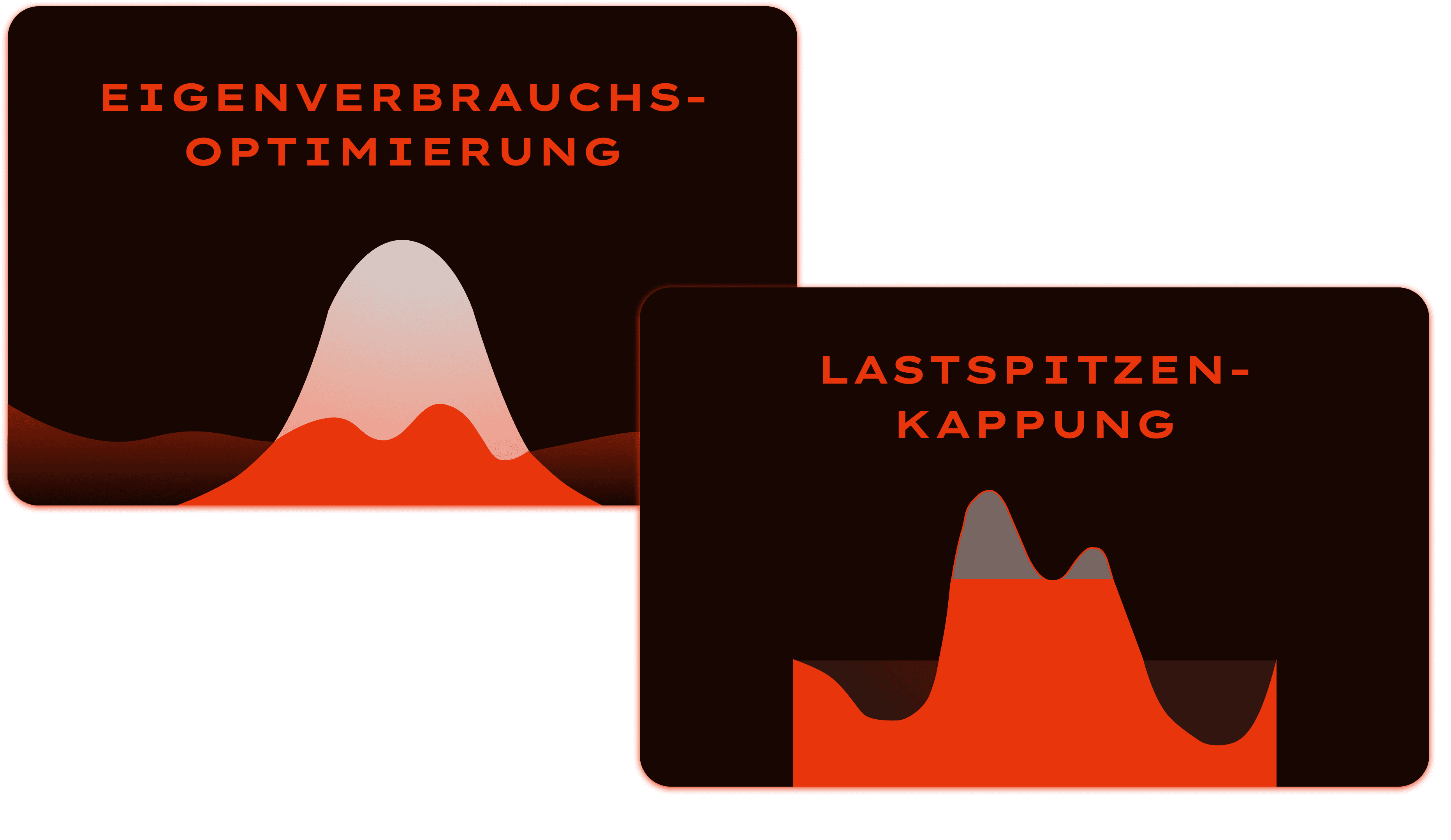
Battery storage is regarded as a key technology of the energy transition because it makes fluctuating renewable energy sources such as solar and wind power flexibly usable. Both private households and businesses can benefit from behind-the-meter (BTM) battery storage. BTM storage systems serve to reduce electricity consumption “behind the meter”, save on energy costs, and lower grid fees.
There are three core use cases that BTM battery storage can specialize in:
(1) Self-consumption optimization (using as much self-generated solar power as possible),
(2) Peak shaving (capping expensive load peaks in grid supply, also known as peak shaving), and
(3) a combination of both strategies.
In the following, these use cases are explained in a practical and easy-to-understand way – including their implementation in simulations as well as their deployment in real-world operation.
1. Self-Consumption Optimization – Using More Solar Power Yourself
Self-consumption optimization is about maximizing the share of self-generated power from a PV system. In practice, this means: when a lot of solar power is produced at midday, storing this surplus in the battery so it can be used in the evening or at night when needed. Without storage, surplus PV power often has to be fed into the grid (frequently at a lower feed-in tariff), while during low-sun hours electricity is drawn expensively from the grid. With a battery storage system, this gap can be closed.
How is this implemented technically? A simple control algorithm charges the battery whenever PV generation > consumption (surplus power) and discharges it when consumption > PV generation (deficit), as long as the battery level (state of charge, SoC) allows. In this way, grid supply is minimized. Mathematically, the self-consumption strategy can be formulated as cost minimization: electricity supply costs over a period are minimized by keeping the power drawn from the grid low and avoiding feed-in (for which there is only a low feed-in tariff). Put simply, the goal is: “Consume as much of your own solar power as possible, buy as little grid power as necessary.” In a simulation, this could be realized through an optimization model that decides, for each time interval, whether the battery should charge, discharge, or remain idle – while respecting battery capacity and power limits.
Implementation in energy management: Many energy management systems (EMS) today use forecasts for PV generation and consumption to control the battery proactively. For example, forecast-based battery charging can ensure that the battery has enough free capacity before a sunny day (so that no PV power goes unused) and is sufficiently charged before consumption rises in the evening. The challenges here lie primarily in forecast inaccuracies and sizing: if the battery is too small or charged incorrectly, it may run out early or be unable to absorb all of the surplus. Economically, too, it should be considered that storage solely for higher self-consumption does not pay off in all cases – many businesses already use ~60–70 % of their PV power directly, so storage often provides only marginal additional benefit that bears no relation to the costs. Nevertheless, some users value the increased independence from the electricity supplier and the long-term predictability of electricity costs, so they are willing to invest in storage to maximize self-consumption.
2. Peak Shaving – Smoothing Out Expensive Load Peaks
Peak shaving is a use case primarily for commercial and industrial electricity consumers. The aim is to cap short power peaks in grid supply, because in many electricity tariffs these cause high demand charges. Specifically, grid operators bill larger consumers an annual or monthly grid fee based on the highest power drawn (kW) within a billing period. Load peaks occur, for example, when several large machines start up at the same time or other consumption-intensive processes take place simultaneously. Even if such a peak lasts only a few minutes, it can substantially increase the electricity bill. This is where the battery storage system steps in as a buffer: as soon as consumption exceeds a defined threshold, the battery automatically supplies the additional power instead of drawing it from the grid. This limits the grid load to a maximum value (the “capped” peak), and the measured peak supply power remains lower. During periods of low load, the storage is then recharged from the grid or from surplus PV power to be ready for the next peak.
Example: If a company has a tariff with €100 per kW demand charge and normally has peaks up to 900 kW, then without storage ~€90,000 per year in demand charges alone would be incurred. A battery system could limit these peaks to, say, 800 kW, lowering the billed peak value – every avoided kW peak directly saves costs. In a practical example, a 100 kWh/50 kW battery storage system can reduce a load peak by 50 kW, which at a demand charge of ~€200/kW can mean roughly €10,000 in annual savings.
Technical implementation and simulation: In simulations, peak shaving is formulated as an optimization problem in which the maximum grid power is to be minimized. Mathematically, this can be expressed, for example, as minimizing the peak load $P_{\text{peak}}$:
$P_{\text{peak}} = \max_{t} \big( P_{\text{Last}}(t) - P_{\text{Batterie-Entladung}}(t) \big)$,
where $P_{\text{Last}}(t)$ is the power demand from the consumer's perspective and $P_{\text{Batterie-Entladung}}(t)$ is the power supplied by the battery. The battery should be controlled so that $P_{\text{peak}}$ becomes as low as possible. The optimization is carried out under constraints such as limited battery capacity and maximum discharge power. In practice, this can often be represented by choosing a threshold: e.g. “Draw at most 800 kW from the grid; the battery handles everything above that.” An EMS with a peak-shaving function continuously monitors the power and controls the battery in real time to flatten the load curve. What matters is an intelligent algorithm that recharges the battery immediately after a peak-shaving event so that it is ready for the next load peak, since load forecasts can often be inaccurate and a single “missed” load peak can already send the electricity bill soaring.
Challenges in application: Peak shaving requires adequate sizing of the storage for the individual load profile. The storage must hold enough power and energy to cover the typical peaks – very high but rare peaks may not be fully capped without maintaining an oversized (and uneconomical) storage system. Therefore, in planning the storage, an economically optimal threshold must be found at which capping takes place. Implemented correctly, peak shaving relieves not only the electricity bill but also the power grid – flatter load curves mean less need for grid expansion and reserve power plants, and thus a contribution to climate protection and grid stability.
3. Combining Both Strategies – The Best of Self-Consumption & Peak Shaving
In practice, battery storage systems are often sized to deliver several benefits at once in order to improve economic viability. Combining self-consumption optimization and peak shaving makes it possible to achieve synergy effects: the storage can absorb solar surpluses during the day and help reduce costs in the evening while also smoothing out brief power peaks. Such multi-use increases the benefit and significantly shortens the payback period of the storage. More advanced planning tools, such as Lumera Energy, therefore offer so-called multi-use concepts in which a battery storage system flexibly handles several operating modes.
How does the combination work? In principle, both strategies can be controlled with a prioritized set of rules. A simple solution is to reserve part of the battery capacity for peak shaving and use the rest for PV storage. For example, an energy management system can be configured as: “Always keep 30 % SoC free in the battery for peak shaving; use the capacity beyond that for PV self-consumption.” As long as the battery is charged above 30 %, it can absorb surplus solar power or discharge for the household (self-consumption mode). If the state of charge drops to 30 % or below, this remainder stays as a reserve that only kicks in when a grid load peak occurs (peak-shaving mode). However, the reserved 30% of the battery often sits unused in storage, which both prevents higher self-consumption and requires an oversized battery, thereby reducing economic viability.
A more modern solution is optimization models that account for both objectives in a shared objective function. In such models, the costs from energy supply (€/kWh) and demand charges (€/kW) are minimized together. This can be formulated as an optimization problem with the battery constraints (capacity, power limits, SoC continuity) and time series for PV generation and load. Such integrated optimizations make it possible to lower demand charges while simultaneously increasing self-consumption, delivering both financial savings and greater supply resilience.
Challenges and practical relevance: The combined operating mode considerably increases the demands on energy management. The goal is to avoid conflicts, for example: should the battery be fully charged for self-consumption on a sunny day, or must capacity be left free because a consumption peak might come in the afternoon? One solution is the reserve strategy mentioned above, or an intelligent forecast that, based on planned production or historical data, recognizes whether peaks are to be expected on the current day. Accordingly, the control system can set priorities dynamically – for example, using the full capacity for PV on a quiet Sunday, but being more cautious with discharge on a weekday morning in order to be prepared for midday peaks. Multi-use systems therefore require sophisticated software. Last but not least, economic viability plays a role: purchasing a large storage system is expensive, but combining several benefits creates additional revenue sources or savings potential. Studies and real-world projects show that only the combination of use cases (possibly supplemented by further services such as arbitrage trading or the provision of balancing energy) truly makes a battery storage system profitable.
Conclusion
Battery storage can offer different advantages depending on the use case. For businesses with demand-based tariffs, peak shaving is often the decisive lever for lowering energy costs while at the same time reducing grid load. The combination of both strategies makes it possible to fully exploit the potential of a storage system: day and night, for both energy supply and demand, the storage takes on a dual function. However, there is no one-size-fits-all solution – every project should be planned individually. Load profiles, PV generation, tariff structure, and business processes must be analyzed to find the optimal operating strategy. With the right sizing and intelligent energy management, however, a battery storage system is a powerful tool: it can help cut electricity costs noticeably, maximize self-consumption, and relieve the power grid – a win-win situation for operators and the energy system.
More Articles
Furo raises $4M from TQ Ventures, Neo and Sheryl Sandberg to build the operating system for industrial battery storage
Furo and LUOX Energy Launch Combined Solution for Optimizing Commercial and Industrial Battery Storage
MiSpeL Becomes Binding: Determination from October 2026, Transitional Phase until September 2027
Aging: Why Charging and Discharging an Industrial Battery Storage System for Arbitrage Doesn't Always Pay Off
Balancing Group and Balancing Energy: Why Storage Projects Lose Economic Viability During Operation
Why the dynamic rate plan is the first step toward flexible marketing, and what else you need