Multiple PV systems at one site – an overview of compensation, meters and billing rules
More and more commercial operations run PV systems from different installation years on the same roof. A system from 2010 with a high EEG feed-in tariff, an extension from 2017 at a significantly lower rate, perhaps even another addition from 2025. What appears confusing at first glance follows clear rules - provided you know the decisive differences.
This article explains:
which constellations arise with multiple PV systems at one site,
how compensation is calculated in each case,
when separate meters are required,
and how the rules on negative electricity prices affect mixed systems.
Why this topic is becoming relevant now
Since 2021, more PV systems reach the end of their 20-year EEG funding period every year. At the same time, existing systems are being supplemented with new ones – whether for higher self-consumption, to combine with a battery storage system or to participate in direct marketing.
The result: a single site increasingly hosts systems with very different compensation rates, commissioning dates and marketing models. For project developers and energy consultants, it is no longer enough to calculate with a single compensation rate.
The three typical constellations
Depending on which systems come together at a site, different rules apply for meters, compensation and billing. The three most common cases are examined individually below.
Case 1: Same form of sale, different vintages
Example: Two PV systems, both in the market premium model – one from 2010 at 39 ct/kWh, one from 2017 at 10 ct/kWh.
Meters
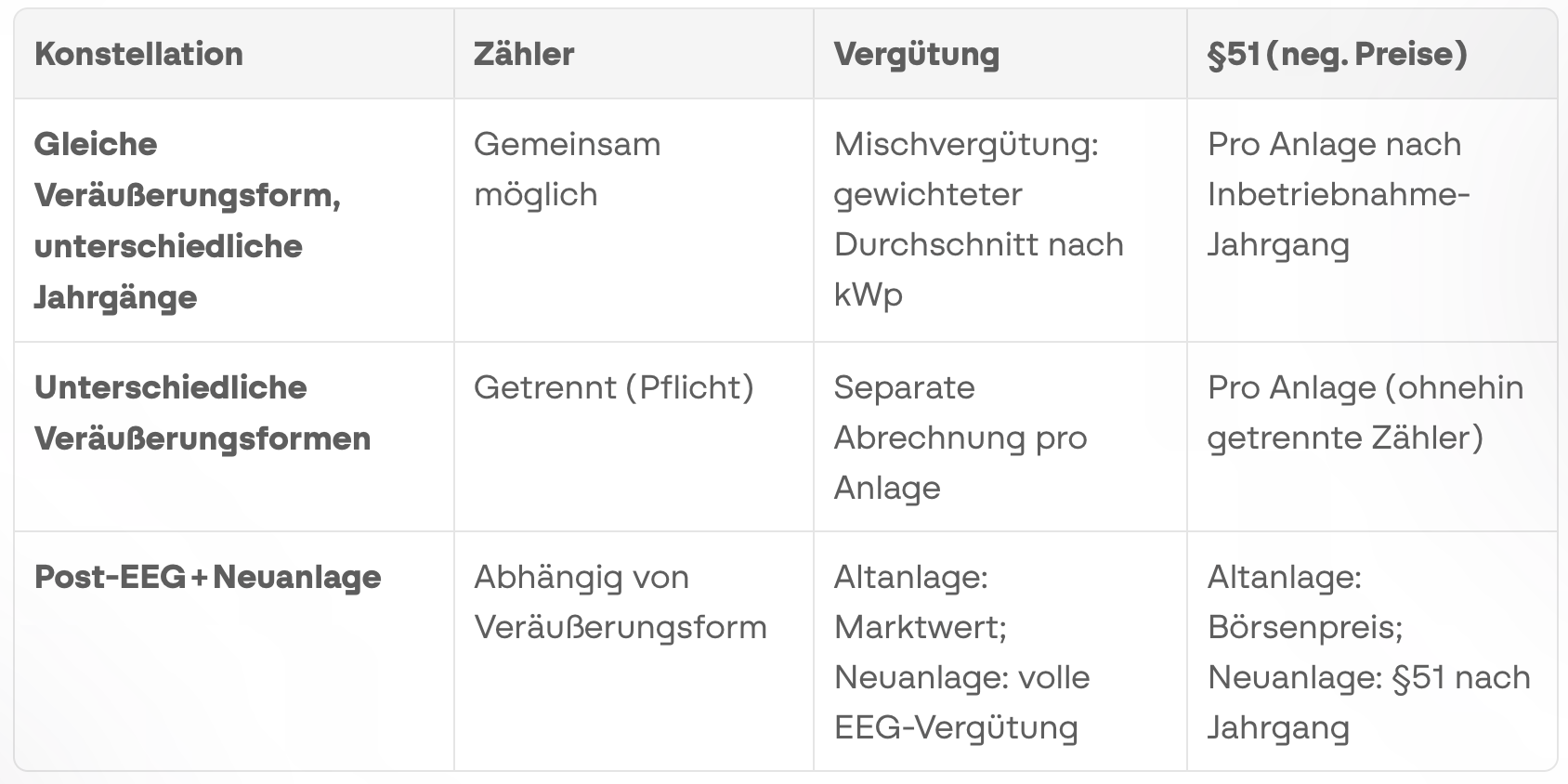
With the same form of sale (e.g. both market premium or both fixed feed-in tariff), the systems can be billed via a shared metering installation (§24 para. 3 EEG 2023). A separate feed-in meter for each system is not required.
Compensation: blended rate by kWp
The total metered feed-in is split proportionally by installed capacity (kWp) across the individual systems. Each system then receives its individual compensation rate. The result is a capacity-weighted blended rate.
Calculation example:
System A: 100 kWp, commissioned 2010, applicable value 39 ct/kWh
System B: 300 kWp, commissioned 2017, applicable value 10 ct/kWh
Blended rate = (100 × 39 + 300 × 10) / 400 = 17.25 ct/kWh
Important: The system aggregation under §24 para. 1 EEG – which combines systems commissioned within 12 consecutive calendar months into a single system – does not apply here, because the commissioning dates are years apart. Each system retains its individual compensation rate.
Negative electricity prices (§51 EEG)
The same applies to the compensation reduction due to negative electricity prices: each system retains the §51 version applicable at its commissioning date (§100 para. 46 EEG). The shared metering installation does not change this.
This means: during a negative-price phase, the systems can drop out of compensation at different points in time – depending on their individual threshold.

With 5 consecutive hours of negative exchange prices, the following happens:
System A (6h threshold not reached): its 40% share of the feed-in continues to be compensated at 10 ct/kWh.
System B (3h threshold exceeded from hour 3): its 60% share of the feed-in is set to 0 ct/kWh from the 3rd hour onwards.
The effective compensation of the overall system therefore decreases during the negative-price phase – but not to zero, as long as the older system is still within its threshold.
Case 2: Different forms of sale
Example: One system from 2012 with a fixed feed-in tariff, one new system from 2025 in direct marketing (market premium model).
Meters
As soon as the systems use different forms of sale, separate meters are mandatory. The Clearingstelle EEG (Frequently Asked Legal Question 123) explicitly rules out shared metering installations in this case.
The reasons:
Different metering requirements: Direct marketing requires quarter-hourly metering (§21b EEG), the fixed feed-in tariff does not.
Penalty for non-compliance: If billing is nonetheless carried out via a shared meter, compensation for all electricity is reduced to the market value MWSolar(a) – a drastic loss.
Compensation
Thanks to the separate meters, each system is billed entirely separately. A blended rate is neither necessary nor permitted. In practice, these are two independent systems that merely share the same grid connection point.
Negative electricity prices (§51 EEG)
Here too, each §51 rule applies individually per system. Since the systems are metered separately anyway, the allocation is unambiguous.
Case 3: Post-EEG system and new system
Example: A system from 2004, whose 20-year EEG funding expired in 2024, plus a new extension from 2025.
Meters
Whether a shared meter is possible depends on the form of sale under which each system is operated:
Both in direct marketing: Shared meter possible → Case 1 (blended rate)
Different forms of sale: Separate meters → Case 2
Compensation for the post-EEG system
Systems whose EEG funding has expired have several options:
Other direct marketing: The electricity is marketed on the spot market. The system receives the exchange price – no market premium, no guaranteed minimum price.
Follow-up arrangement (§21 para. 1 no. 4 EEG): For smaller systems up to 100 kWp, there is an entitlement to the market value less a marketing flat rate.
Compensation for the new system
The new system receives the regular EEG compensation applicable at its commissioning date – regardless of the fact that an older system is located at the same site.
Since the commissioning dates are far more than 12 months apart, no system aggregation under §24 para. 1 EEG takes place. The new system is treated as if the old one did not exist.
Negative electricity prices (§51 EEG)
The post-EEG system in other direct marketing only receives the exchange price anyway – so with negative prices, the compensation is automatically negative (or zero, if no power is fed in). For the new system, the current §51 rules applicable at its commissioning date apply.
Summary
Conclusion
Multiple PV systems on one roof are no longer a special case, but increasingly the norm. The regulatory basics are clear: systems with the same form of sale can be billed via a shared metering installation, compensation is split proportionally by capacity, and each system retains its individual §51 rules.
The challenge lies in representing this correctly in the economic viability calculation. Anyone planning a storage system and a new extension for an existing building with an old PV system must cleanly separate the different compensation mechanisms and negative-price thresholds. A single flat compensation rate leads to incorrect return expectations – too optimistic or too conservative, depending on the constellation.
For project developers, this means: before planning, check which case applies, clarify the meter setup and calculate compensation accurately for each system.
Sources:
§24 para. 3 EEG 2023 – Shared metering installation
§51 EEG 2023 – Compensation reduction with negative electricity prices
§100 para. 46 EEG 2023 – Transitional provisions
Clearingstelle EEG|KWKG, Frequently Asked Legal Question 123 – Shared metering installation
Clearingstelle EEG|KWKG, Frequently Asked Legal Question 264 – Compensation reduction with negative prices
More Articles
Furo raises $4M from TQ Ventures, Neo and Sheryl Sandberg to build the operating system for industrial battery storage
Furo and LUOX Energy Launch Combined Solution for Optimizing Commercial and Industrial Battery Storage
MiSpeL Becomes Binding: Determination from October 2026, Transitional Phase until September 2027
Aging: Why Charging and Discharging an Industrial Battery Storage System for Arbitrage Doesn't Always Pay Off
Balancing Group and Balancing Energy: Why Storage Projects Lose Economic Viability During Operation
Why the dynamic rate plan is the first step toward flexible marketing, and what else you need