No EEG Remuneration at Negative Electricity Prices – Current Regulations, Background and Economic Effects for PV Systems

Negative electricity prices now occur regularly on the German electricity market – particularly during sunny midday hours. For operators of photovoltaic systems, the key point here is: Negative exchange prices can lead to a complete loss of EEG remuneration.
This article explains:
how the EEG market premium model works in principle,
which regulations on negative electricity prices have applied since 2016,
what fundamentally changed on 25 February 2025,
what effects this has on new and existing PV systems.
Basic principle of the EEG market premium model
In the market premium model, the electricity fed in is marketed directly on the exchange. In addition, the system operator receives a market premium, so that overall the so-called applicable value results.
In simplified terms:
EEG remuneration} = applicable value - market price
Applicable value: legally defined remuneration rate (e.g. 6–8 ct/kWh)
Market price: day-ahead price on the electricity exchange
Historically, the decisive factor was: even at negative exchange prices, at least the applicable value was paid.
Development of the regulations on negative electricity prices
The legislator has progressively tightened the remuneration at negative prices. The aim was to reduce false incentives in cases of overproduction.
Overview of all relevant regulations for PV systems
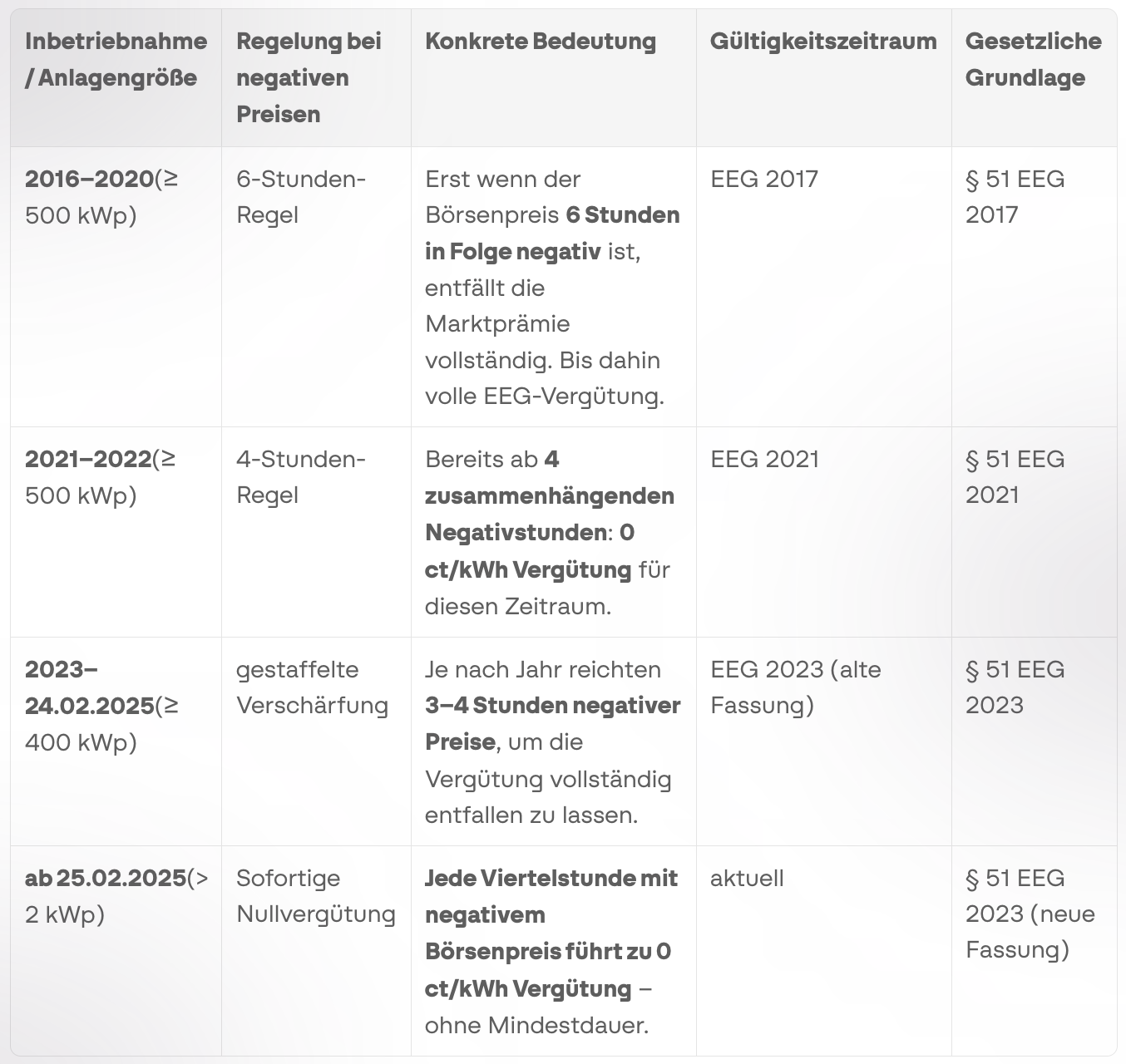
With the entry into force of the EEG amendment on 25.02.2025, the following applies to new PV systems:
As soon as the exchange electricity price is negative, the EEG remuneration is eliminated entirely.
This abolished the previous logic with a minimum duration (4- or 6-hour rule).
For new systems, the following applies: no more market premium at negative electricity prices, i.e. 0 ct/kWh remuneration during negative-price hours. This regulation applies on a quarter-hourly basis and affects almost all newly built PV systems.
Does this also apply to existing systems?
No.
For existing systems, the regulations that were decisive at the time of their commissioning continue to apply. The new immediate zero remuneration affects only new systems.
In practice, two parallel remuneration logics therefore exist:
Existing systems: remuneration despite negative prices (up to the respective threshold)
New systems: immediate loss of remuneration at negative prices
This distinction is absolutely essential for consulting, project planning and software simulations.
Economic effects in practice
Negative electricity prices today typically occur for 400 to 800 hours per year. These hours fall disproportionately often in periods of high PV generation.
The consequence:
disproportionate revenue losses
especially for south-facing new systems
depending on the market year and location, 10–20% lower annual revenues possible
Conclusion
The remuneration of photovoltaic systems in the EEG market premium model has changed fundamentally in recent years. Whereas negative electricity prices previously led to a loss of remuneration only in exceptional cases, a clear rule has applied to new PV systems since 25 February 2025: at negative exchange electricity prices, no EEG remuneration is paid anymore.
This change has noticeable economic effects, as negative prices increasingly occur during high-yield hours. For new systems, this can lead to significant revenue losses, particularly in the case of classic south orientation without flexibility options. Although existing systems are not affected by the new regulation, two different remuneration logics now exist in practice that must be clearly separated from one another.
For planning, consulting and economic viability calculations, this means: models that do not explicitly take negative electricity prices into account no longer correctly reflect the current legal situation. For new systems in particular, zero-remuneration periods, curtailment and storage options must be realistically simulated.
The development clearly shows that flexibility – for example through battery storage or load-side control – is becoming increasingly important. A precise representation of the EEG regulations is therefore not only a legal necessity, but a central factor for robust investment decisions in the photovoltaics market.
More Articles
MiSpeL Becomes Binding: Determination from October 2026, Transitional Phase until September 2027
Aging: Why Charging and Discharging an Industrial Battery Storage System for Arbitrage Doesn't Always Pay Off
Balancing Group and Balancing Energy: Why Storage Projects Lose Economic Viability During Operation
Why the dynamic rate plan is the first step toward flexible marketing, and what else you need
Trading spare capacity: how your battery earns money on the spot market on the side
Plant Certificates for Battery Storage: When You Need One, What It Costs, and How the Process Works