More Revenue Through Trading with Battery Storage
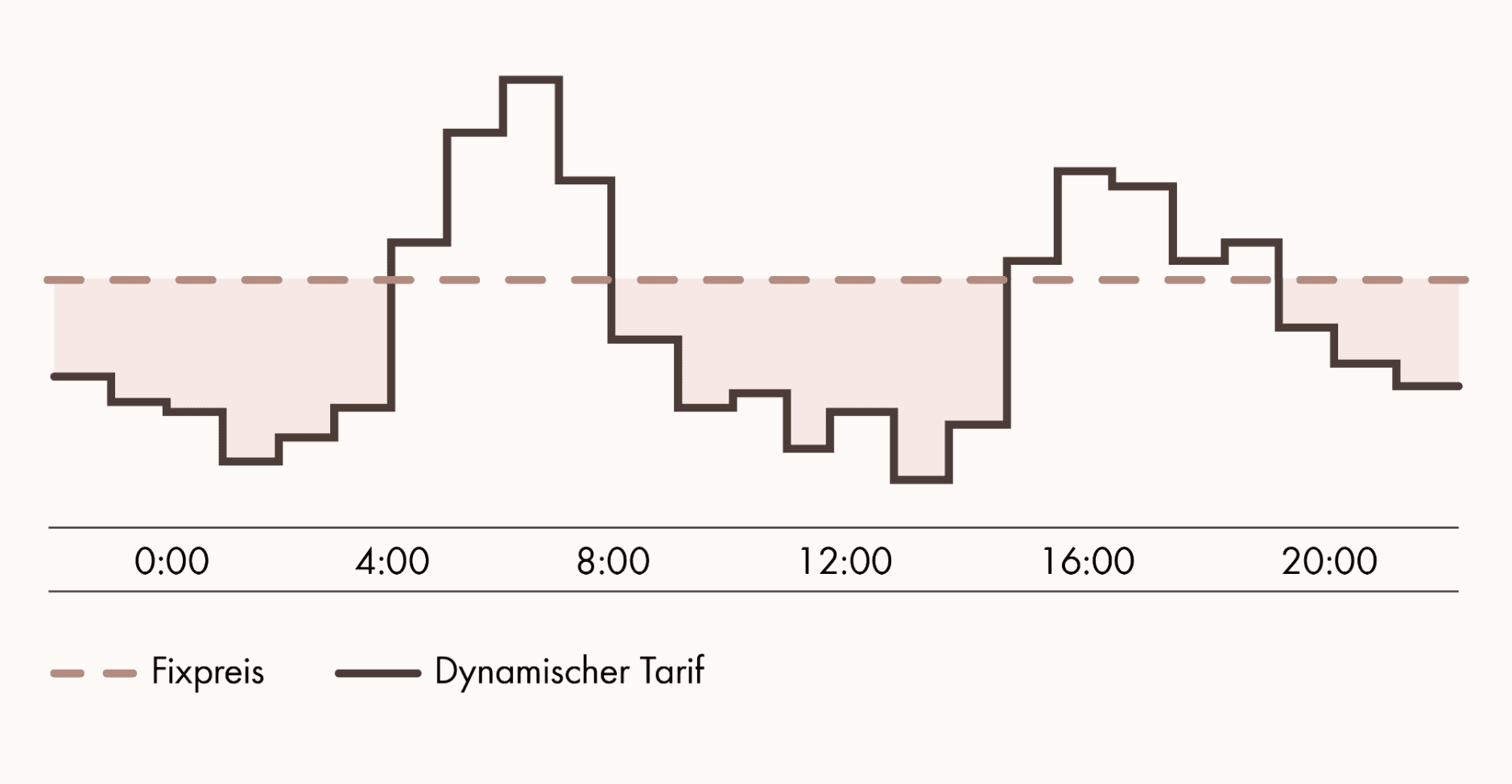
Integrating stationary battery storage into commercial and industrial projects is becoming increasingly attractive, not only because of self-consumption optimization or reduced grid fees, but also through additional revenues on the electricity market. Project developers planning storage solutions today should factor in the opportunities and challenges of market integration from the very start.
Market Participation Options for C&I Battery Storage
Commercial and industrial businesses can use battery storage for market participation in different ways. Fundamentally, two models exist:
Hybrid use of the same battery for behind-the-meter (BTM) and front-of-meter (FTM) – i.e. a single battery storage system handles both internal operational tasks (e.g. peak shaving, self-consumption optimization) and grid or market services (e.g. providing balancing power, electricity trading).
Use of separate battery storage systems for BTM and FTM – i.e. two separate storage systems: one dedicated to internal company purposes, while the other is operated exclusively for the electricity market (as a standalone facility with a grid connection).
Comparison: Hybrid Dual Use vs. Separate Storage
To contrast the two approaches, Table 1 shows the key characteristics, advantages, and disadvantages:
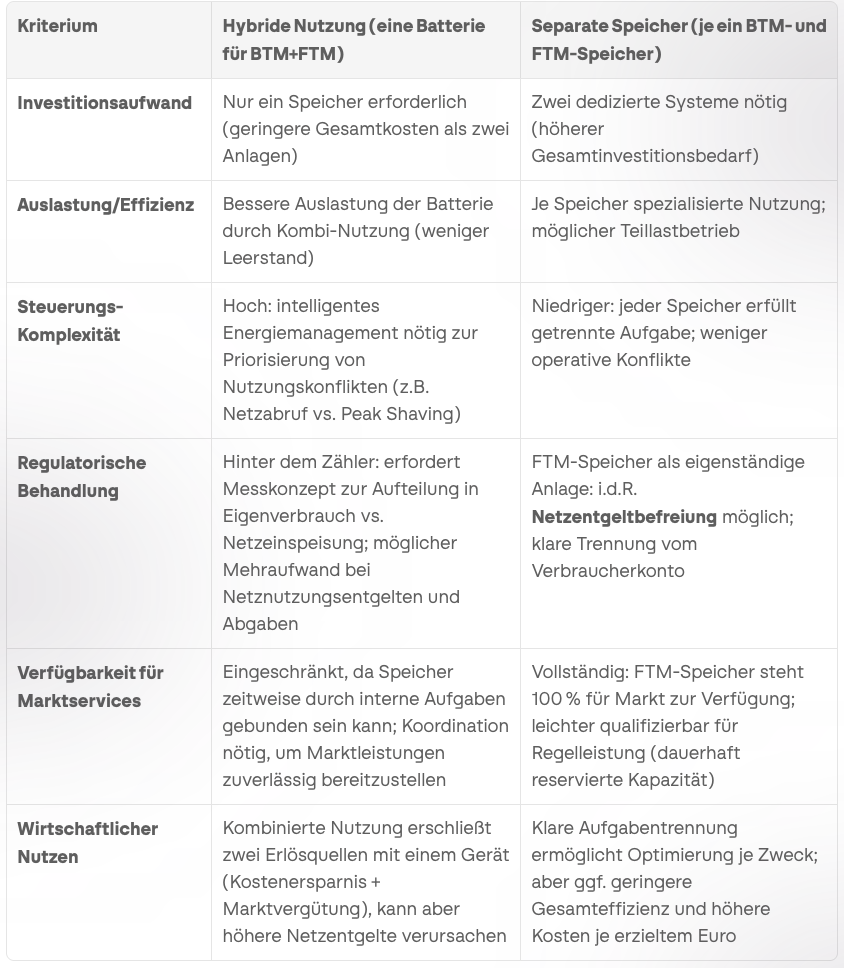
In many cases, the dual use of a battery storage system appears advantageous, since it can reduce energy costs and generate new revenues at the same time . For example, an industrial storage system can absorb solar surpluses during the day and shave load peaks in the evening, while at other times providing free capacity for grid services . This dual use unlocks additional revenue streams and increases the profitability of the investment in a battery storage system .
However, the operational and regulatory requirements for a hybrid deployment are higher. Some energy service providers therefore recommend a separated approach: EnBW, for instance, focuses its battery marketing on storage systems without a self-consumption background – the benchmark is ≥ 1 MW of power and 1 MWh of capacity, used exclusively for the market [1]. Such a stand-alone storage system can be operated optimally on the balancing and spot markets, independent of consumer loads.
Practical Challenges of Hybrid Models
Combining BTM and FTM applications in a single storage system places special demands on technology, market processes, and organization. In detail, the following challenges are relevant:
Energy Management and Control of Hybrid Applications
A high-performance energy management system (EMS) is indispensable for operating a battery storage system simultaneously for self-supply and market participation. The EMS must coordinate multiple uses in real time – e.g. sending grid control signals to the battery without jeopardizing local security of supply or the peak-shaving strategy.
Such hybrid use cases place high demands on hardware and software. In many projects, integration with a virtual power plant is implemented: a remote control unit connects the battery to the aggregator. At the same time, a local EMS keeps an eye on on-site operations (state of charge, load profile, etc.). In any case, the energy management must ensure that minimum storage levels, power reserves, and response times are maintained, so as not to violate external commitments (e.g. providing balancing power).
Minimum Bids and Aggregation of Capacity
Many lucrative electricity markets require minimum sizes for bids that individual C&I battery storage systems often cannot reach on their own. For primary balancing power (FCR), a typical minimum capacity of 1 MW still applies, while for secondary (aFRR) and tertiary balancing power (mFRR) it is usually 1–4 MW, depending on the transmission system operator. In practice, the aggregation of multiple decentralized storage systems via an aggregator is therefore usually necessary to pool marketable capacity.
By contrast, the barriers to entry in day-ahead and intraday trading are significantly lower: here, the minimum bid size is just 0.1 MWh (100 kWh). This means smaller storage systems can also participate directly – provided they have access to the trading infrastructure. Nevertheless, many aggregators or direct marketers pool small installations in order to trade larger blocks efficiently and reduce transaction costs.
Balancing Group Management and Risks (Forecast Deviations, Schedules)
As soon as a battery storage system feeds energy into the public grid or draws from it, this must take place within a balancing group. Every market participation therefore requires a balancing group manager (BKV) – usually an energy supplier or direct marketer – who is responsible for schedule reporting and volume balancing vis-à-vis the transmission system operator.
For FTM storage systems (i.e. storage with its own grid connection), this role is usually taken on by the direct marketer. The setup is comparatively simple, since the storage system is operated as a standalone facility with a clearly defined feed-in and withdrawal point.
For BTM storage systems (behind the meter), the situation is more complex: the battery shares the grid connection with other consumers, which makes precise metering and separation of self-consumption and market feed-in necessary. This requires setting up a separate sub-balancing group, which not only means additional technical and administrative effort but also requires suitable partners. In practice, the market integration of BTM batteries often fails because no BKV is willing to take on responsibility for the complex and risky balancing group.
In addition, BKVs bear the risk of forecast deviations: for the schedules, feed-in and withdrawal profiles must be reported with quarter-hourly precision. A storage system that is both a generator and a consumer – as in hybrid use – can be hard to predict. If the actual output deviates from the reported plan (e.g. due to unplanned self-supply coverage), balancing energy costs arise that can weigh heavily on the economics.
For these reasons, a separate FTM storage system is the more pragmatic solution in many cases: it can be delineated more clearly in technical terms, integrated more easily from a regulatory standpoint, and is more readily accepted by marketers.
Conclusion: Market Integration, Yes – But With the Right Setup
For commercial and industrial businesses, battery storage today offers far more than just peak shaving or self-consumption optimization. Participating in the electricity market – whether through balancing power or trading – unlocks additional revenue potential and significantly improves economic viability. But the path there is demanding: market processes, technical requirements, and regulatory specifications call for a well-thought-out concept.
The hybrid use of a storage system for BTM and FTM purposes sounds economically attractive, but is often only feasible with considerable control effort and additional risks. Balancing group management in particular represents a key hurdle for BTM batteries, since it requires precise metering and data allocation as well as a balancing group manager who is willing to take on the complex schedule responsibility – which in practice is often not the case.
Separately operated FTM storage systems offer clear advantages here: they are technically clearly delineated, easier to integrate from a regulatory standpoint, and considerably easier to trade from the perspective of direct marketers and aggregators. FTM storage systems are also often the preferred solution for prequalified participation in balancing power markets.
Project developers should therefore weigh up early on whether a combined model is actually economically and organizationally viable – or whether a dedicated market storage system as an FTM facility might be the more sustainable way to unlock market opportunities efficiently. An intelligent EMS, a strong aggregator, and a clean metering concept are indispensable in both cases.
More Articles
Plant Certificates for Battery Storage: When You Need One, What It Costs, and How the Process Works
Lumera Energy becomes Furo
How battery storage really ages and how we model it
Charging a PV storage system with grid power: comparing the rules in Germany (MiSpeL) and Austria
Multiple PV systems at one site – an overview of compensation, meters and billing rules
A systematic electricity supply contract: why the choice of model matters more than the PPA price