A systematic electricity supply contract: why the choice of model matters more than the PPA price

In our previous article "When the electricity doesn't belong to the consumer: calculating operator models and PPAs correctly" we explained why two perspectives always have to be considered with PPAs: that of the operator and that of the offtaker. This article goes one step further. Here we show which model variants exist, how ownership and remuneration can be combined, and which levers determine whether a PPA works out economically for both sides.
Why onsite PPAs are changing PV direct marketing
In classic direct marketing of PV electricity, the energy flows via the grid to the exchange. With an onsite PPA, the electricity stays where it is generated - on the offtaker's site.
The offtaker saves grid fees and electricity costs without investing themselves
The operator receives predictable revenues over the contract term
Not every PPA is structured the same way. Depending on how delivery and payment are arranged, three basic types are distinguished:
Pay-as-produced: The offtaker pays for the amount actually produced, regardless of whether they are consuming the electricity at that moment or not.
Pay-as-consumed: Payment is made only for the amount the offtaker actually consumes on site. Surplus amounts flow into the grid or storage.
Pay-as-nominated: Delivery and payment are based on amounts defined in advance, typically on a daily basis.
Lumera calculates PPAs according to the pay-as-consumed principle: the offtaker pays only for the electricity they actually consume. Surplus PV electricity is either remunerated via grid feed-in or stored in the battery. This corresponds to the common billing model for onsite PPAs.
The first decision: who owns the system?
Before it comes to prices or remuneration, there is a fundamental question: who owns what?
Combined model: The operator invests in PV and battery, the offtaker draws the electricity via a PV contracting model. The investment risk lies entirely with the operator. In return, feed-in revenues also flow to them.
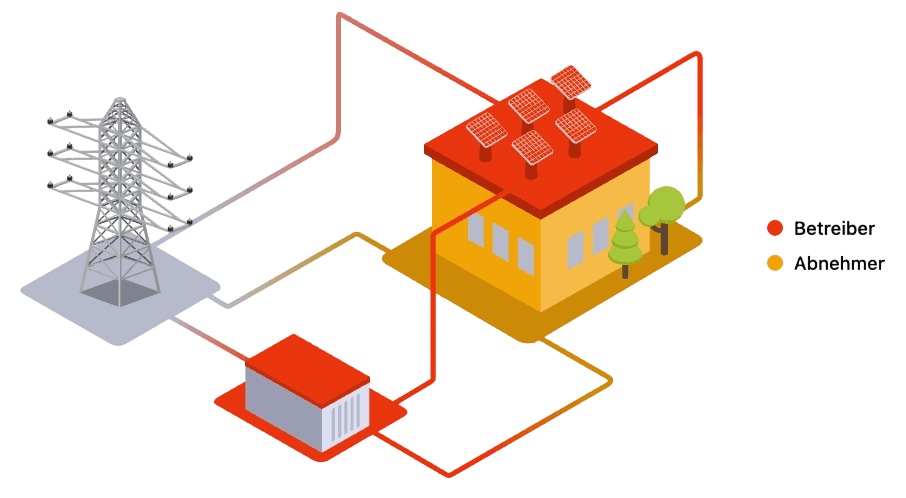
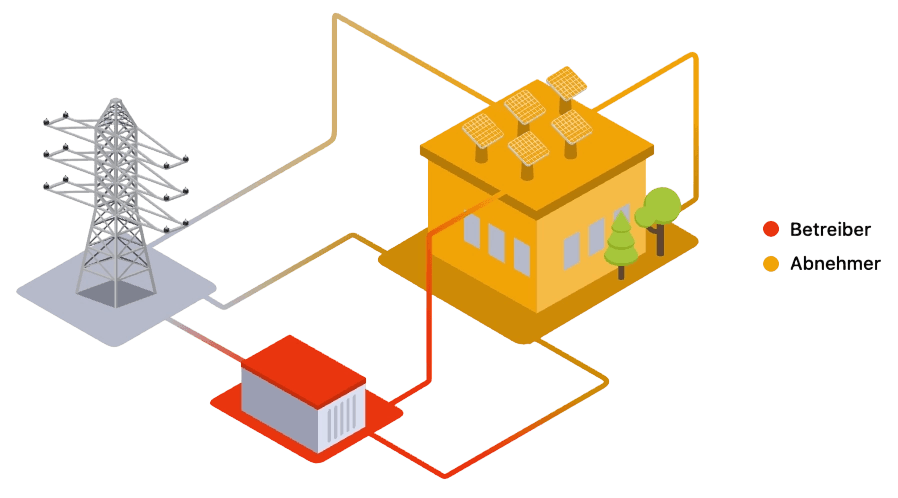
Battery-only: The offtaker already owns the PV system and keeps the feed-in tariff. The operator invests only in the storage. Their revenue comes from the additional optimization the storage enables, for example through peak shaving or self-consumption optimization.
The second decision: how is remuneration structured?
Once the ownership question is settled, the choice of remuneration model follows. Two approaches have become established, but many different combinations of remuneration are possible.
Model A: Fixed PPA price + peak shaving share
The offtaker pays a fixed price per kilowatt-hour delivered. In addition, the savings on grid fees (through peak shaving) are split according to an agreed formula. Selling electricity to the offtaker at a fixed PPA price is only possible in the combined model (PV + battery with the operator).
→ Advantage: Both sides have clear, traceable revenue and cost streams.
→ Fits when: The offtaker wants planning certainty and the tariff structure is manageable.
Model B: Share of total savings
Instead of a fixed PPA price, the operator receives a percentage of the total cost saving the offtaker achieves through the system. Electricity costs, grid fees, feed-in revenues: everything feeds into one overall assessment.
→ Advantage: The operator automatically benefits from every saving the offtaker makes. The larger the saving, the larger their profit.
→ Fits when: The tariff structure is complex or the savings are hard to split into individual revenue streams in advance.
⚠️ Important: The two remuneration models are mutually exclusive. Whoever agrees on a fixed PPA price cannot at the same time apply a share of total savings, as the incentives would contradict each other.
Additionally: lease in both directions
Regardless of the chosen remuneration model, the operator and offtaker can additionally agree on a fixed annual lease, and indeed in both directions. The operator can pay the offtaker a roof rent, for example for the use of their roof area. Conversely, the offtaker can pay the operator a lease so that the operator has more security for their investment. These fixed amounts create additional planning certainty and make it possible to fine-tune the economic balance of the contract.
Separate prices for PV electricity and battery electricity
With the PPA-price remuneration model, a uniform price for all electricity delivered is not necessarily required. In the combined model (PV + battery with the operator), the PPA price can be differentiated by electricity source: one price for directly delivered PV electricity, another for electricity from the battery storage.
Why does this make sense? Direct PV electricity flows immediately from the system to the consumer, without a detour and without losses. Battery electricity, by contrast, has been stored in the meantime: charging and discharging lose a few percent due to efficiency, but the electricity is flexibly available over time and can be delivered specifically during high-price periods. Two separate PPA prices fairly reflect this difference in value. Depending on the contract, battery electricity can be priced higher or lower than direct PV electricity.
This differentiation also opens up a practical scenario: if an offtaker already has an existing PV PPA and subsequently becomes interested in the economic viability of an additional battery PPA, exactly that can be represented and specifically calculated via separate prices.
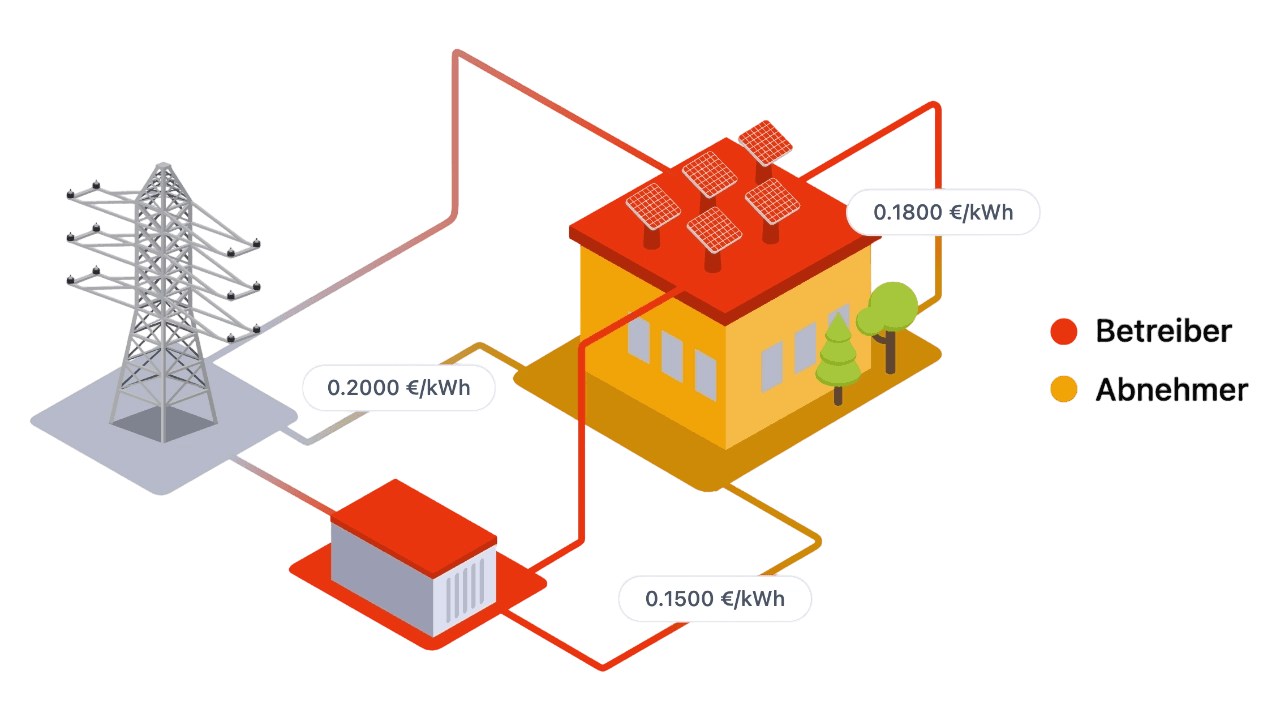
⚠️ PV electricity always goes to the offtaker first: Regardless of the agreed PV PPA price, the generated PV electricity is delivered directly to the offtaker as far as possible. The PV PPA price therefore does not affect whether delivery happens, only how it is billed. For battery optimization, only the net load curve is used, i.e. the remaining load after deducting the direct PV supply.
⚠️ No arbitrage at the offtaker's expense: With dynamic electricity tariffs, it would theoretically be possible to charge the battery from the grid during low-price periods and then sell the electricity to the offtaker at the higher fixed PPA price. In Lumera's calculation, this is deliberately not permitted. If such an arbitrage opportunity exists, the action is taken in the offtaker's interest: they can cover the load not met by the PV (net load) directly at the cheaper grid prices.
Who gets what? Feed-in tariff and battery charging costs at a glance
Depending on the remuneration and ownership model, it is regulated differently who receives the feed-in tariff and who bears the costs for grid supply to charge the battery. The following tables show the allocation for both system configurations, as implemented in Lumera's economic viability calculation.
PV + battery combined
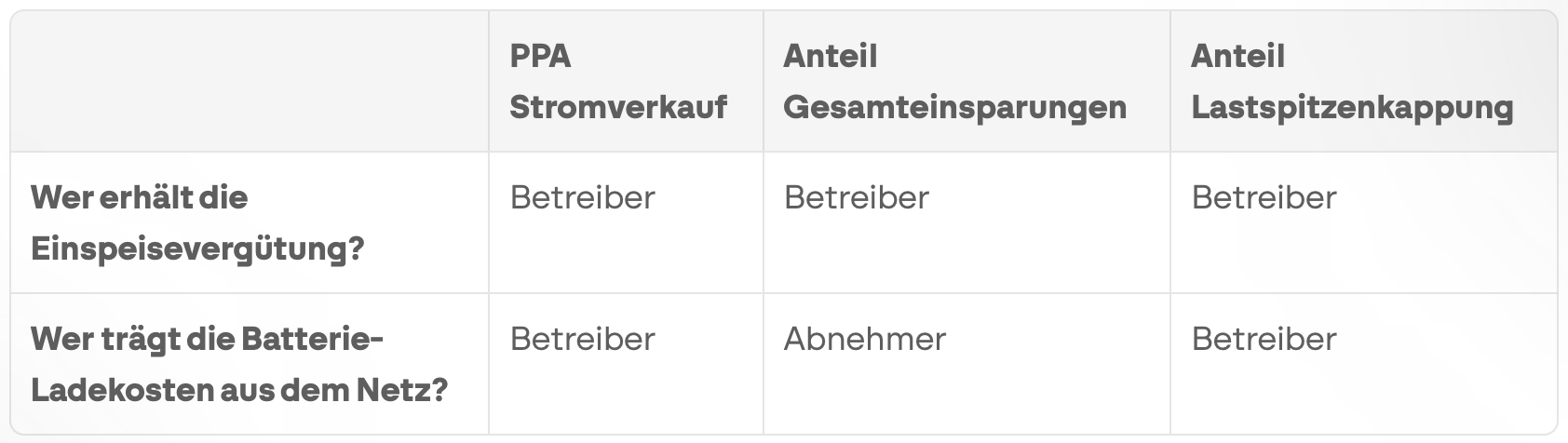
In the combined model, the feed-in tariff always flows to the operator, because they own the system and bear the investment risk. There is one exception for the battery charging costs: in the total-savings model, the offtaker bears these costs, since they feed into the overall assessment of their savings.
Battery-only
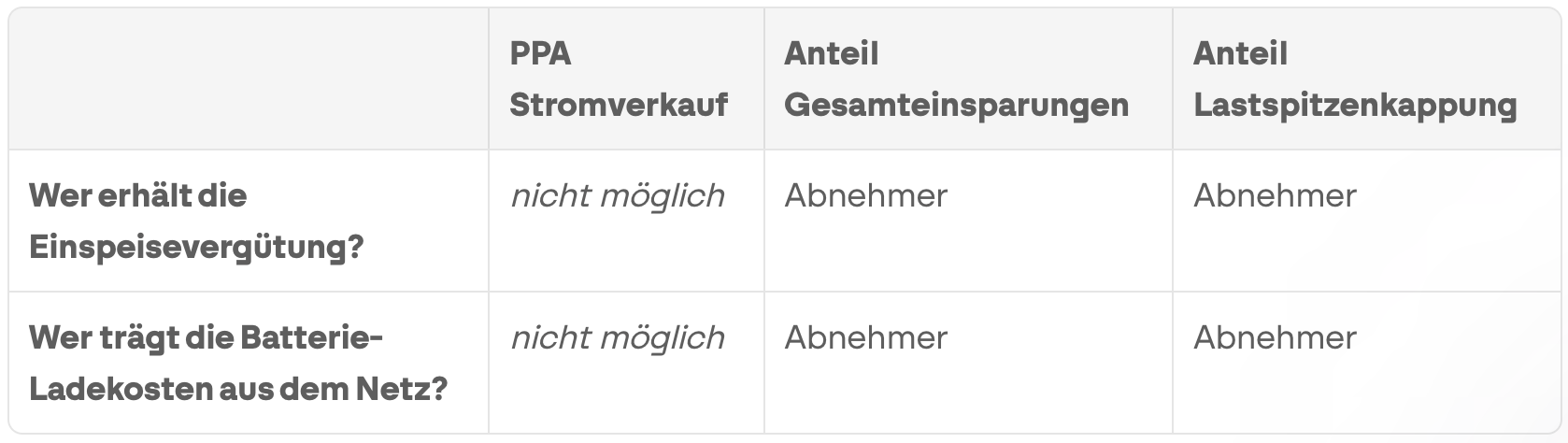
In the battery-only model, the offtaker keeps the feed-in tariff, since they own the PV system after all. The offtaker also bears the battery charging costs. Pure PPA electricity sales are not provided for in this configuration, as the operator owns only the storage and does not generate any electricity of their own.
The levers that make the contract economically viable
The choice of model sets the framework. Within this framework, concrete parameters determine whether the PPA works out for both sides:
Operator levers
PPA price per kWh: the most obvious lever, but not always the biggest
Share of total savings: what percentage of the total savings flows to the operator
Peak shaving share: what percentage of the grid fee savings flows to the operator
Grid feed-in: surplus electricity earns the feed-in tariff (only in the combined model)
Lease/rent: fixed annual payments, e.g. roof rent to the offtaker
Offtaker levers
Reduced grid fees: peak shaving through PV and/or battery
Lower electricity supply costs: PPA price often cheaper than grid supply
Planning certainty: fixed costs instead of volatile exchange prices
Mutual interest in savings: in the case of a savings split
Conclusion: two questions before every PPA
1️⃣ Who owns what? The ownership question determines the distribution of investment and the available revenue sources. If the offtaker already has a PV system, battery-only is the obvious choice.
2️⃣ How is remuneration structured? A fixed PPA price provides planning certainty, a share of total savings fits complex tariff structures. The two models are mutually exclusive.
More Articles
Plant Certificates for Battery Storage: When You Need One, What It Costs, and How the Process Works
Lumera Energy becomes Furo
How battery storage really ages and how we model it
Charging a PV storage system with grid power: comparing the rules in Germany (MiSpeL) and Austria
Multiple PV systems at one site – an overview of compensation, meters and billing rules
When the electricity doesn't belong to the consumer: calculating operator models and PPAs correctly