The MiSpeL allocation option in practice: What does mixed operation really cost?
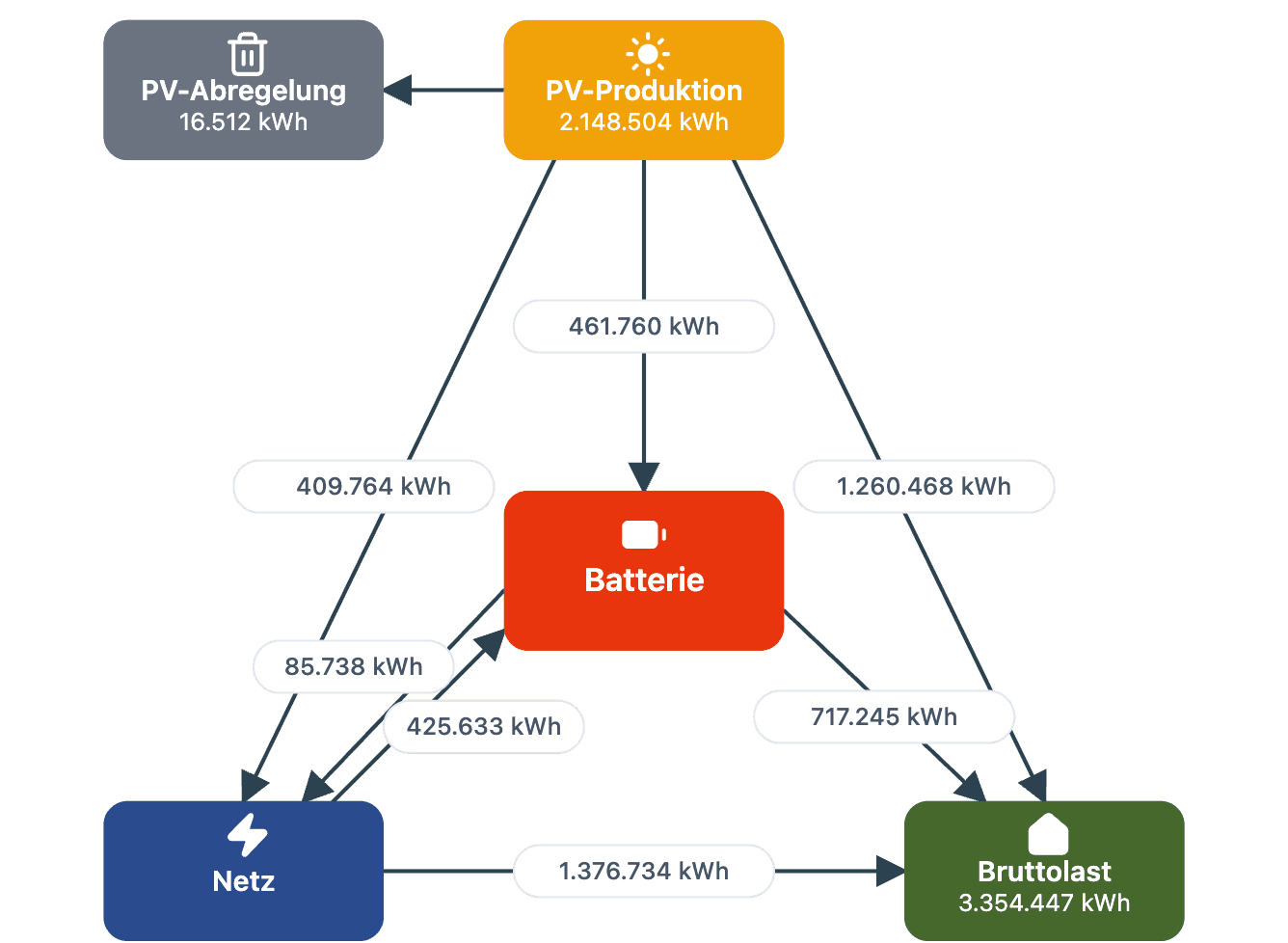
An example calculation using real market data shows that the costs of the allocation option are surprisingly low.
In the last article we presented the Federal Network Agency's MiSpeL key points and explained the three options: the exclusivity option, the allocation option and the flat-rate option.
The allocation option enables flexible mixed operation — battery storage systems may charge both PV power and grid power and still receive proportional EEG support. But how high is the price for this? Many operators fear that the proportional loss of the market premium makes mixed operation unattractive.
We did the math.
The example project
Our calculation is based on a real industrial project:
PV system: 2,000 kWp
Annual consumption: ~2 million kWh
Remuneration model: market premium model with an applicable value of 6 ct/kWh
Spot prices: real data, Germany 2025
In mixed operation, the battery is charged with both PV power and cheap grid power and discharged again when prices are high.
How is the green power share calculated?
The allocation option requires a quarter-hourly assignment of all power flows. The decisive factor is the green power share: how much of the energy charged into the battery comes from the PV system?
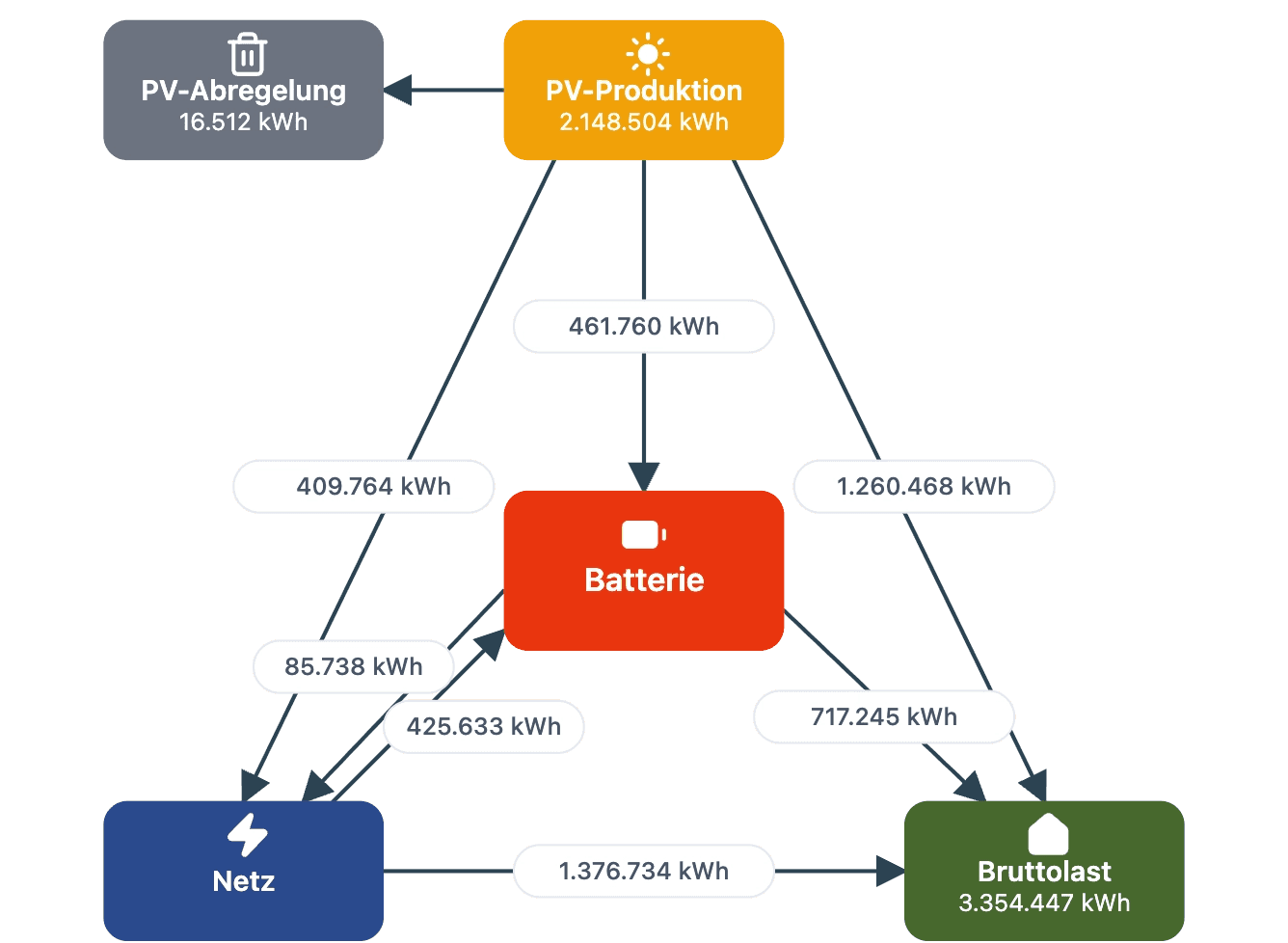
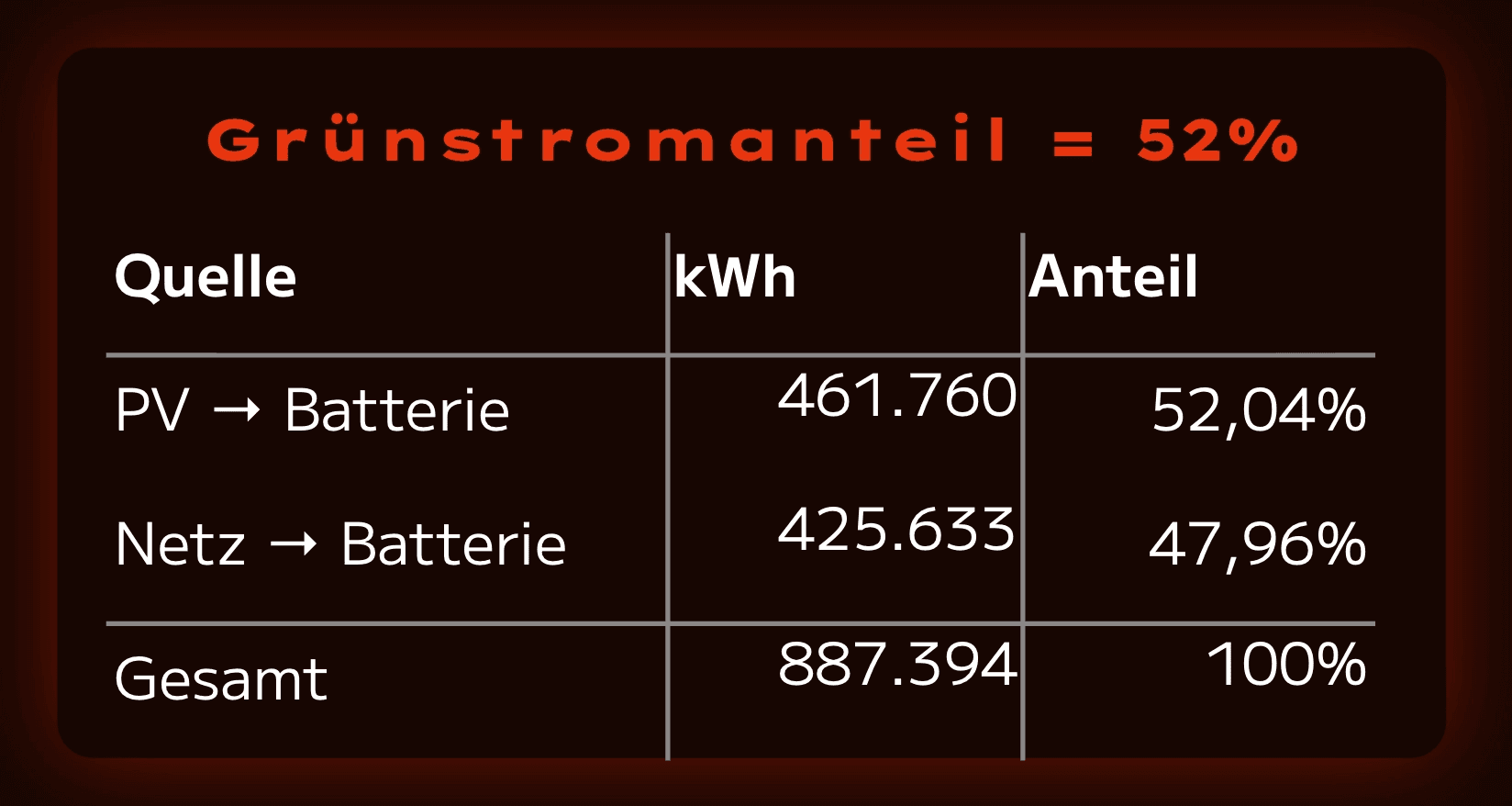
In our example, 52% of the battery charge comes from the PV and 48% from the grid. This green power share of 52.04% determines what proportion of the battery feed-in receives the full EEG remuneration.
The formula: What changes about the feed-in tariff?
Without MiSpeL — that is, under the previous exclusivity option (only possible with a green-power storage system) — the entire battery feed-in receives at least the applicable value, that is, either:
the spot price, if it happens to be higher than the applicable value, OR
market premium + spot price = applicable value (except during negative periods)
With the allocation option, the market premium is reduced proportionally:
Remuneration = spot price + green power share × market premium
The guaranteed minimum price (floor) therefore falls from 6.00 ct to 3.12 ct per kWh. But: this floor only applies when the spot price is below 6 ct. At higher spot prices, the formula yields the spot price anyway — with or without MiSpeL.
When does the reduction actually apply?
That is the decisive question. We have broken down all hours in which the battery feeds into the grid by spot price level:
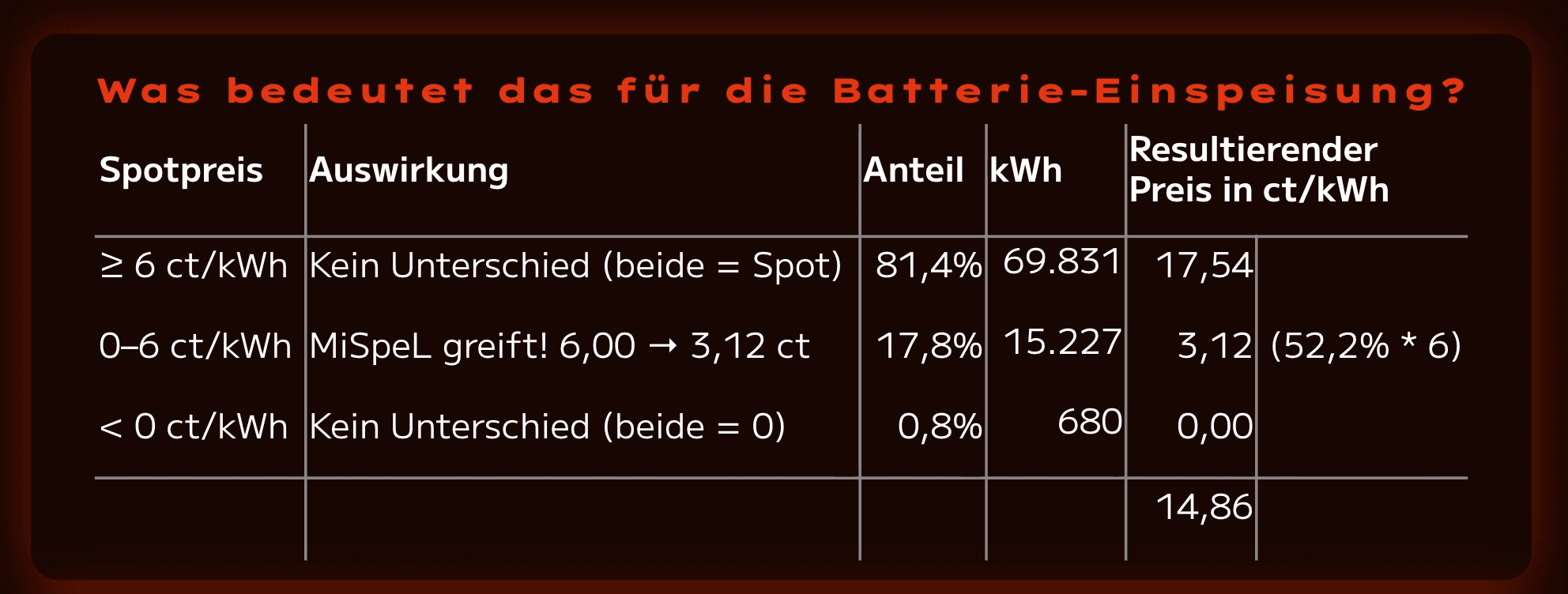
The result is clear: 81.4% of battery exports take place at spot prices above 6 ct — there the remuneration is identical, whether with or without MiSpeL. This is also logical: the battery preferentially discharges at high prices, because that is exactly what mixed operation is for.
The MiSpeL reduction only affects the 17.8% of exports at low spot prices (avg. 3.12 ct/kWh). In these hours, the remuneration falls from 6.00 ct to 3.12 ct — a difference of 2.88 ct/kWh on a relatively small volume of 15,227 kWh.
The result
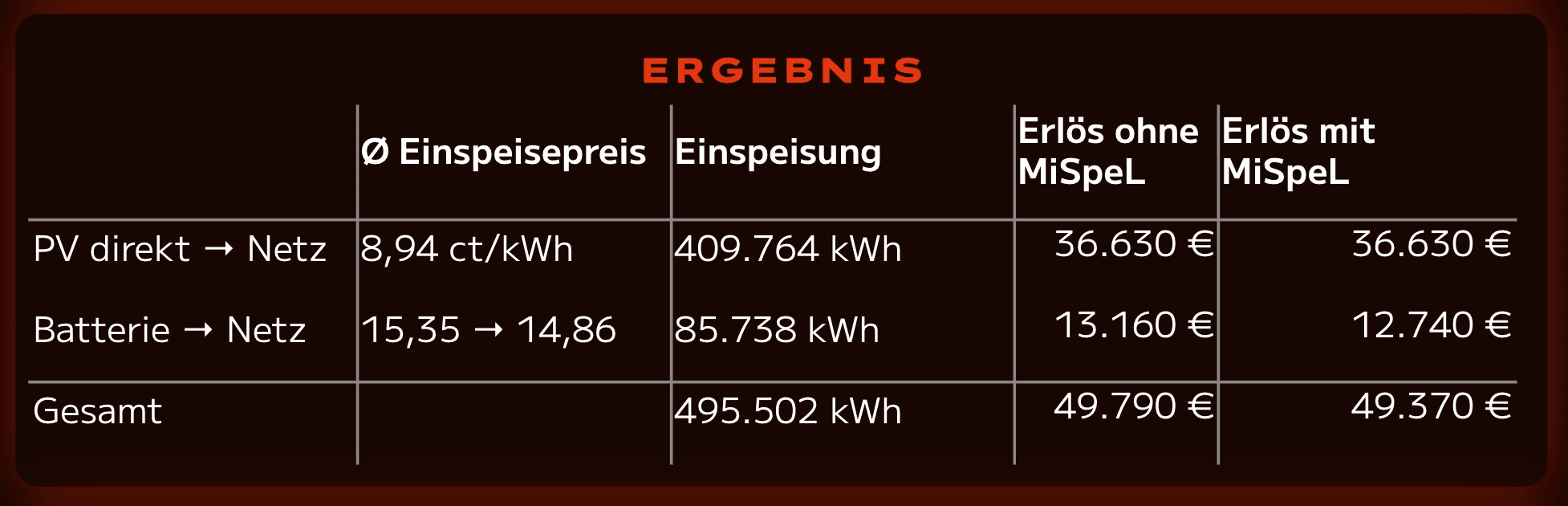
The MiSpeL costs amount to €416/year. That corresponds to less than 1% of the total feed-in tariff.
What would be the alternative?
Anyone using the allocation option accepts a proportional reduction of the market premium. But what is the alternative? Keeping the full market premium under mixed operation is not possible — that is precisely what MiSpeL regulates. Anyone who wants to avoid the reduction has to forgo the EEG remuneration entirely and switch to pure direct marketing.
We also calculated the same project with pure direct marketing:
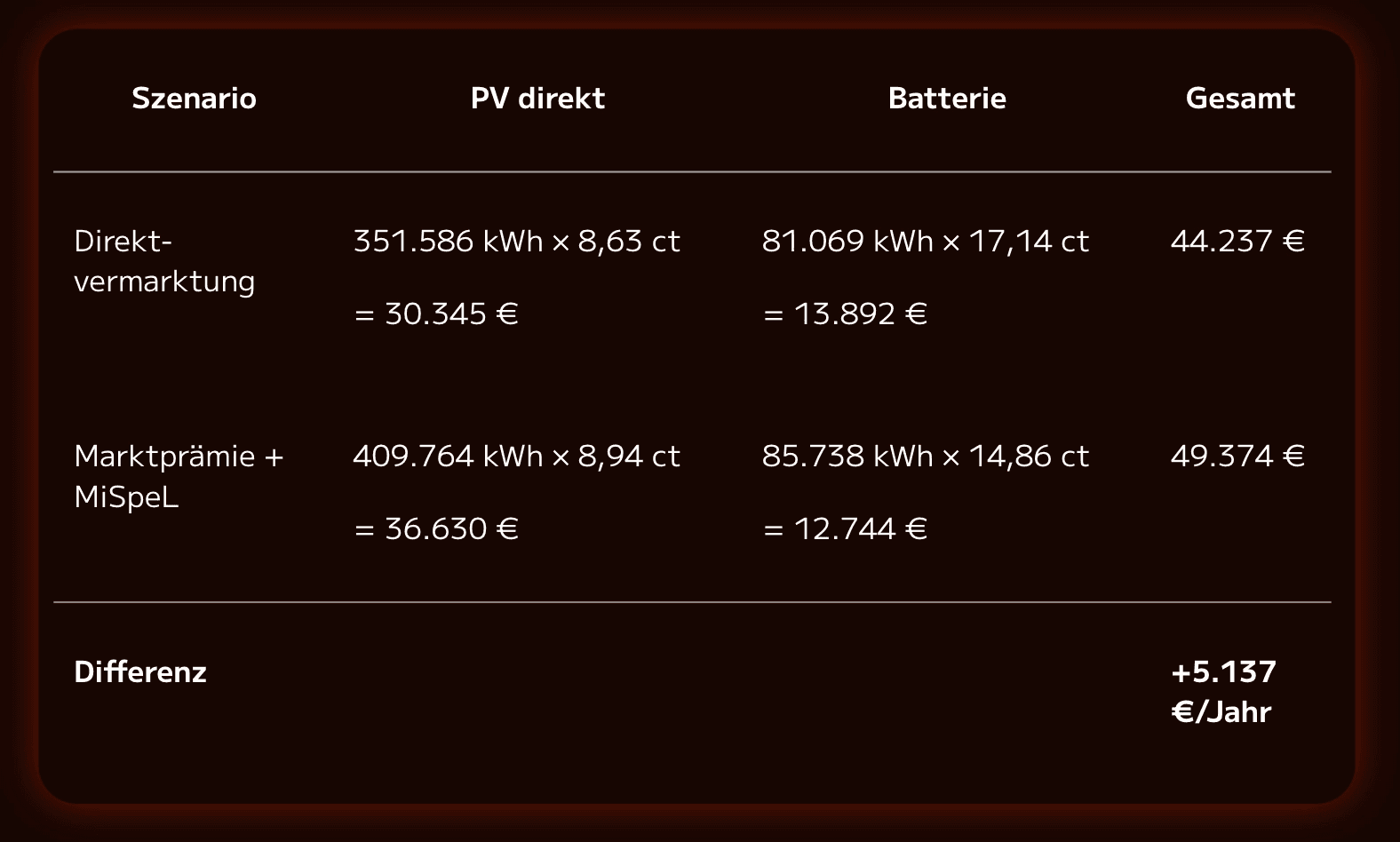
Without the market premium, the battery does achieve a higher average price per kWh — it now only exports at high spot prices. But the direct PV feed-in loses the market premium completely: instead of at least 6 ct/kWh, it only receives the spot price, which is often well below that. The differing feed-in volumes in the table are explained by negative spot prices: with the market premium, the tariff is set to 0 ct and the PV continues to feed in — under direct marketing, it is curtailed instead. Economically this makes no difference (both result in €0), but it explains the difference of around 60,000 kWh.
On balance, pure direct marketing loses more than €5,000 per year compared with the market premium combined with the allocation option. Accepting the MiSpeL costs of €416/year is around 12× cheaper than forgoing the market premium.
Conclusion
In practice, the allocation option costs very little. Mixed operation is clearly advantageous economically — the flexibility gained far outweighs the proportional reduction of the market premium.
Operators should not see the allocation option as a cost risk, but as what it is: the opportunity to realize the full economic potential of their PV-plus-storage combination.
More Articles
Plant Certificates for Battery Storage: When You Need One, What It Costs, and How the Process Works
Lumera Energy becomes Furo
How battery storage really ages and how we model it
Charging a PV storage system with grid power: comparing the rules in Germany (MiSpeL) and Austria
Multiple PV systems at one site – an overview of compensation, meters and billing rules
A systematic electricity supply contract: why the choice of model matters more than the PPA price